The current case against AI writing goes something like this: it doesn’t really create anything. It absorbs everything humans have ever written, runs it through a statistical blender, and pours out a smoothie of borrowed phrases dressed up as new prose. It’s derivative. It’s slop. And the more polished it gets, the more dangerous the imitation becomes.
That objection isn’t wrong about the mechanics. Large language models really do learn from human work and recombine what they’ve absorbed. The output really is, in a strict sense, derivative.
The objection is just wrong about the implication.
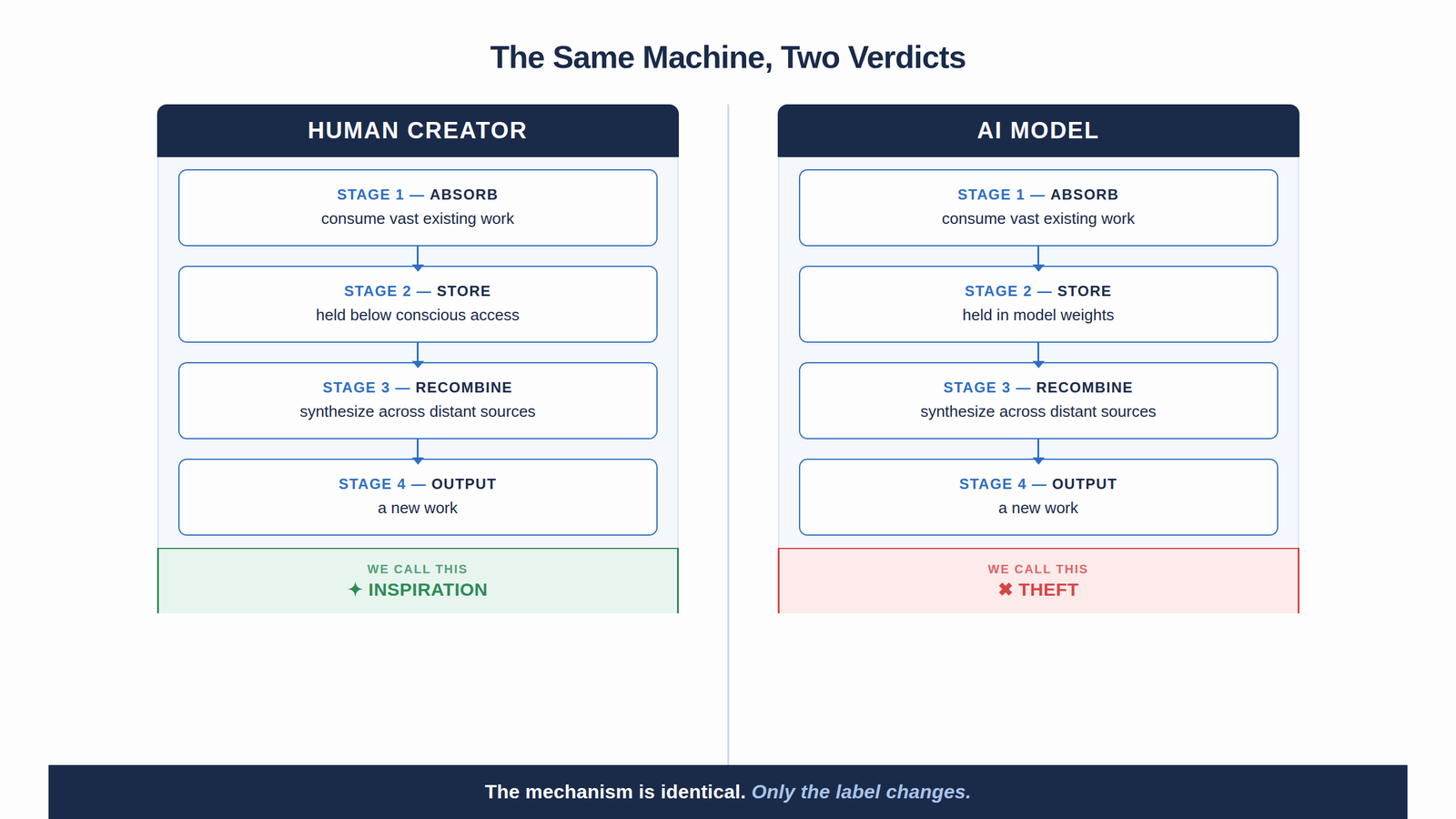
Because nearly all human creation is derivative too. We just dress the borrowing up in nicer language when a person does it.
Consider the case of one of the most beloved films of the twentieth century.
What Lucas Took
George Lucas didn’t invent Star Wars in the romantic sense. He recombined it. The lineage isn’t a secret. He’s talked openly about it for fifty years. Anyone with a passing interest in film history can trace the borrowings:
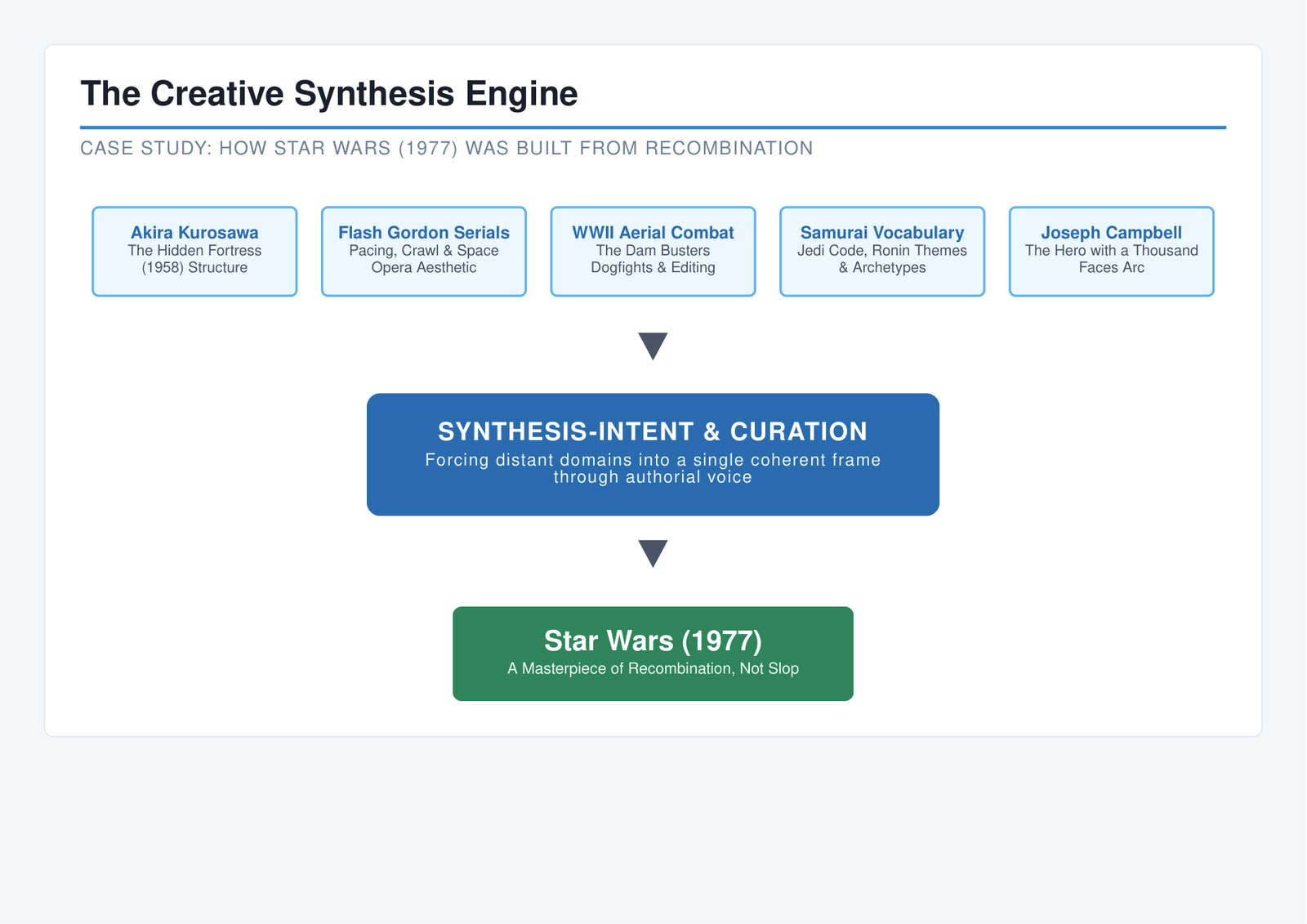
The peasant characters who unwittingly carry a princess’s secret across hostile territory? That’s the spine of Akira Kurosawa’s The Hidden Fortress (1958). The two bumbling farmers in Kurosawa’s film become C-3PO and R2-D2 in Lucas’s. The structure of a hidden royal smuggled by accidental couriers is lifted nearly intact.
The opening crawl, the wipe transitions, the breathless adventure pacing? That’s Flash Gordon and Buck Rogers. Lucas tried to license the Flash Gordon rights before he wrote Star Wars. When that fell through, he built his own variant from the same DNA.
The Death Star trench run? It’s a near-direct visual translation of British WWII dogfight films, especially The Dam Busters (1955) and 633 Squadron (1964). Lucas screened those movies for his special-effects team as reference. The shots match. The pacing matches. The tense ground-crew cutaways match.
The Jedi as ronin, the lightsaber choreography, the wise mentor archetype passing on a noble tradition to a young initiate? That’s Kurosawa’s broader samurai vocabulary, present across half his filmography. The word “Jedi” itself is commonly attributed to jidaigeki, the Japanese term for period dramas, though some scholars trace it to Edgar Rice Burroughs’s Barsoom novels and their “jeddak” rulers. Either lineage is borrowed.
The hero’s journey itself, the structural arc from ordinary world to call to refusal to mentor to ordeal to return? Lucas has been explicit: that’s Joseph Campbell’s The Hero with a Thousand Faces. He didn’t just absorb it. He used it as a template.
So: a samurai film, a serial space opera, a war movie, a samurai vocabulary, a comparative-mythology textbook. Lucas didn’t write Star Wars from nothing. He stitched it together from at least five clearly identifiable sources, and probably dozens more we haven’t catalogued.
We call it a masterpiece. We don’t call it slop.
What Changed Between Then and Now
The objection to AI isn’t really that it derives. It’s that it derives badly, or scales the derivation industrially, or does it without paying the source artists. Those are real concerns and I’ll come back to them. But the surface-level objection, that derivation itself disqualifies the output, falls apart the moment you apply it consistently.
Nobody looks at Star Wars and concludes Lucas was a fraud because he watched Kurosawa. The borrowing isn’t the indictment. The borrowing is the raw material.
What separates a masterwork from a remix-pile isn’t whether the creator borrowed. It’s what they did with the borrowing. Lucas combined samurai film and wartime documentaries and pulp serials, three traditions that had nothing to do with each other in their original contexts, and forced them to share a frame. He layered Campbell’s mythological architecture over the fusion. He brought a particular sensibility, a particular visual instinct, a particular commitment to a specific kind of optimistic heroism. The synthesis was the work. The synthesis was the art.
Call that synthesis-intent. It’s what high-effort human creation does that low-effort human creation, and most current AI output, does not. It transforms by combining across distant domains. It bends the borrowed material toward a coherent authorial vision. It accepts the responsibility of choosing what to keep and what to discard.
The honest version of the AI objection isn’t “it’s derivative.” It’s “the synthesis-intent is missing or thin.” That’s a much harder claim to make confidently, because synthesis-intent is in the prompt, the curation, the editing, the iteration. It’s in what the human at the keyboard brings to the loop. Sometimes it’s nothing. Sometimes it’s everything. The output reflects the input.
The Section We Almost Cut
There’s a moment in Star Wars that’s harder to talk about than the others. The throne-room ceremony at the end of the original film, where Princess Leia awards medals to Luke and Han while the rebel troops stand in geometric formation, bears a striking visual resemblance to a sequence in Leni Riefenstahl’s Triumph of the Will (1935), the Nazi propaganda film celebrating the Nuremberg rallies.
The composition matches. The wide architectural framing, the long approach down a central aisle, the assembled ranks in receding rows, the elevated central figures, the ceremonial transfer of recognition. People have been pointing this out since the seventies.
Lucas denies it. He says he hadn’t watched Triumph of the Will in roughly fifteen years when he was making Star Wars and didn’t consciously model the scene on it.
I believe him. And the parallel still matters.
Because we have two possible explanations, and both of them undercut the current AI panic.
The first explanation is that Lucas absorbed Riefenstahl’s visual grammar at some point earlier in his life, stored it below conscious access, and reproduced it without deciding to. That’s not theft. That’s how human influence works. We ingest, we incubate, we reproduce uncited. Every writer who has ever felt a phrase arrive unbidden and only later recognized whose phrase it was knows this experience. We don’t call it stealing when humans do it. We call it inspiration, or absorption, or just memory working the way memory works. The exact same mechanism we condemn when a machine does it.
The second explanation is that Lucas didn’t derive it at all. We do. We connect the throne room to Triumph of the Will from our own media diet, our own internal catalogue of geometric ceremonial imagery, our own pattern-matching habit. That also serves the thesis. We’re so steeped in remix culture that we see derivation everywhere, even where the author insists it isn’t there. The line between perceived borrowing and actual borrowing is blurry because all of us, all the time, are running comparison algorithms on what we consume.
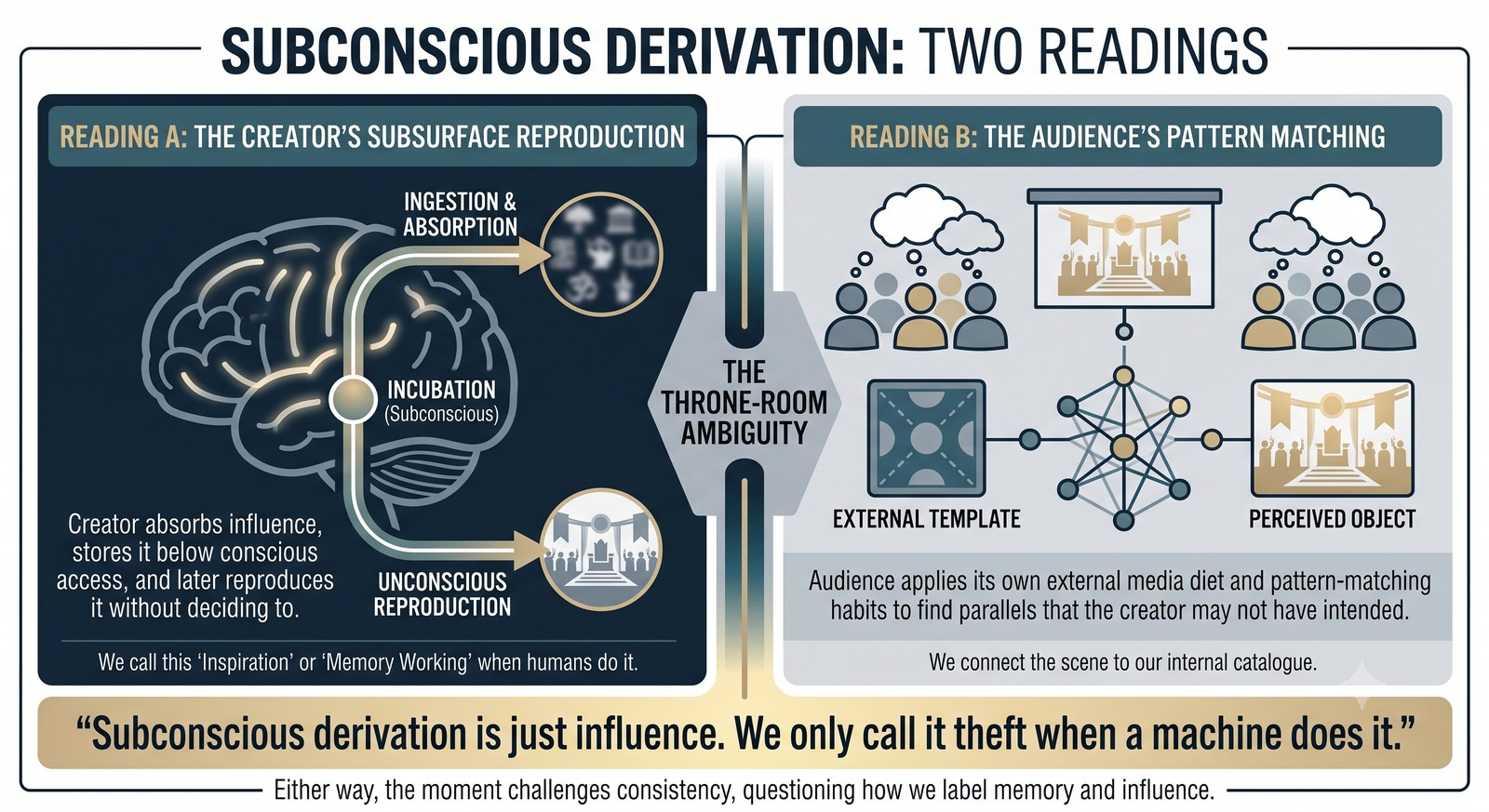
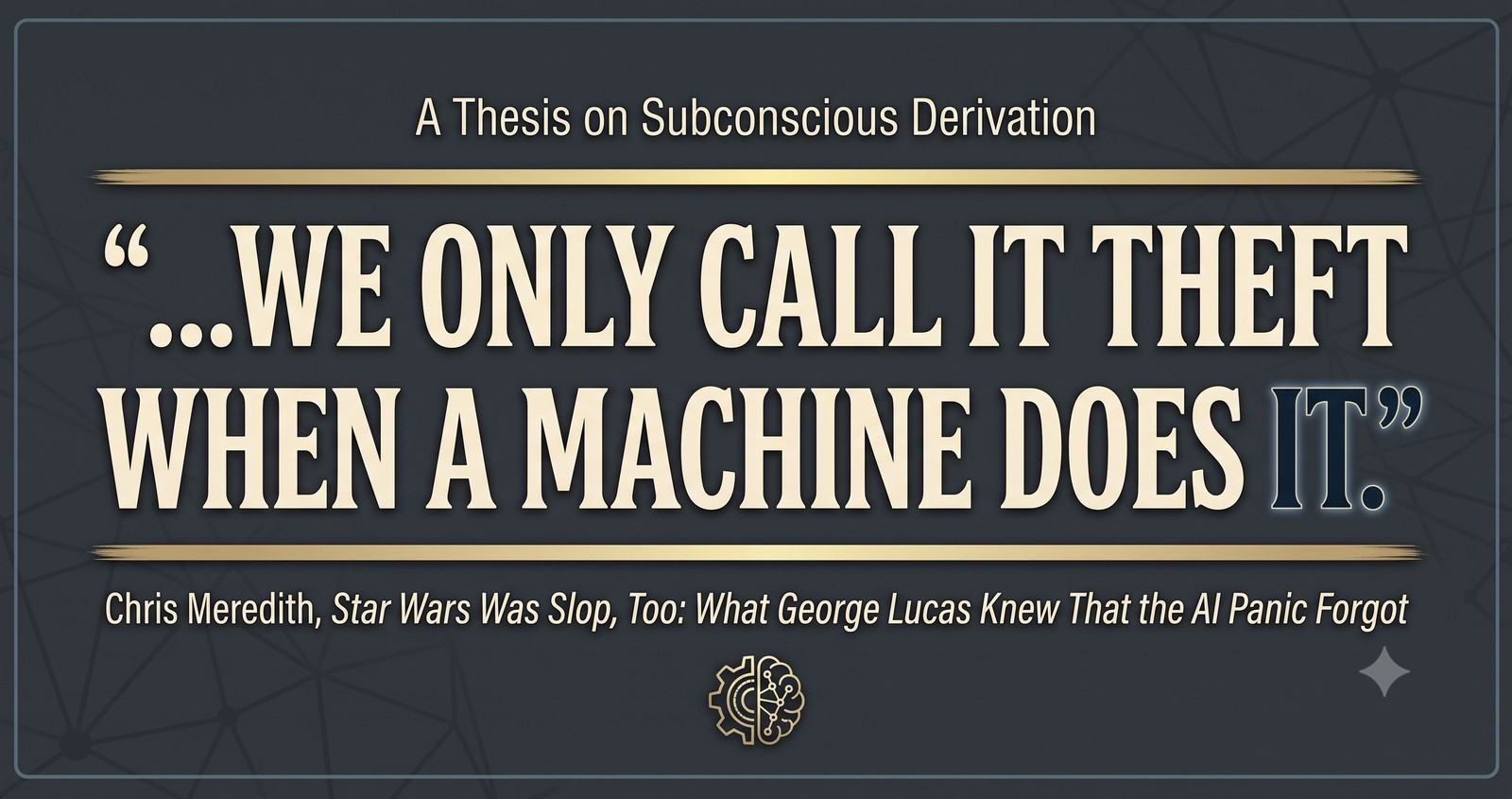
Either way, the throne-room moment is the essay’s sharpest test case. Subconscious derivation is just influence. We only call it theft when a machine does it.
The Cycle, Then and Now
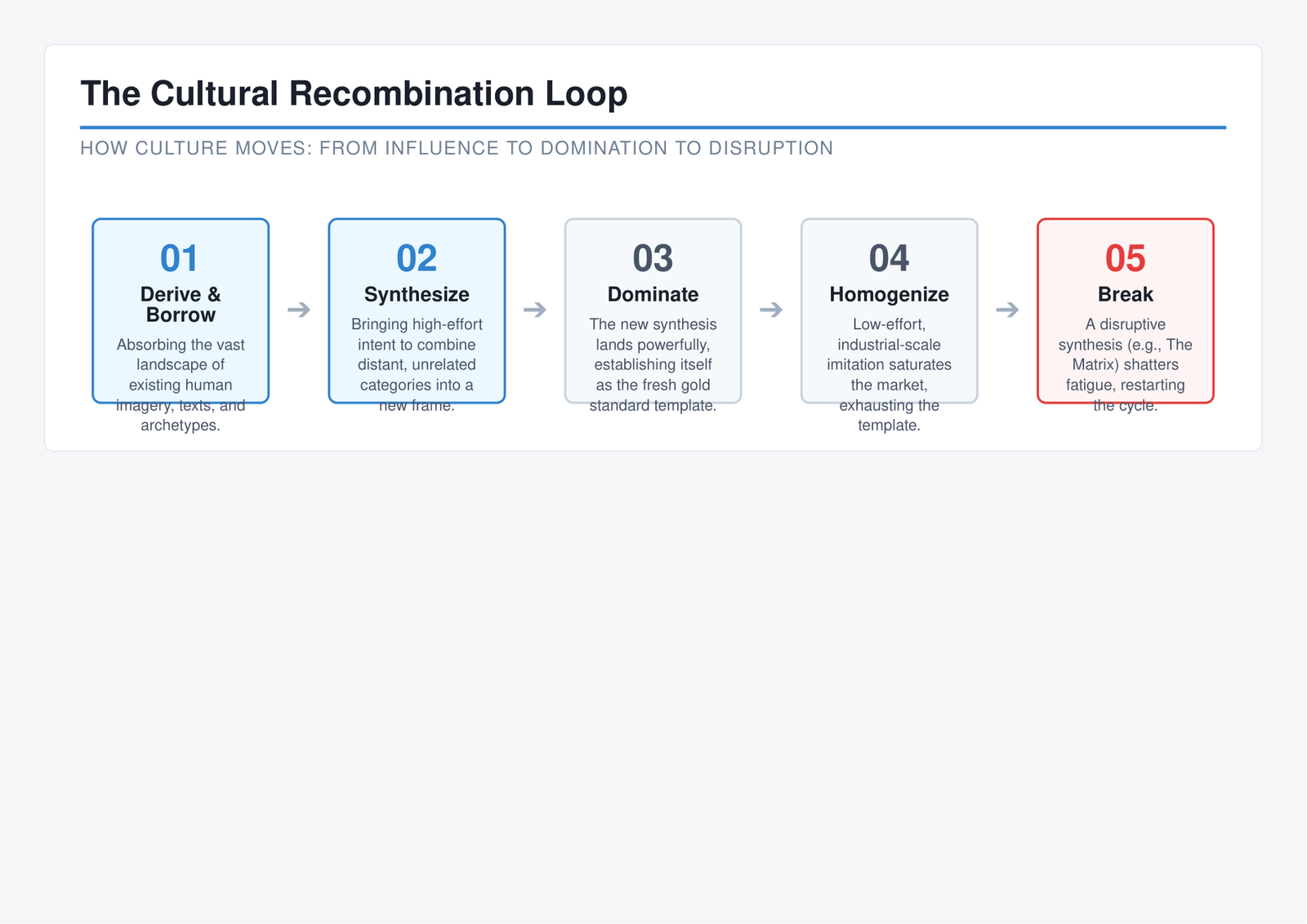
Once a synthesis lands hard enough to dominate, it becomes the template everyone else derives from. Star Wars itself became the thing. For twenty years afterward, every adventure film, every space opera, every coming-of-age myth bore its fingerprints. Then the dominant template started to feel exhausted, and someone made The Matrix, which fused Hong Kong action cinema with cyberpunk philosophy with kung-fu choreography with anime aesthetic. The Matrix became the new dominant template. Then it too got exhausted. Then something else broke through.
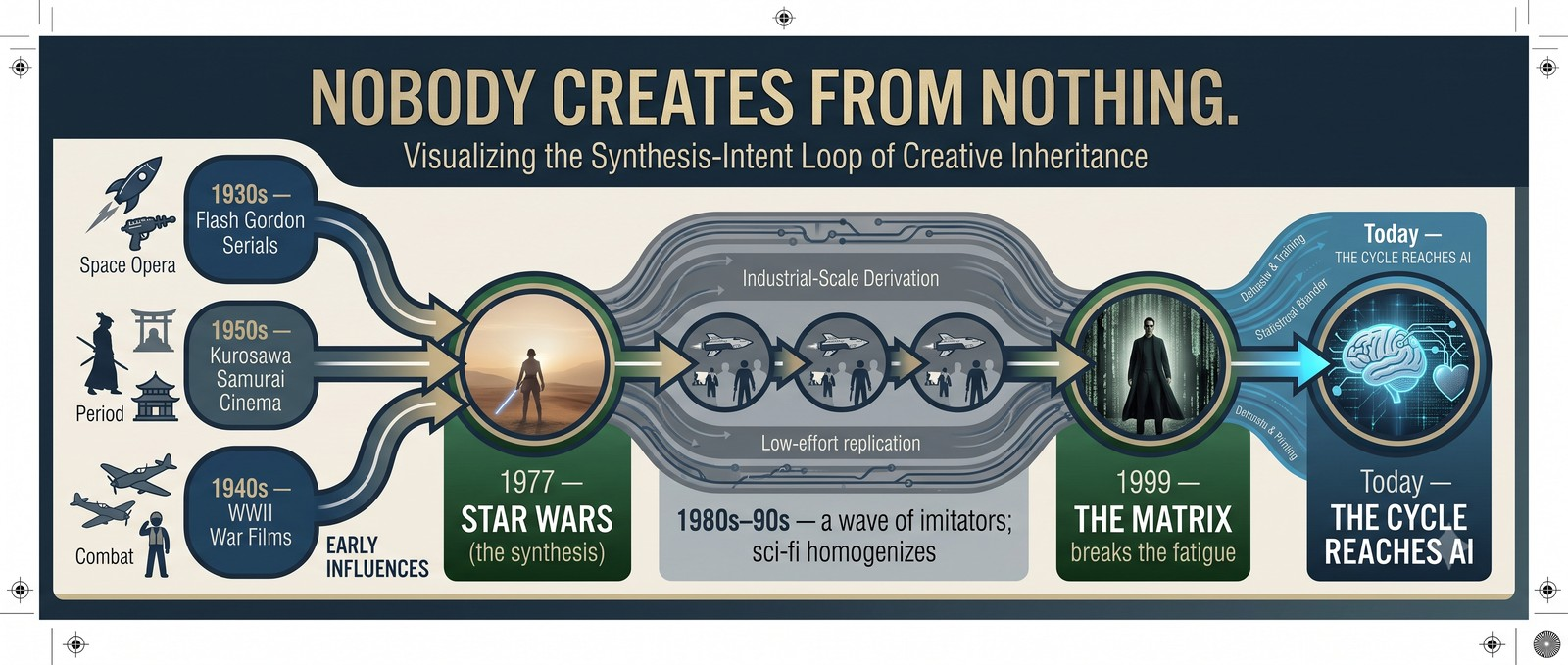
This is how culture moves. Derive, synthesize, dominate, homogenize, break, dominate again. It’s not unique to film. The same cycle runs through music, fashion, literature, software architecture, everything humans make at scale. Originality is a rare event in a long sequence of recombinations, and even the originality is usually a recombination across categories no one had thought to combine before.
AI sits inside that cycle. Not above it, not outside it. The same loop. The interesting question isn’t whether the loop continues. It will. The interesting question is what the next break looks like, and whether the people doing the synthesizing this time are bringing intent or just chasing volume.
The Real Objections
The honest case against AI’s current state isn’t that it derives. It’s that the scale of the derivation is industrial, that the source artists weren’t asked or compensated, and that the economic displacement falls on creators who can’t compete with a system that absorbed their work to replace them.
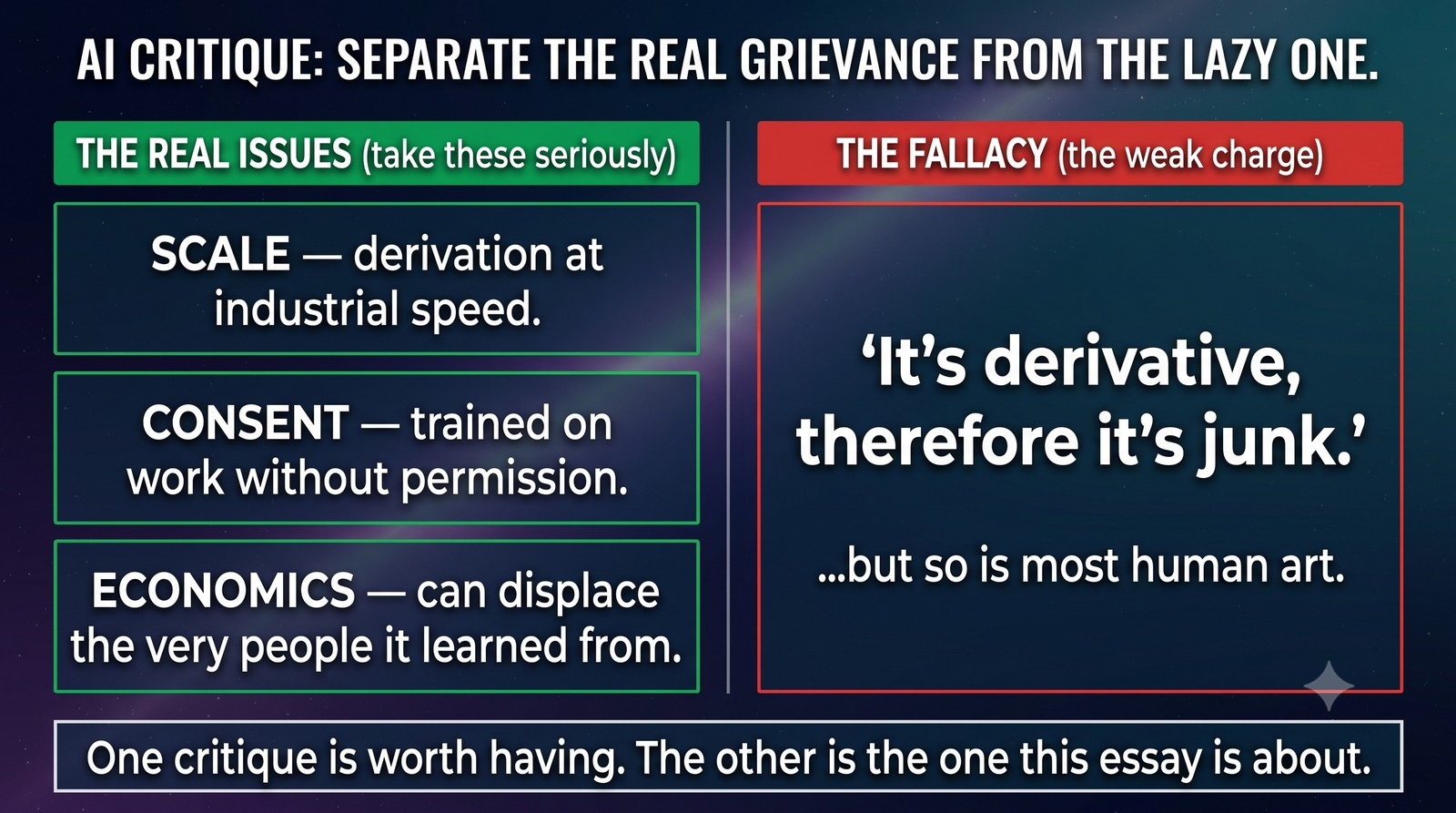
Those are legitimate grievances. They’re not the same complaint as the slop one. They’re about consent and economics and power, not about derivation as such. And they survive scrutiny in a way the slop complaint doesn’t, because they don’t require us to pretend humans don’t derive too.
The slop complaint, in contrast, asks us to apply one standard to humans and another to machines, while doing the same thing. That standard collapses on contact with any honest accounting of how creative work actually gets made.
The Better Question
So here’s the move. Stop asking whether something is derivative. Almost everything is. Stop using “it’s derivative” as a standalone condemnation. It’s not one.
Ask instead: what did the maker contribute to the synthesis?
That question separates Lucas from the imitators who tried to replicate Star Wars without understanding what made it work. It separates the writer who uses a research assistant from the writer who launders a stolen draft. It separates the AI workflow that brings curation, intent, taste, and editing from the AI workflow that just hits enter and ships whatever falls out.
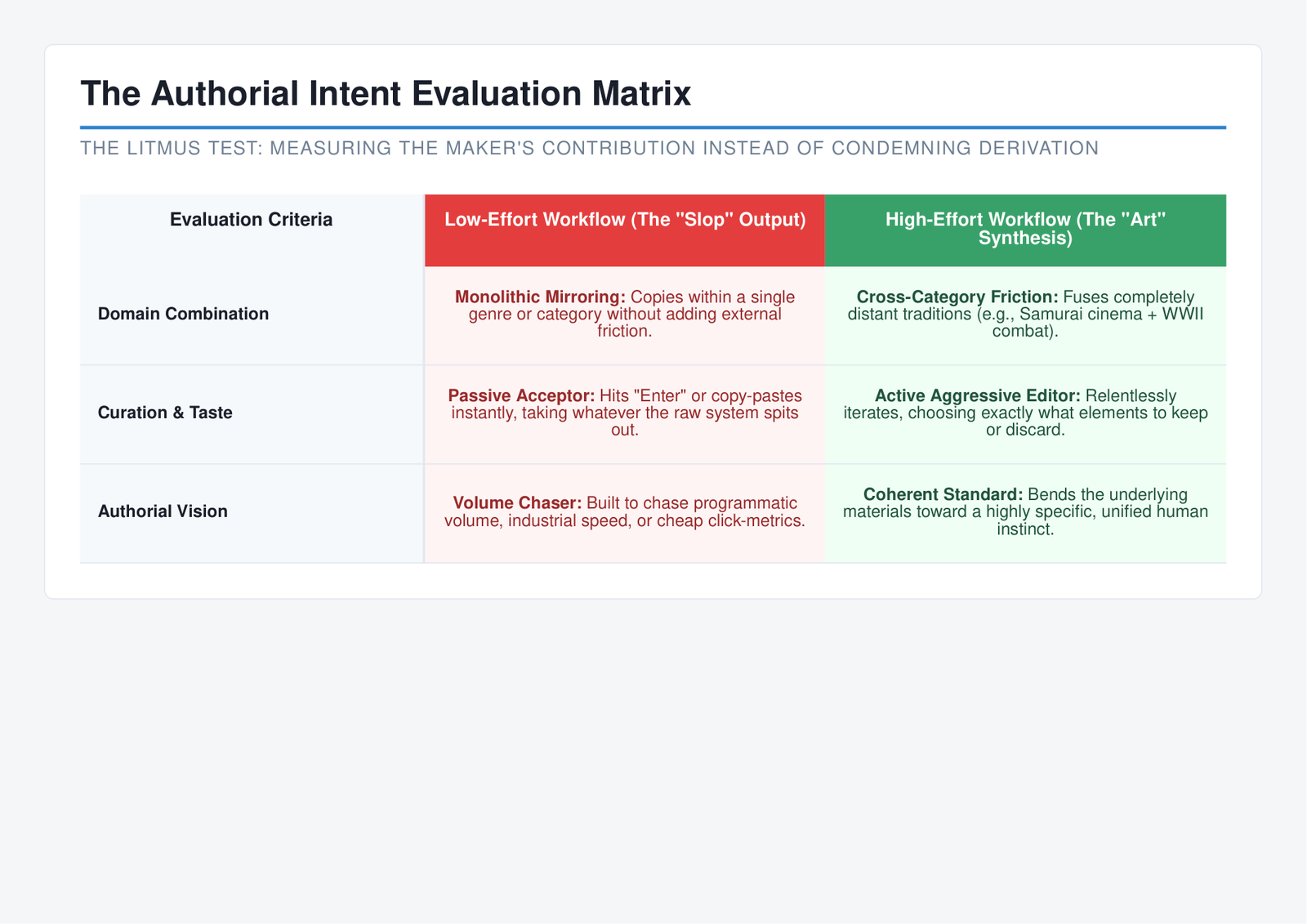
It indicts lazy machines. It also indicts lazy humans. It does both impartially. And it survives consistency, which is more than the current slop complaint manages.
Lucas didn’t invent Star Wars. He combined what he loved into something that hadn’t existed before, in the specific way he loved it, with a particular vision of what he wanted the combination to feel like. That’s the work. That’s what we should be measuring everyone against.
Including ourselves.
Chris Meredith writes about AI, technology, and what it actually means for real people. Follow along on Substack: monkeyattack.substack.com