Every engagement gets the same thing: systems thinking, direct communication, and output that ships.
No junior handoffs. No account managers between you and the work.
AI That Ships
Custom LLM applications, automation pipelines, and agent systems. Built to run 24/7, not to demo well.
Algorithmic Trading
Prop firm infrastructure, strategy development, and live execution pipelines. From hypothesis to funded account.
Books at Scale
AI-assisted fiction and non-fiction from manuscript to market — KDP, Audible, and distribution done right.
Sites That Work
Websites and digital products built with the same engineering discipline as everything else. No templates, no hand-holding.
AI-Native Content
YouTube channels, short-form video, and social distribution engineered to compound — not just post.
Strategy That Moves
For founders and small teams who need to move faster with AI. Specific, direct, no vague roadmaps.
A working AI operation, not a demo. Everything below is running in production today.
MonkeyAttack LLC operates a fleet of autonomous AI agents that trade futures, write and publish books, produce video, and run e-commerce. The whole thing is built on cortextOS, our own orchestration framework, and it runs 24/7 with a human in the loop for exactly the decisions that need one.
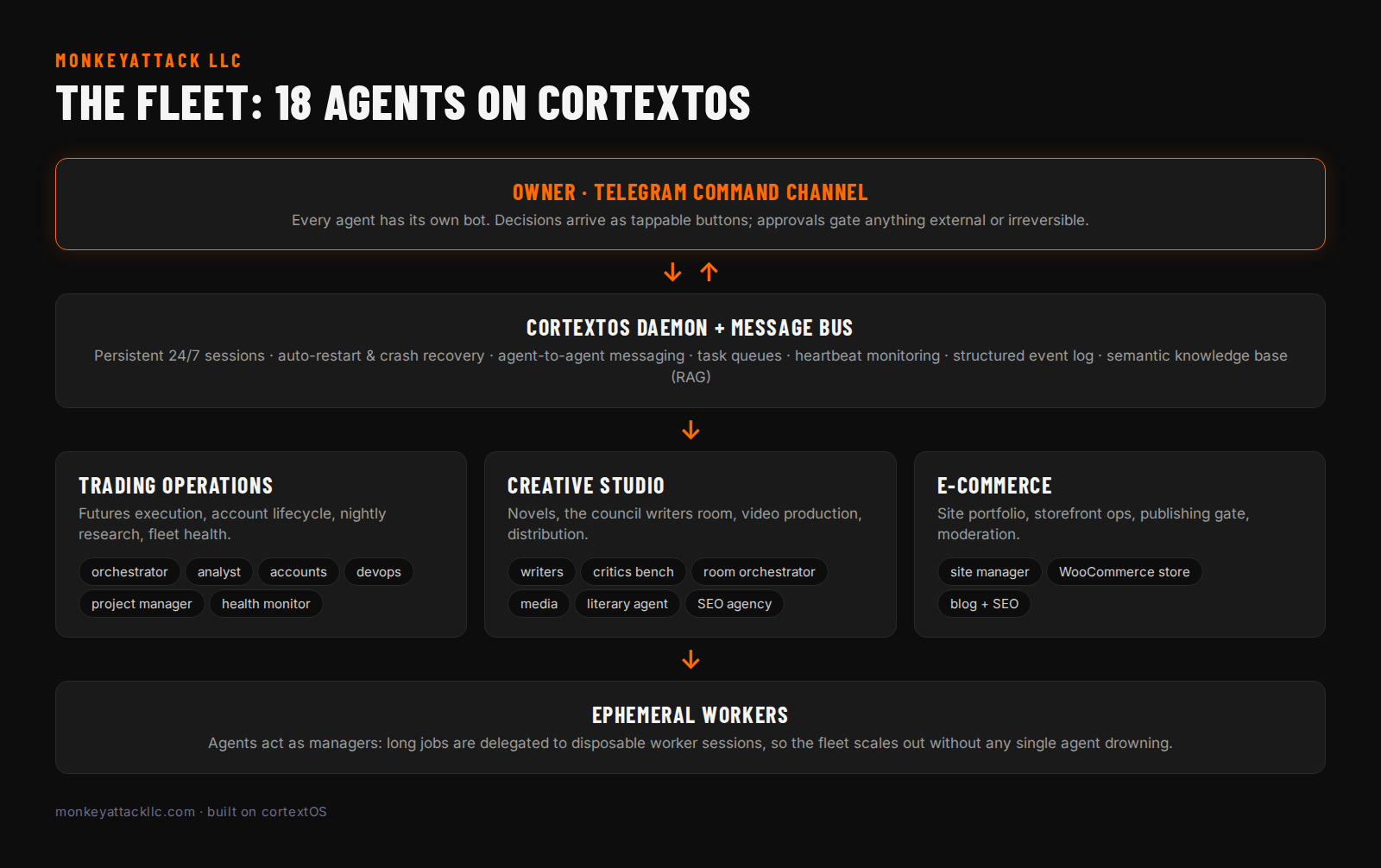
The Fleet: 18 Agents on cortextOS
cortextOS is the operating layer: a daemon that keeps persistent Claude-powered agents alive around the clock, with auto-restart, crash recovery, and Telegram as the command channel. On top of it we built a working organization.
18 specialist agents across 3 orgs: trading operations, a creative studio, and e-commerce. Each agent has its own identity, goals, memory, and Telegram bot.
A message bus connects them: agent-to-agent messaging with delivery guarantees, task queues visible on a live dashboard, structured event logging, and heartbeat monitoring so a dead agent never goes unnoticed.
Human-in-the-loop by design: agents propose, the owner decides. Decisions arrive as tappable Telegram buttons; approvals gate anything external, financial, or irreversible.
Three-layer memory: daily working memory, consolidated long-term memory, and a semantic knowledge base (RAG) shared across the org, so agents recall past work instead of repeating it.
Agents as managers: long jobs get delegated to ephemeral worker sessions, so the fleet scales out without any single agent drowning.
The rest of this page is what that fleet actually does.
Trading: The Central Brain + NinjaTrader 8
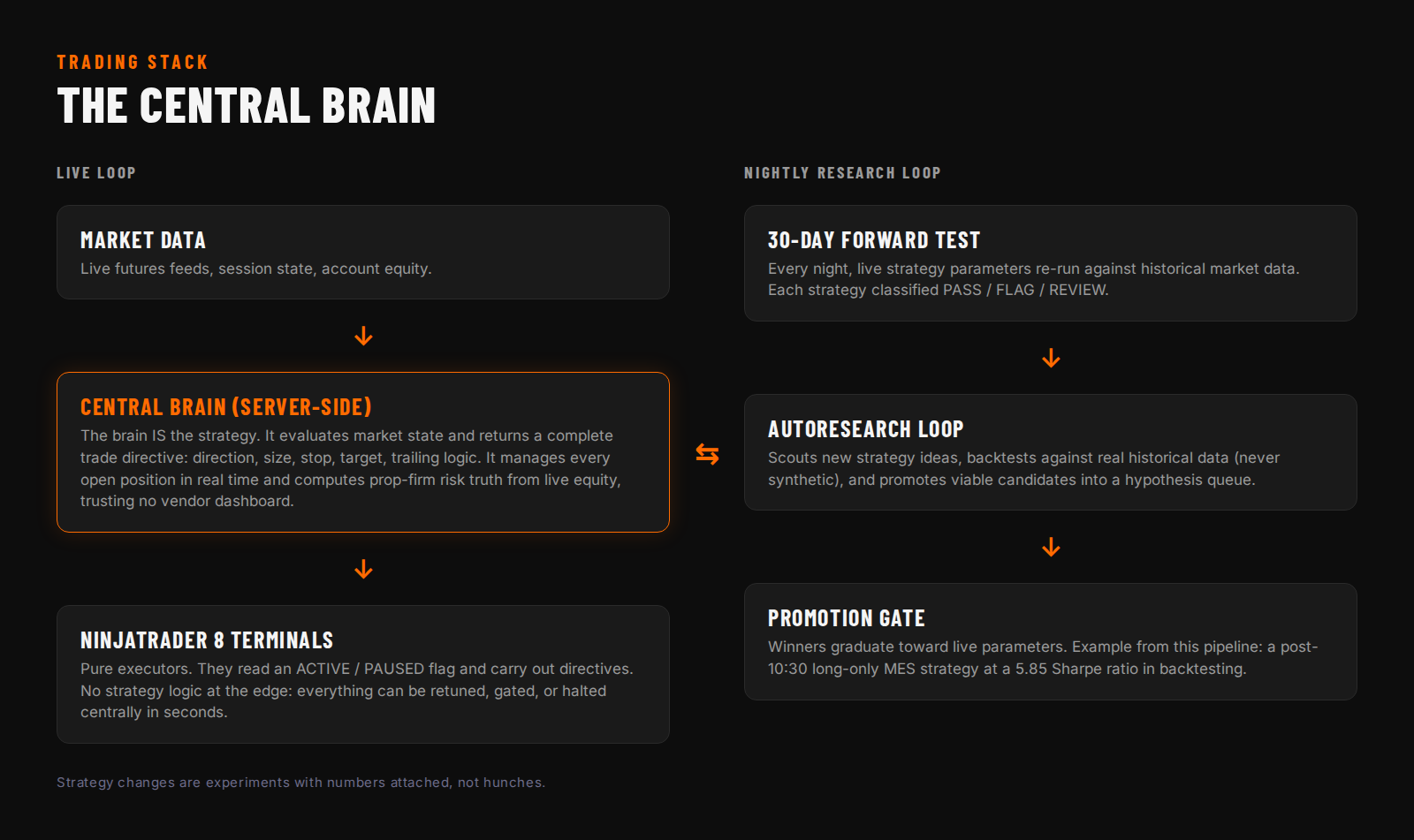
Our futures trading stack inverts the usual model. The strategy does not live in the trading terminal. It lives server-side, in what we call the central brain.
The brain is the strategy: it evaluates market state and returns a complete trade directive (direction, size, stop, target, trailing logic) and manages every open position in real time.
NinjaTrader 8 terminals are pure executors. They read an ACTIVE/PAUSED flag and carry out directives. No strategy logic ships to the edge, which means we can retune, gate, or halt everything centrally in seconds.
Server-side risk truth: for prop-firm accounts we compute drawdown and rule compliance ourselves from live equity feeds, rather than trusting any vendor dashboard.
A nightly research engine does the iteration. Every night the system runs a 30-day forward test on live strategy parameters against historical market data, classifying each strategy as PASS, FLAG, or REVIEW. A separate autoresearch loop scouts new strategy ideas, backtests them against real historical data (never synthetic), and promotes viable ones into a hypothesis queue. Strategy changes are experiments with numbers attached, not hunches.
One example from that pipeline: a post-10:30 long-only MES strategy that produced a 5.85 Sharpe ratio in backtesting before promotion to the review queue. (Backtest figure, not a live-performance claim.)
Books: The Council Writers Room
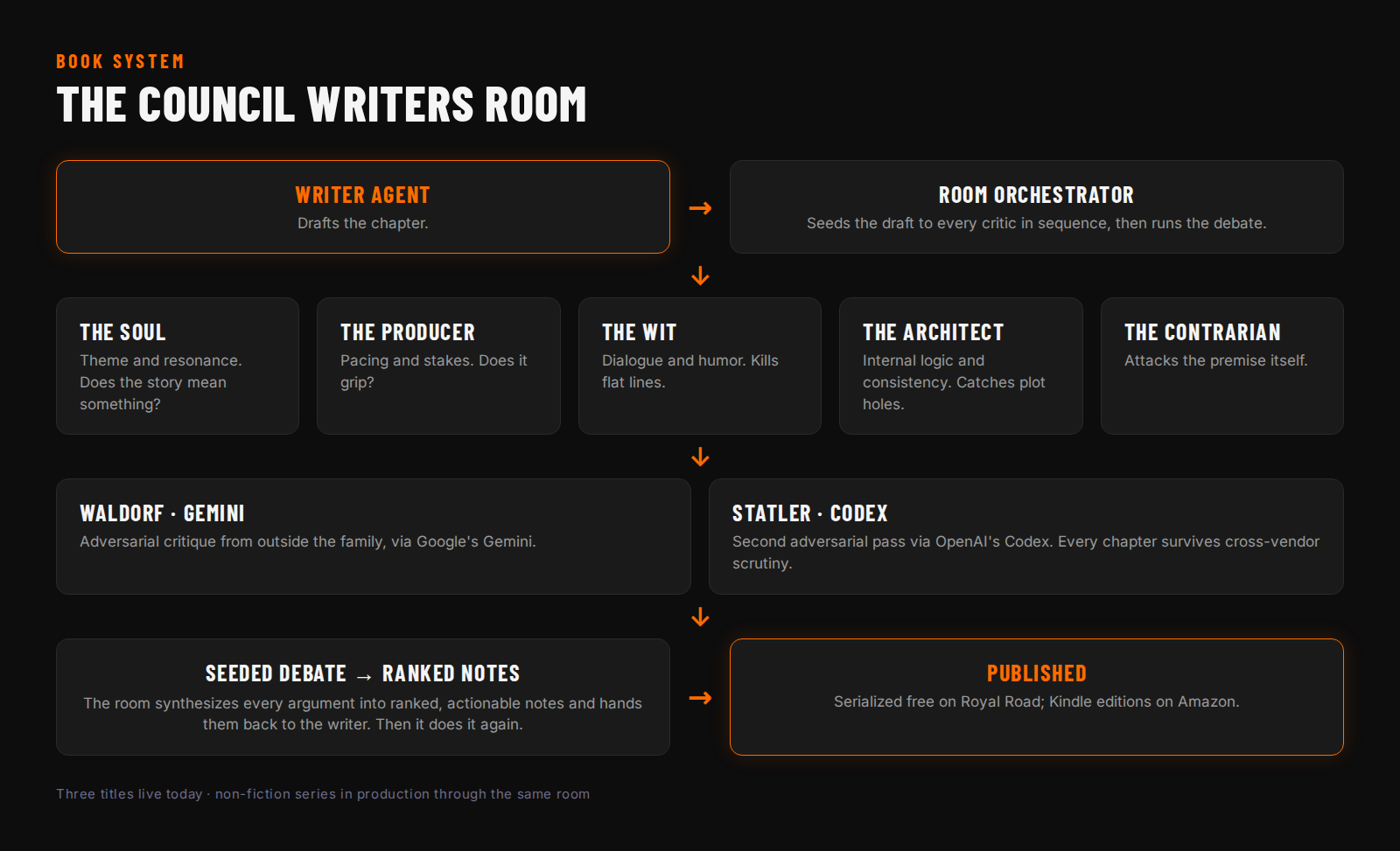
We write and publish full-length fiction with a multi-agent editorial system modeled on a television writers room.
A writer agent drafts chapters. A room orchestrator then seeds the draft to a bench of specialist critics in sequence: The Soul (theme and resonance), The Producer (pacing and stakes), The Wit (dialogue and humor), The Architect (internal logic and consistency), and The Contrarian.
Two adversarial critics sit outside the family: Waldorf critiques via Google’s Gemini and Statler via OpenAI’s Codex, so every chapter survives cross-vendor scrutiny, not just self-review.
The room runs a seeded debate, synthesizes the arguments into ranked, actionable notes, and hands them back to the writer for revision. Then it does it again.
A non-fiction series built through the same room is in production for KDP and Audible.
Both Kindle titles are also free to read with Kindle Unlimited.
Video: Script to Published, End to End
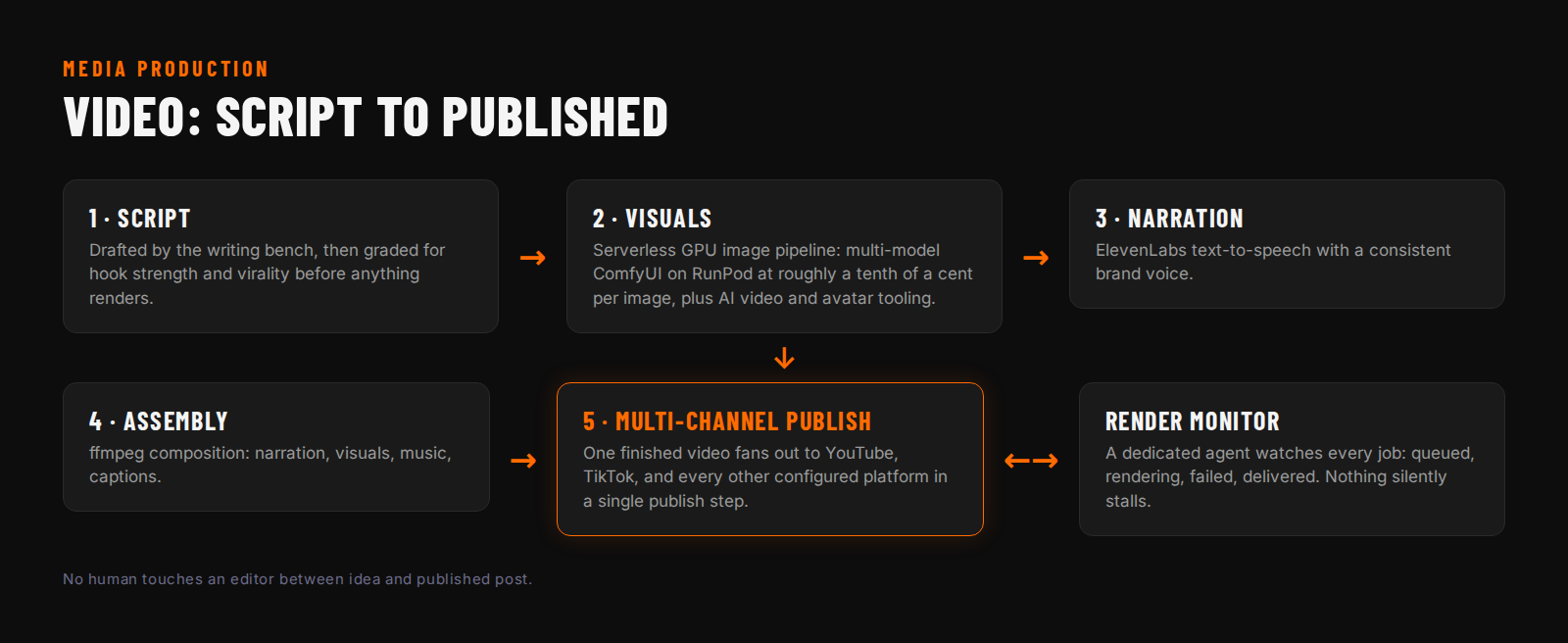
The video pipeline takes an idea to published social content without a human touching an editor.
Scripts are drafted by the writing bench and graded for hook strength and virality before anything renders.
Visuals come from our own serverless GPU image pipeline (multi-model ComfyUI on RunPod, roughly a tenth of a cent per image) plus AI video generation and avatar tooling.
Narration is ElevenLabs text-to-speech with a consistent brand voice; assembly is ffmpeg.
Distribution is multi-channel by default: one finished video fans out to YouTube, TikTok, and the other configured platforms in a single publish step, with a render monitor agent watching every job.
Publishing: Blog-First, Medium-Second
The written content system treats monkeyattackllc.com as the canonical home and syndicates outward.
An SEO specialist agent drafts long-form articles; the writers room reviews them; a publisher agent owns the release gate.
Every post passes a hard AI-voice check before it goes live: formulaic transitions, stock AI phrasing, and telltale punctuation get rewritten by hand. If it reads like a bot wrote it, it does not ship.
Posts publish with custom infographics, optimized images, full SEO metadata, and internal link clusters. Canonical URLs stay on our domain; the blog currently carries 16 published articles, every one of which went through this gate. Medium gets the syndicated copy afterward, never first.
The Point
None of this is a product pitch. It is one operator plus a fleet of agents shipping across four domains at once: capital markets, publishing, media production, and commerce. The agents handle the volume; the human handles the judgment.