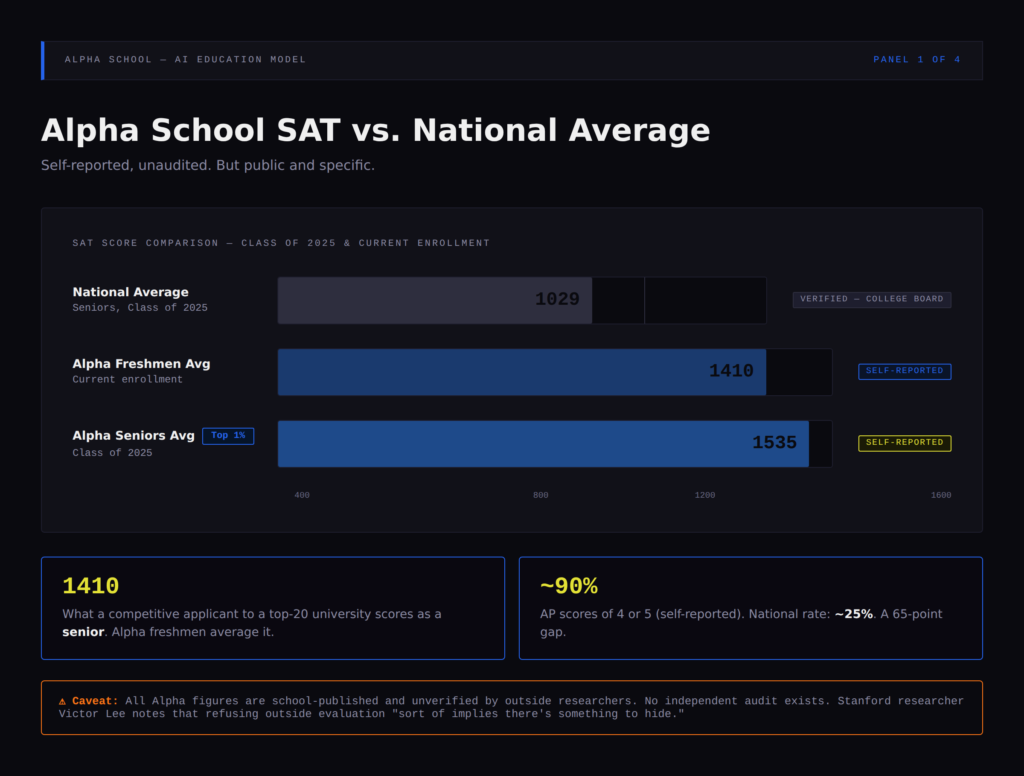
At Alpha School, students spend two hours a day on AI-powered learning apps and post SAT scores in the top 1% nationally, then spend the rest of the school day on entrepreneurship, public speaking, and real-world projects. The school’s freshman class averages 1410 on the SAT. The national average, for graduating seniors three grades older, is 1029.
Sit with the freshman number for a second. 1410 is not a good score for a ninth grader. It’s a good score for a senior applying to a top-twenty university. At Alpha, it’s the class average, reached on two to three hours of academic instruction a day, in a school where the afternoon is spent launching food trucks.
This is an article about a dataset that now exists (self-reported, unaudited, and with every caveat that implies) and about what happens to the traditional school day if even half of it survives scrutiny.
What Does Alpha School Actually Do?
Alpha is a private school network (thirteen campuses as of this spring, headquartered in Austin, roughly $40,000 a year at most locations) built around one structural bet: academics can be compressed.
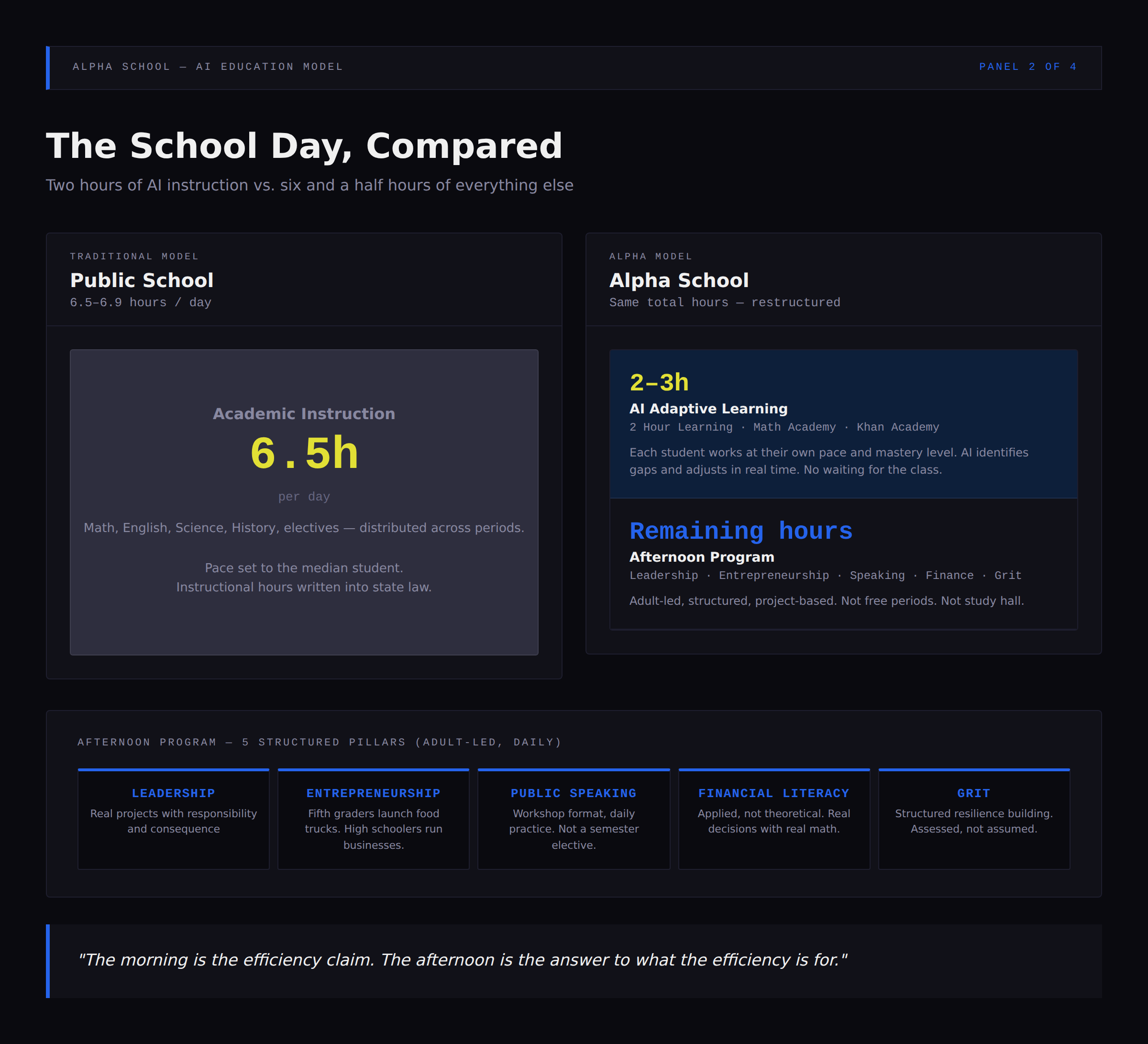
Mornings, students work through adaptive learning software: a proprietary platform called 2 Hour Learning, plus tools like Math Academy and Khan Academy. Two hours a day for elementary and middle school, about three for high school. Each student moves at their own pace: no class-wide lectures, no waiting for the room to catch up, no moving on before you’re ready. Worth being precise here, because the marketing isn’t: this is mostly adaptive-learning software of the kind that has existed for a decade, not a chatbot teaching your kid. And there are adults in the room. Alpha calls them “guides” rather than teachers, but the rooms are staffed.
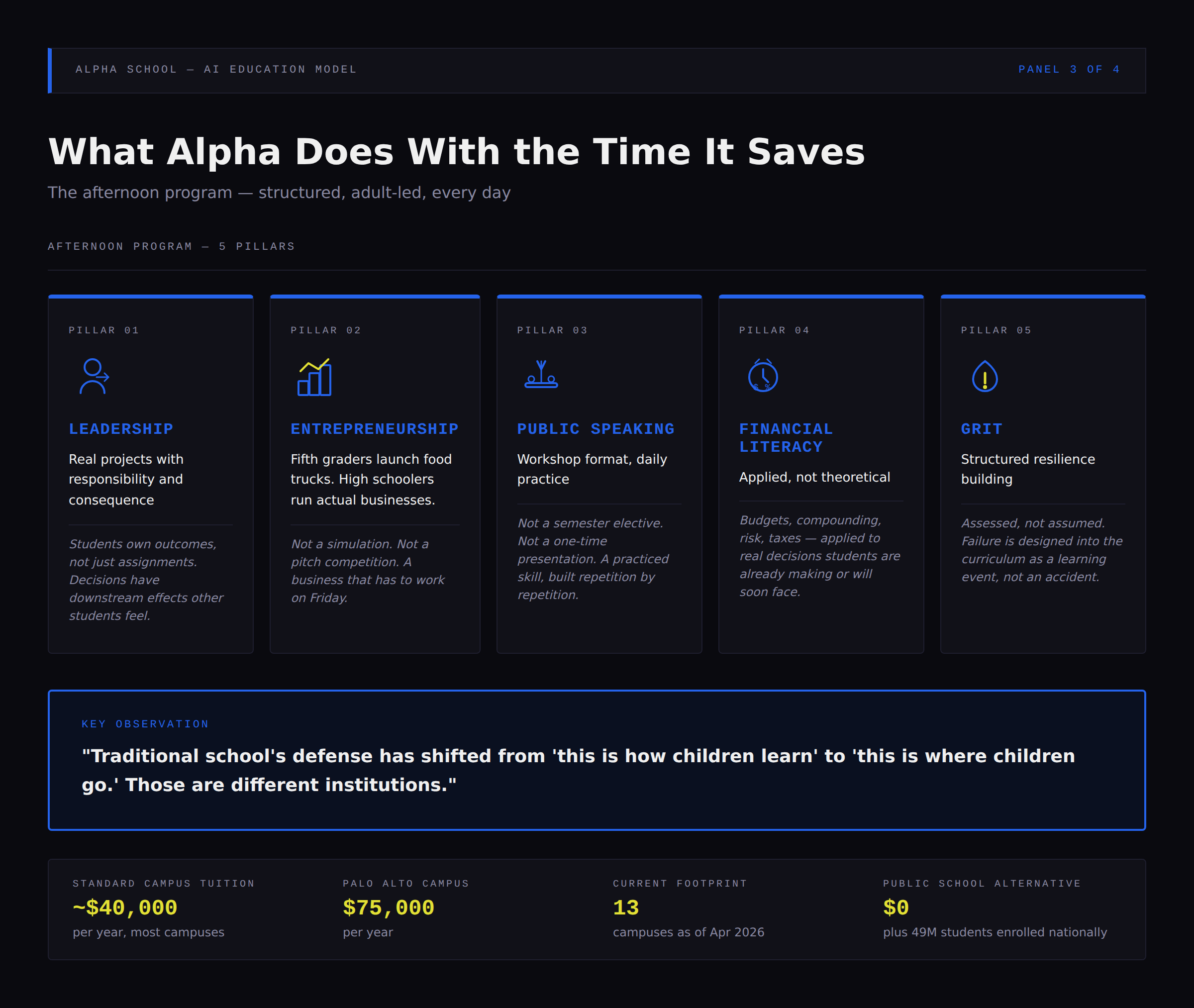
Afternoons are the actual product. Leadership, entrepreneurship, public speaking, financial literacy, run as workshops and real projects. Fifth graders launch food trucks. High schoolers run businesses. The pitch to parents, from Joe Liemandt, the Trilogy Software founder who bankrolls the school and serves as its principal, is a question: if your kid can learn the academics in two hours, what should they do with the other four?
The morning is the efficiency claim. The afternoon is the answer to what the efficiency is for.
How Good Are the Numbers, Really?
Here’s the table, with the honesty built in:
| Measure | Alpha School (self-reported) | National context |
|---|---|---|
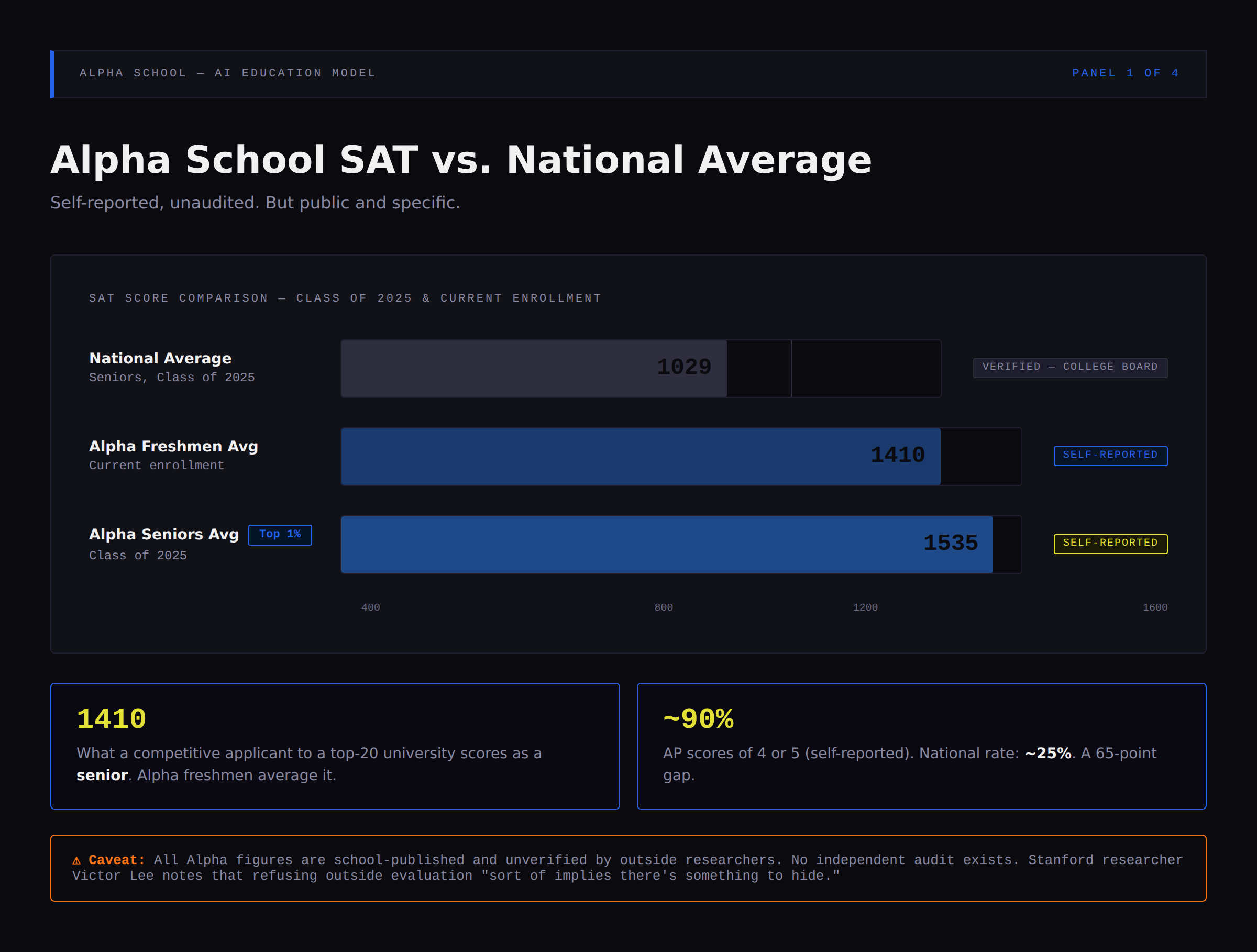
| Freshman avg SAT | 1410 | National mean for seniors, class of 2025: 1029 |
| Senior avg SAT | 1535 (class of 2025) | Top 1% of test takers |
| AP exams | ~90% of scores reported as 4s and 5s | ~25% of all AP scores nationally are 4+ |
| Academic instruction | 2–3 hours/day | ~6.5–6.9 hour school day |
Two things are true at once.
First: these numbers are extraordinary. A senior average of 1535 would make Alpha one of the highest-scoring schools in the country. A freshman average of 1410 has essentially no comparison point: the average American ninth grader is not within five hundred points of it.
Second: every one of these numbers comes from the school. There is no independent audit, no peer-reviewed study, no outside researcher with access. When Stanford’s Victor Lee, an education researcher rather than a culture warrior, was asked about Alpha’s refusal to allow outside evaluation, his answer was that it “sort of implies there’s something to hide.” That’s the strongest version of the skeptic’s case, and it deserves to sit right next to the scores.
The numbers are either the most important education data in a decade or a marketing document. Nobody outside the school currently knows which.
Does the Traditional School Day Survive This Math?
Suppose the numbers hold, even loosely. Then the arithmetic gets uncomfortable fast.
The average American public school day runs about six and a half hours. If two to three hours of adaptive software can outperform it academically, then four hours a day of every child’s life is being spent on something other than measurable learning. The system’s defenders would say those hours carry socialization, supervision, art, gym, lunch, and the accidental education of being around other humans, and they’re not wrong. But notice that this is a retreat: the argument for the traditional school day stops being “this is how children learn” and becomes “this is where children go.”
The honest version is that nobody designed the school day around learning velocity. It’s a factory-era batch process (thirty kids, one pace, one curriculum, sized to the working day of a 1950s parent), and it has survived because nothing forced the question. Teachers aren’t the problem; teachers are the ones absorbing the damage of the design. One adult cannot personalize pacing for thirty students. Software can, trivially, and it doesn’t get better or worse depending on which zip code bought it.
Alpha’s actual innovation isn’t the software. It’s taking the compression seriously and then answering the question it raises: filling the freed hours with structured, adult-led practice in exactly the things classrooms have always claimed to teach and rarely had time for.
Traditional school’s defense has quietly shifted from “this is how children learn” to “this is where children go.” Those are different institutions.
Why Won’t This Scale? (Asking Honestly)
Now the part the enthusiastic version of this story skips.
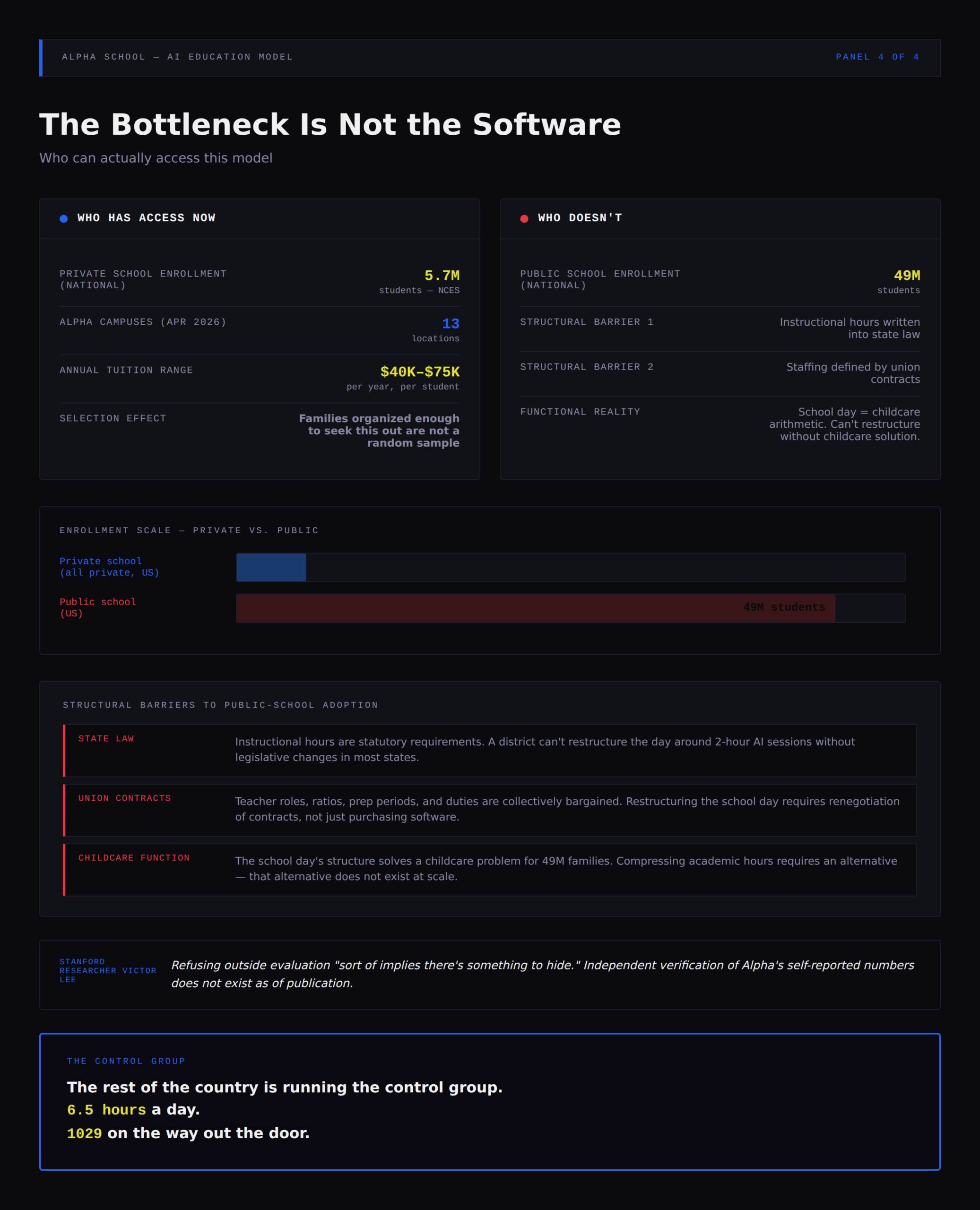
Alpha costs around $40,000 a year at most campuses, and $75,000 in Palo Alto. Its families self-selected hard enough to pay it. Its students are, by construction, the children of parents organized and motivated enough to seek out an experimental school. The Astral Codex Ten review that examined Alpha most carefully concluded that a large share of the headline results likely comes from who is enrolled, not what the software does. Selection effects of that size can manufacture a top-1% average out of admissions alone.
And the model’s requirements travel badly. Adaptive software works when the student engages with it; engagement is exactly what a motivated family produces and a struggling one can’t guarantee. Public schools can’t restructure the day by fiat: instructional hours are written into state law, staffing into union contracts, and the school day into the childcare arithmetic of every working family in the district. The AFT’s Randi Weingarten spent this spring calling for limits on student-facing AI in elementary grades; whatever you think of that position, it signals how the institutional immune system will respond.
So state it plainly, the way the school’s own boosters won’t: the results are real enough to matter and unverified enough to doubt; the technology is cheap but the wrapper of small campuses, hired guides, and curated families is expensive; and the ninety percent of American kids in public schools currently have no path to any of it. The bottleneck is not the software. It never was.
What If It Scales Anyway?
Speculation, labeled as such.
If AI-compressed instruction becomes normal over the next decade, through private networks like Alpha, microschools like Acton Academy’s three hundred campuses, and homeschool co-ops running the same apps, the pressure lands on the public system from outside. Not as reform. As exit.
The teaching job changes shape: less content delivery, more of what Alpha’s afternoons already are: project facilitation, mentorship, the coaching of actual human skills. That’s arguably a better job. It is also a different job, and the transition will be fought by every institution built around the current one, for reasons that are not stupid: schools are also childcare, also community anchors, also the largest employer in a thousand towns.
And the head start compounds. The kids getting compressed academics plus four daily hours of entrepreneurship practice are, for now, almost exclusively the kids of parents who could write the check. If the model works, the gap it opens won’t look like test scores. It will look like a cohort of twenty-two-year-olds who have been running businesses since fifth grade, competing against graduates of an institution that spent those hours on crowd control.
The Narrow Claim Is the Whole Story
Alpha School is not proof that AI fixes education. It’s proof of something narrower and harder to dismiss: one network of schools reorganized the day around the assumption that academics take two hours, and its self-reported outcomes (top-1% averages, unaudited but specific and public) have not been debunked so much as ignored.
The rest of the country is running the control group. Six and a half hours a day, 1029 on the way out the door. A private school in Texas is running the experiment, publishing numbers the field won’t engage with, and refusing the access that would settle it. Both sides of that standoff are choices. The kids, meanwhile, are in one classroom or the other right now.
Sources on file: 2hourlearning.com/results and alpha.school FAQ (freshman avg 1410; class-of-2025 senior avg 1535; ~90% AP 4s/5s; 2h K-8 / 3h HS model, all self-reported); College Board 2025 SAT Suite Annual Report (national mean 1029, class of 2025); NCES State Education Reform tables + Pew Sep 2023 (avg school day ~6.7h elementary / 6.9h secondary); Wikipedia/Block Club Chicago Mar 2026 (13 campuses Apr 2026, Chicago fall 2026; founded 2014 by MacKenzie Price and Brian Holtz as Emergent Academy; Liemandt = principal and financial backer via Trilogy Enterprises); tuition range $10K Brownsville–$75K Palo Alto, ~$40K typical (Wikipedia, aifunlab.io); platform detail: 2 Hour Learning/TimeBack, IXL being replaced by Math Academy, Khan Academy for science (Dan Meyer Substack; deeplearning.ai); Astral Codex Ten “Your Review: Alpha School” 2025 (selection effects); CNN Jan 29 2026 (Stanford’s Victor Lee on refusal of outside evaluation); Block Club Chicago Mar 2026 (Northwestern’s Charles Logan, “mixed at best”); Chalkbeat May 27 2026 (Weingarten/AFT on student-facing AI limits); Acton Academy (300+ campuses); The Hustle/Deseret News (Synthesis, Ad Astra lineage).
Chris Meredith writes about AI, technology, and what it actually means for real people. Follow along on Substack: monkeyattack.substack.com