
If AI destroys enough jobs fast enough, and the projections now run as high as 300 million positions exposed worldwide, governments will be forced to provide universal basic income and universal healthcare. Not because anyone in power wants to. Because the alternative is collapse.
That’s the whole argument. The rest of this is me showing my work.
There’s a subreddit called r/almosthomeless. Spend ten minutes there. One woman posts that she’s $266.77 short on her weekly rent: “I don’t have any family to turn to—no backup, no safety net. It’s just me and my girl trying to hold on. I used to make ends meet doing Doordash but my car broke down a while back and I had no choice but to sell it. Since then it’s been week to week in a motel room trying to stay afloat.” Another poster donates plasma for the first time, then finds out the money won’t clear until Wednesday: “I’m only short 40 dollars for a hotel room tonight … time to seek shelter.” A father writes: “This is my last weekend with my daughter in our first home and it feels incredibly dark …”
Notice what’s missing from these posts: AI. Nobody in that subreddit lost their job to a language model. These are legacy-economy casualties: the gig work, the broken-down car, the motel math. The machine hasn’t even touched them yet.
That’s the baseline. Keep it in mind, because everything that follows lands on top of it.
When Did the Middle Class Actually Die?
Earlier than you think. The American middle class as we imagine it, with one income, a house, retirement, and kids who do better than you, was a specific historical artifact that ran from roughly 1945 to somewhere around 2008. It wasn’t the natural order. It was a postwar anomaly: unions at peak strength, global competitors in rubble, a tax structure nobody today would recognize.
Then the long unwinding. Stagflation in the seventies. Deindustrialization in the eighties. The financial crisis took the housing wealth. The gig economy took the benefits and called it flexibility.
The Economic Policy Institute has tracked the divergence for decades: since the early 1970s, productivity has grown several times faster than the typical worker’s pay. The economy kept getting richer. The people in it, mostly, did not. For the bottom 60% of earners, real wages have been essentially a flat line for fifty years.
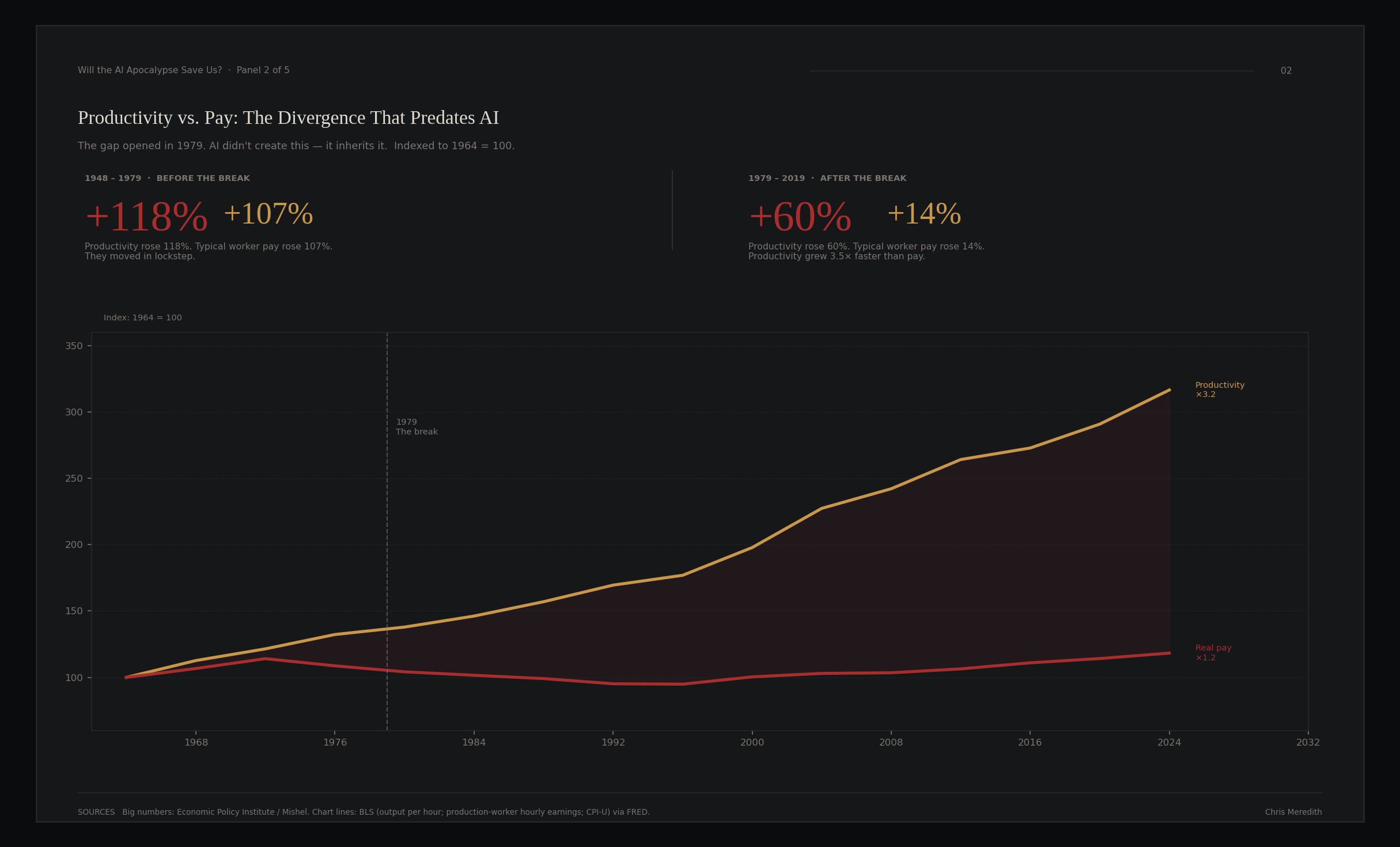
“Middle class” now means “not yet homeless.” That’s the honest definition. It’s a category people cling to on the way down.
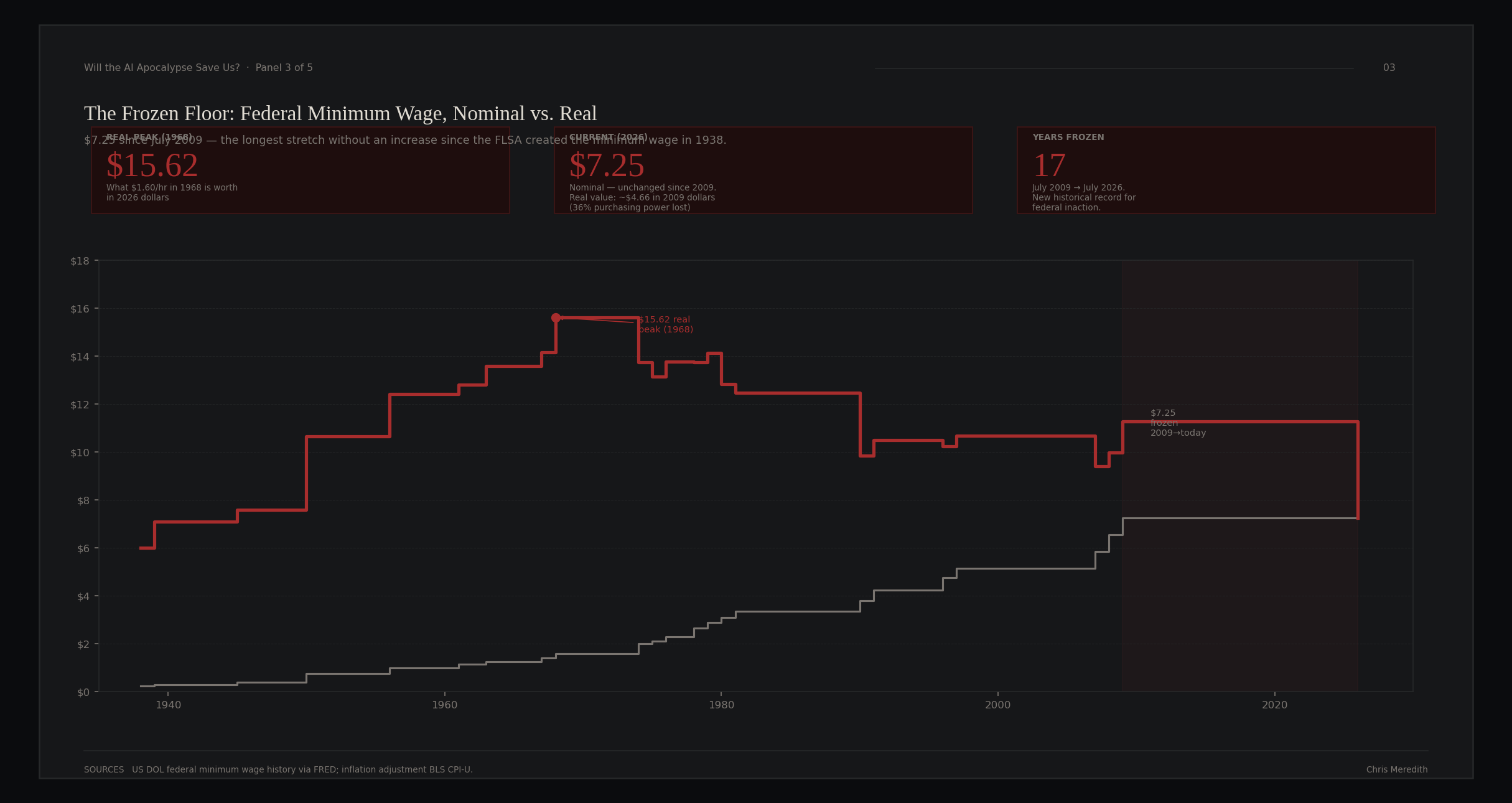
The frozen wage floor tells the same story from the bottom up:
And the two costs that define a middle-class life, a home and a degree, ran the other way:
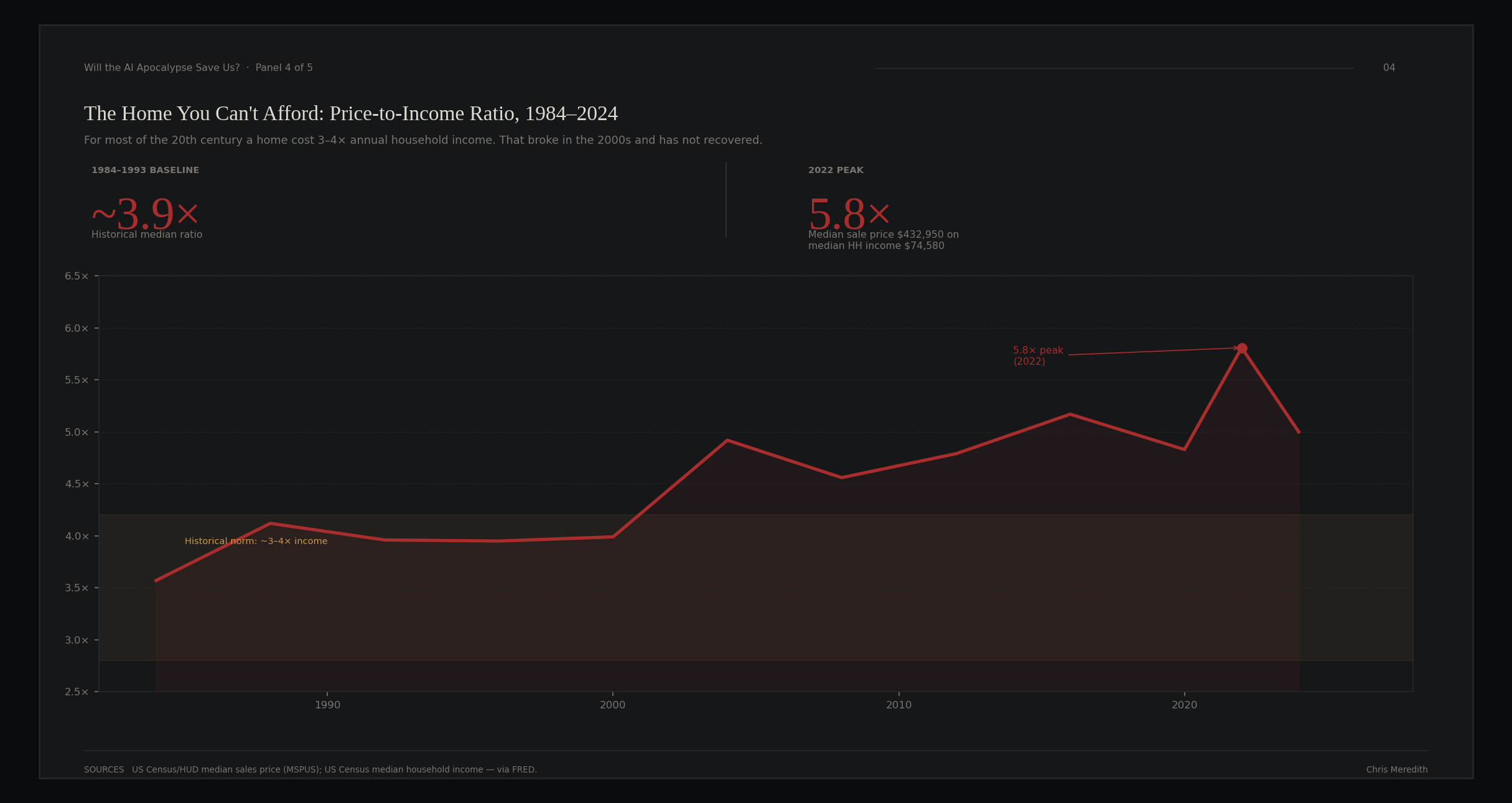
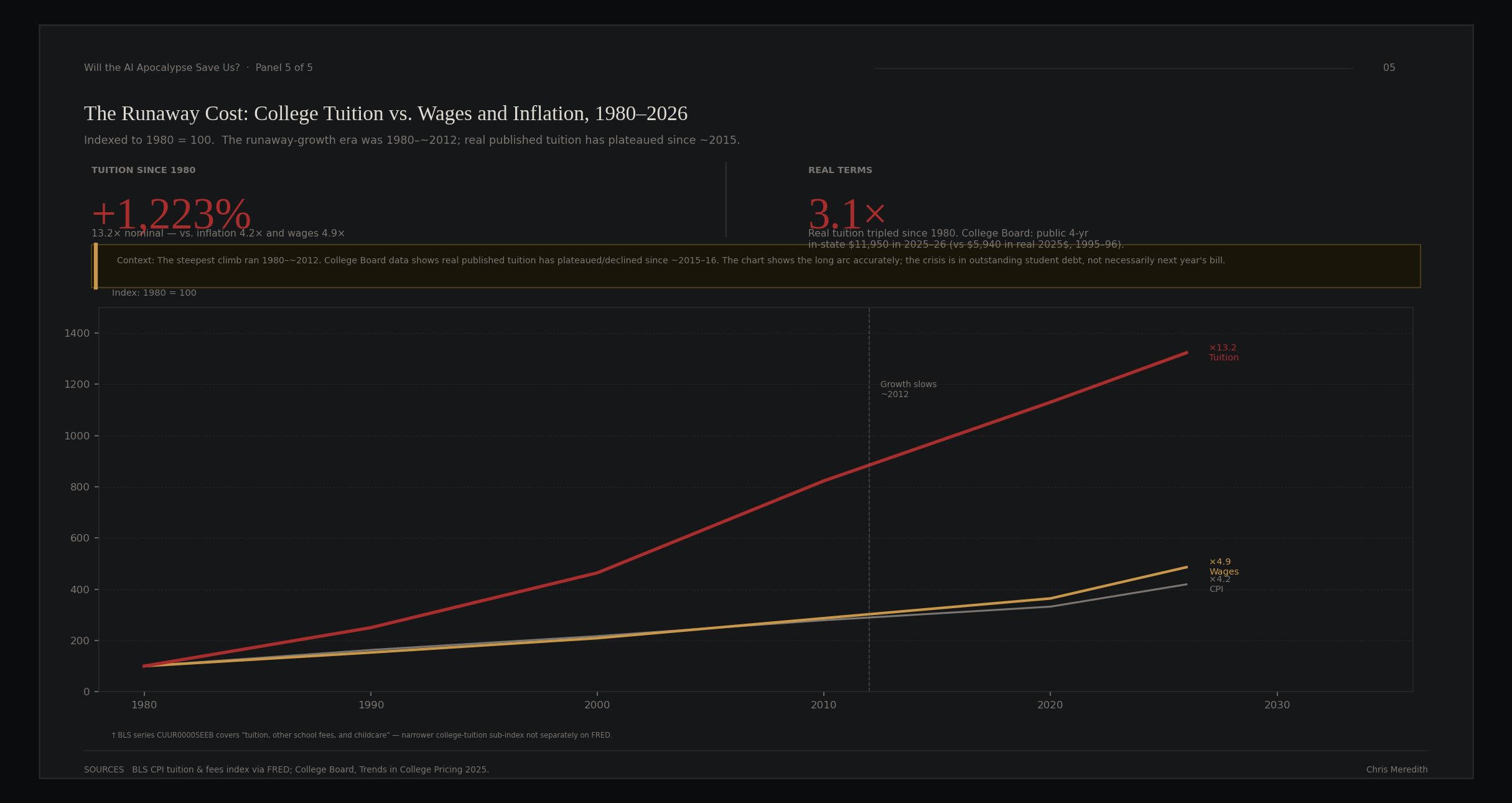
AI didn’t do any of this. AI arrived at the end of it, an accelerant poured on a structure that had been quietly burning for half a century.
Why Didn't Governments Fix This When They Could?
Because nothing forced them to. That’s the answer. Everything else is commentary.
Every tool that could have arrested the slide has existed, fully formed, for generations: labor law, tax policy, healthcare decoupled from employment. Other rich countries used them. Ours declined, decade after decade, under both parties. Redistribution has a structural problem: the people it would take from are organized, funded, and heard. The people it would help, mostly, are not.
But there was a second mechanism, subtler and more effective: the slowness of the decline. The middle class didn’t collapse; it eroded. And erosion is survivable, politically, because people who lose ground slowly blame themselves. The laid-off machinist in 1988 didn’t see a system; he saw his own bad luck. The adjunct professor with food stamps in 2015 saw her own bad choices. Slow suffering individualizes. Every decade produced the same official sentence, “the economy will adjust,” and the economy never adjusted. People adjusted. Downward.
Sixty years of managed decline taught our political class a durable lesson: you can ignore this forever. Inaction has never once been punished at the scale required to change it.
AI is about to test that lesson.
What Does AI Actually Change About the Math?
Three dimensions, and none of them is “the robots are smarter than us.”
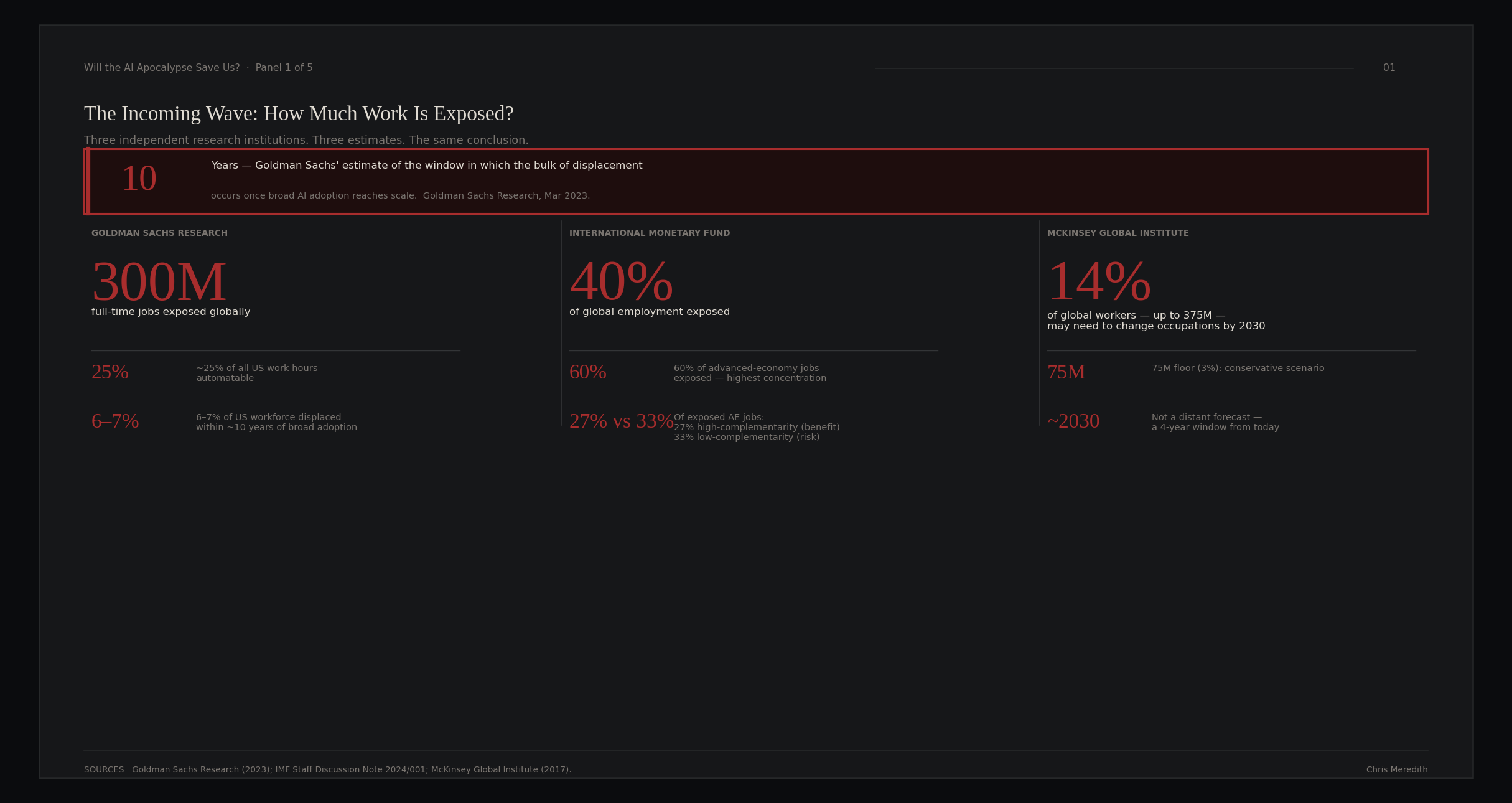
1. Speed. Agricultural mechanization pushed farm work from about 40% of American employment in 1900 to under 5% by 1970. That was a seventy-year transition, with two or three generations to absorb it. Manufacturing offshoring ran about thirty years. The current AI projections compress the same scale of displacement into a decade or less. Goldman Sachs puts 300 million jobs globally in exposure, with tasks amounting to a quarter of all US work hours automatable, and 6–7% of the workforce displaced within roughly ten years of broad adoption. The IMF’s figure is starker: nearly 40% of global employment exposed, and 60% in advanced economies. McKinsey’s scenarios run as high as 375 million workers, up to 14% of the global workforce, needing to switch occupational categories by 2030. You can quarrel with any single number. The direction and the compression are not in dispute.
2. Scale, and more importantly, altitude. Deindustrialization hollowed out people that Washington found easy to ignore: factory towns, no donor networks, shrinking unions. This wave targets the credentialed. Lawyers, accountants, analysts, radiologists, journalists, middle managers: the people who vote in every election, donate, know their representatives’ names, and have never once believed the economy’s failures applied to them personally.
3. Visibility. Slow erosion individualizes blame; simultaneous displacement socializes it. When the layoffs hit one industry, the displaced worker is told to reskill. When they hit law, medicine, finance, media, and logistics in the same electoral cycle, “personal responsibility” stops working as a narrative, not because it got less cruel but because it got statistically absurd. You cannot tell forty percent of the workforce they all failed individually, at the same moment, in the same way.
The political formula that protected sixty years of inaction was slow, dispersed, and deniable. It inverts on every axis: fast, concentrated, undeniable.
Is r/almosthomeless the Preview?
Yes. That’s precisely what it is.
Go back to those posts. The woman in the motel was doing DoorDash. She was already living in the economy’s shock-absorber layer, the one that catches you after the stable job disappears and before the street. The plasma donor was converting his own blood into one night of shelter. These are people who did what the script said: worked, hustled, stayed off the ledger’s wrong side. The script failed them anyway, pre-AI, in the ordinary crumbling economy we already had.
The subreddit is not an outlier community of the unlucky. It’s a leading indicator, the first visible edge of a curve. Every person displaced in the coming decade lands on exactly that terrain: the same motels, the same weekly math, the same absence of any net. The difference is volume. The shock-absorber layer was built to catch the economy’s stragglers, one at a time. It was never designed for the orderly descent of the professional class.
The preview is already running. Most just haven’t recognized the genre yet.
So How Does This Force UBI and Universal Healthcare?
Run the scenario forward using the published projections, not science fiction. Something in the range of 20–40% of white-collar work displaced or degraded across five to ten years.
Consumer spending is roughly two-thirds of the US economy, and the professional class does a disproportionate share of the consuming. Displace them at scale and demand doesn’t dip. It craters, taking the service jobs beneath it. The income-tax base follows. State budgets, built on that base, follow that. Social services designed for single-digit unemployment meet demand they were never sized for. Employer-based health insurance, the load-bearing absurdity of the entire American system, detonates on contact, because coverage that lives inside a job dies with the job, in the middle of the exact crisis when forty million people most need it.
At that point a government of any party, at any point on the ideological spectrum, faces a short menu, and the other items on it fail mechanically. Austerity cuts spending into a demand collapse, which deepens the collapse, which shrinks the tax base: a feedback loop, not a policy. Protectionism and retraining are supply-side answers to a demand-side wound: you can’t tariff your way back to 1970s employment, and you can’t retrain forty million people for jobs that don’t exist. Repression manages the corpse without reviving it: consumption stays dead, revenue stays dead. Only direct demand-side support breaks the loop: money and healthcare put back under people faster than the displacement takes them away. Direct income support and healthcare decoupled from employment stop being progressive wishlist items and become the only mechanisms that keep the machine running: the only way to keep consumption alive, keep the tax base breathing, and keep tens of millions of newly furious, newly organized, formerly comfortable people inside the political process rather than outside it.
Not empathy. Plumbing. UBI and universal healthcare arrive not as a triumph of conscience but as emergency infrastructure, installed by frightened people, at the last possible moment, because every alternative was worse for them.
Finland piloted a basic income and found people no less likely to work. Stockton, California handed out $500 a month and full-time employment among recipients went up. GiveDirectly has run the experiment across Kenyan villages for years with the same broad result. These were pilots, not systems; a few thousand people, not forty million. But they answer the workability question at the scale they were run. The evidence exists. It has been sitting there, politely ignored, waiting for the fear to arrive.
What's the Catch?
The catch is everything above.
If this comes to pass, the policies arrive soaked in the suffering that forced them. Years of it between the displacement and the response: foreclosures, bankruptcies, motel weeks, plasma donations, r/almosthomeless scaled to a national institution. Governments that spent sixty years perfecting inaction will not move until the damage is undeniable, which means the damage comes first, in full, guaranteed. The people crushed in the interval do not get made whole. Ask the machinist from 1988 how the adjustment period went.
And there is no guarantee of the good ending. A collapse can produce emergency infrastructure, or it can produce scapegoats and strongmen. History runs both programs, and it doesn’t take requests.
So no, the AI apocalypse will not save us. The world was going down this road regardless; the machine just stepped on the accelerator. The only live question is a narrow one: whether the generation that lives through the crash gets the infrastructure on the other side of it, or just the crash.
I wouldn’t call that hope. I’d call it a coin toss we spent sixty years refusing to make by choice.
Sources on file: r/almosthomeless posts (pullpush archive, May 2025; verbatim re-verified 2026-07-05); EPI productivity–pay tracker; Goldman Sachs Research (300M jobs exposed, ~25% US work hours, 6–7% displacement over ~10yr adoption); IMF SDN 2024/001 (40% global / 60% advanced-economy exposure); McKinsey Global Institute (75M–375M / up to 14% occupational change by 2030); Finland KELA pilot; Stockton SEED; GiveDirectly Kenya; infographic data from FRED (BLS/Census/DOL series), College Board Trends in College Pricing 2025.
Chris Meredith writes about AI, technology, and what it actually means for real people. Follow along on Substack: monkeyattack.substack.com