FOUNDER PLAYBOOK
A simple framework for moving materially faster without shipping permanent mistakes.
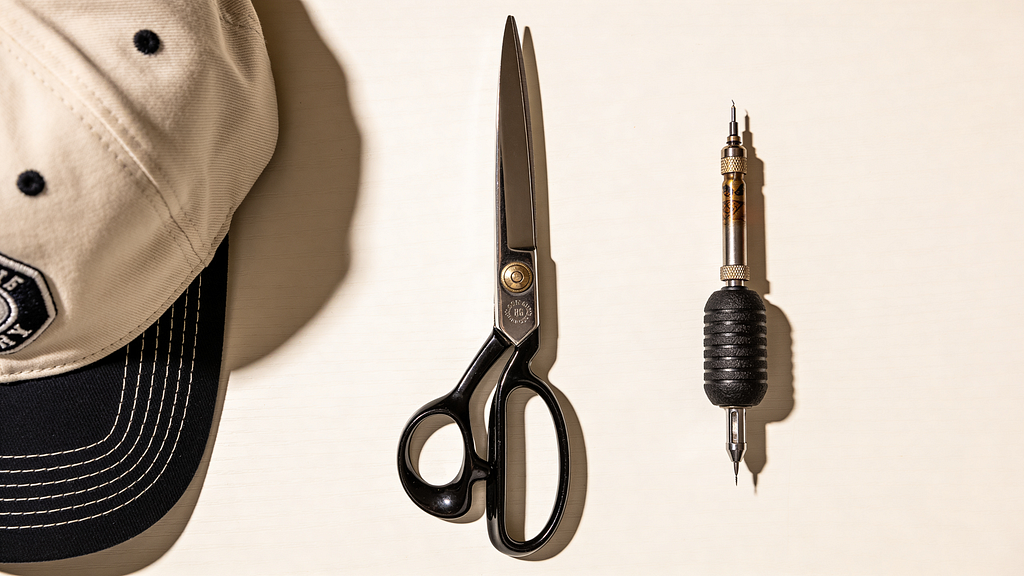
A leader at a billion-dollar family business needed approval to run a $20,000 marketing test. The approval cycle took nine months. A different leader at the same company, asked about a different test, said the words “do it now.” The test that got the green light reportedly delivered fifteen million new followers to the brand. Steven Bartlett has told this story, summarized by Holly Ransom here, and it sticks for a simple reason: the first leader was treating a hat like a tattoo.
The framework Bartlett’s using isn’t his. It belongs to James Clear, the author of Atomic Habits, who wrote about it in his 3–2–1 newsletter before it found its way onto Bartlett’s video. Clear built the model. Bartlett gave it the anecdote. Both are worth crediting, in the right order.
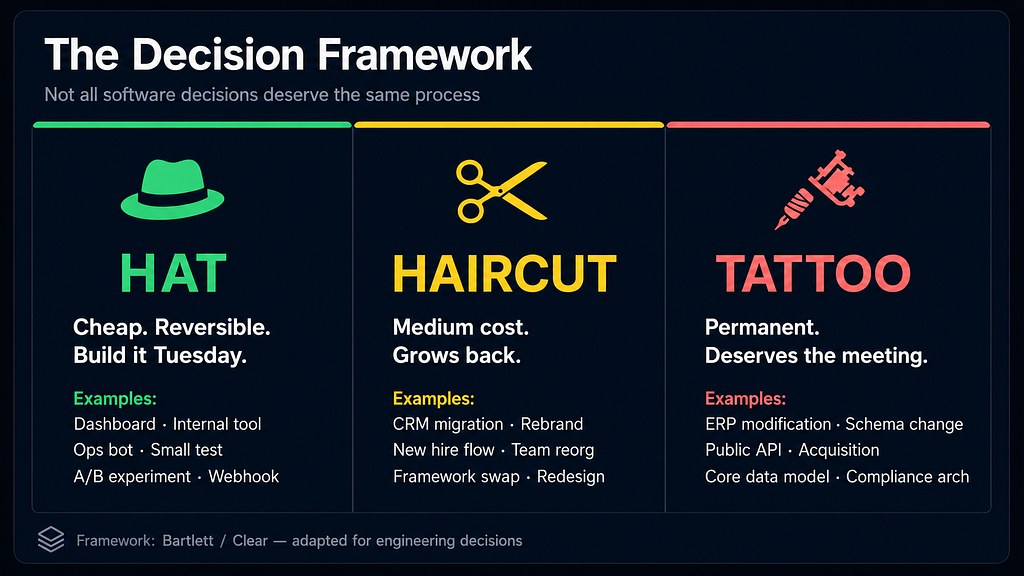
Here’s the model. Most decisions fall into one of three buckets. The expensive mistake is treating all three the same.
Hats, Haircuts, Tattoos
A hat is cheap and reversible. You try it on, you look at it, you take it off if it doesn’t fit. The cost of trying is near zero. The cost of being wrong is near zero. Operational choices are mostly hats: trying a new tool, posting a thought, joining a meeting, running a small test.
A haircut is medium cost and recoverable. You commit, you live with it for a while, and if it was the wrong call it grows back out. Most pivots are haircuts: a role change, a rebrand, a contractor engagement, a quarter-long initiative. Awkward in the short term, fully recoverable on a month-to-quarter timeline.
A tattoo is permanent or near permanent. The cost of getting it right is high. The cost of being wrong is enormous. Marriage. Major M&A. A public IP release. Firing a key employee badly. Having a child. Tattoos deserve the meeting. They deserve the four-week deliberation. They deserve the consultant.
Clear’s load-bearing observation, which Bartlett amplifies: ninety-nine percent of the things you do are hats or haircuts. The diagnosis is that most leaders treat them all like tattoos. They schedule the meeting. They form the committee. They write the SOW. They run the procurement process. They burn nine months on a $20,000 hat and miss the fifteen million followers.
Reversibility isn’t the only variable. Blast radius matters too. A dashboard five internal operators use can be wrong for a week and nobody gets hurt. A dashboard finance uses to close the books has a different risk profile, even with the same interface pattern. So the real question isn’t “software or not software.” It’s this: how many people, systems, dollars, or obligations does a bad decision touch before you can reverse it? A reversible call with a wide blast radius still earns a pilot; a reversible call with a narrow one earns a shrug and a ship.
The Software Version
This article is the software-and-engineering-leader version of the same diagnosis. Watch what happens when you apply the framework to the decisions that actually live on your roadmap.
Building an internal dashboard for your ops team is a hat. It isn’t a strategic asset. It isn’t a competitive moat. It’s a UI on top of three database tables, refreshed every hour, that your operations director will use to stop asking five people the same question every day. With a capable product engineer, a clear data source, and modern AI tooling, a first version can exist by Wednesday. If the first version is wrong, you change it Thursday. The cost of trying is one engineer-day. The cost of being wrong is two engineer-days.
You don’t run a sixteen-week procurement process for a hat. You don’t write a thirty-page requirements document for a hat. You don’t hire a $400-an-hour consulting team to scope a hat. You build the hat. If it’s the wrong hat, you build a different hat next week.
Choosing a CRM is usually a haircut. It isn’t trivial. It involves migration, training, process disruption, and sometimes revenue-operations risk. But unless you have deeply customized workflows, regulated customer data, or hard dependencies across finance and support, it’s rarely permanent. If HubSpot is wrong for you in six months, you can move to Salesforce in six months. If Salesforce is wrong for you in eighteen months, you can move to Pipedrive in eighteen months. None of these moves are free. None of them are catastrophic. The CRM industry depends on companies overweighting the switching cost.
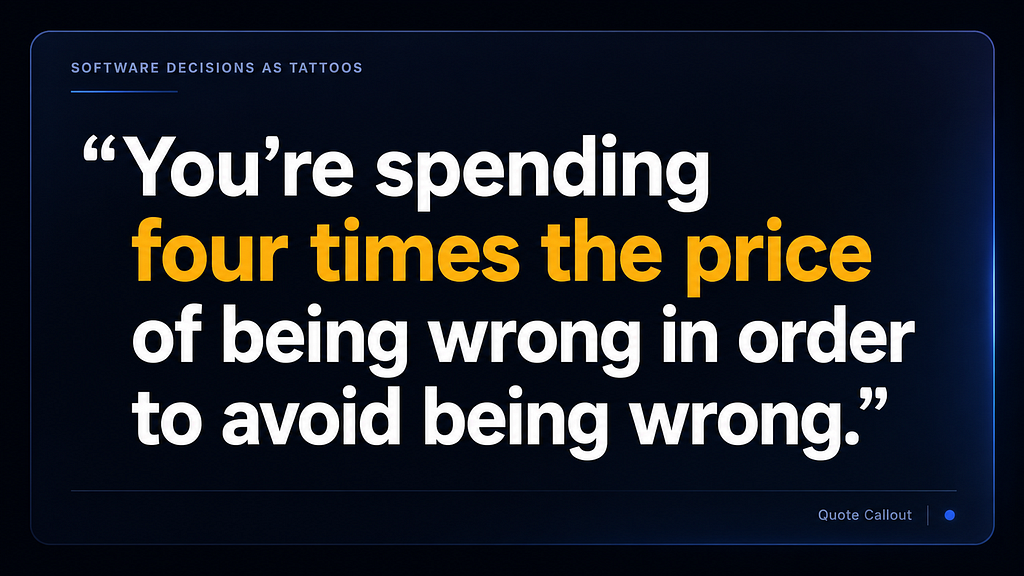
A haircut deserves a real evaluation. Two demos, a thirty-day pilot with one team, a comparison against your top three priorities. It doesn’t deserve an eight-month evaluation process with a steering committee. Run the numbers on that committee: a six-month evaluation for a $50,000-a-year CRM burns something like $200,000 in salary time across the people sitting in those rooms. Switching out the wrong CRM a year later costs $50,000. You’re spending four times the price of being wrong in order to avoid being wrong.
Modifying your ERP is a tattoo. This is where the analogy snaps into focus. The ERP touches every business process you have. It touches your general ledger, your inventory, your procurement, your manufacturing schedule, your reporting to the board, your reporting to regulators. Bad changes propagate. Good changes are sticky in a way that makes them hard to walk back. Tattoo work earns its careful posture. Slow down. Bring in the specialists. Pay the consultant. Run the staging environment. Test the eighteen edge cases.
A leader who’s good at this stops the meeting when she hears a hat being scoped like a tattoo, and starts the meeting when she hears a tattoo being scoped like a hat. Both errors are common. Both are expensive. The second error is more spectacular because it produces visible disasters. The first error is more common, and quieter, and more cumulatively costly, because it shows up as a company that ships nothing.
Why the Miscategorization Persists
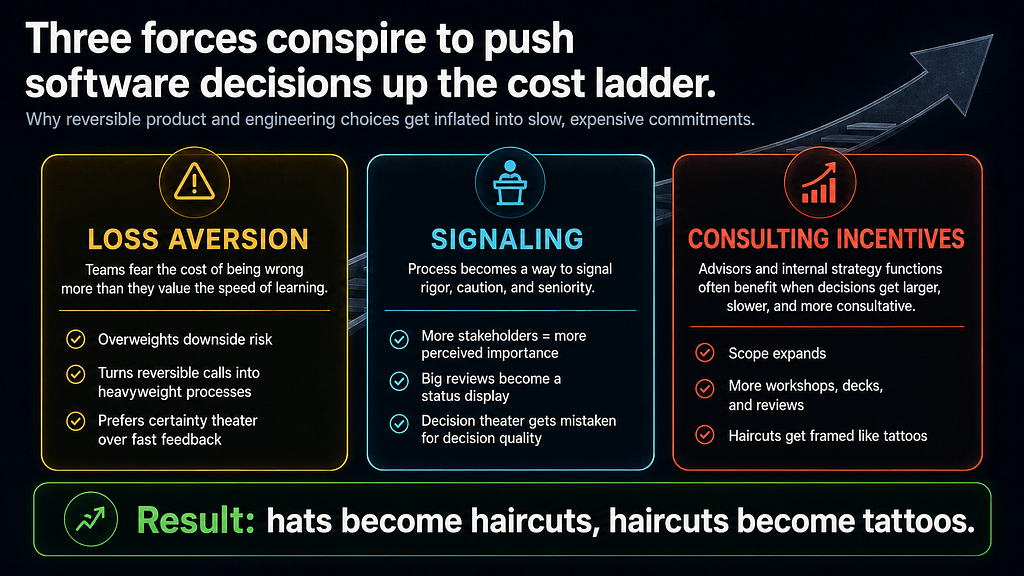
If most leaders can’t tell hats from tattoos, the obvious question is why. The answer isn’t stupidity. It’s structural.
Three forces conspire to push software decisions up the cost ladder.
Recategorizing Your Roadmap
The incentive gradients are real. But the fix is simpler than it looks.
Look at the next quarter of work in your engineering or product backlog and put each item into one of the three buckets. Be honest about the answer, not aspirational.
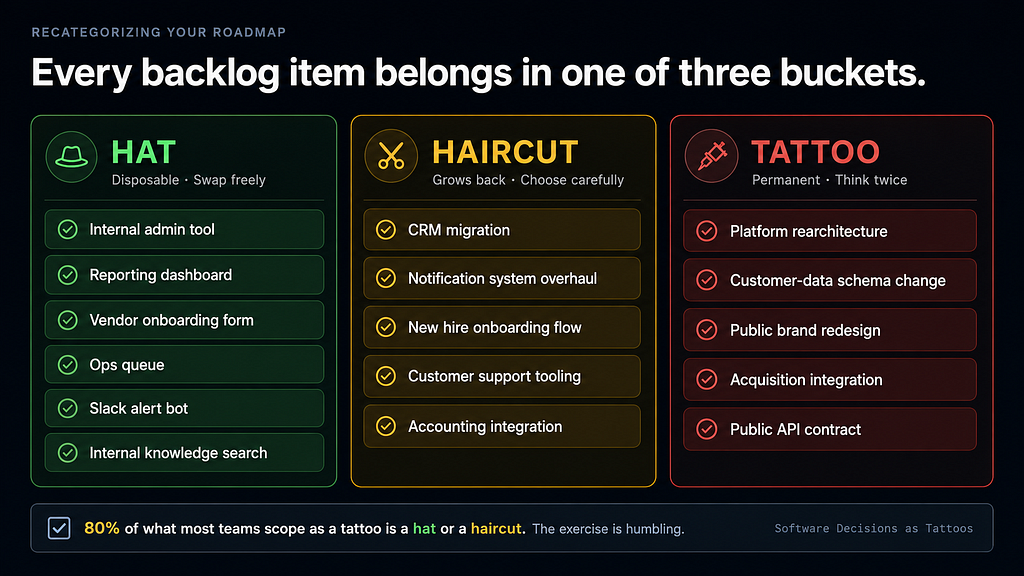
The internal admin tool? Hat. The reporting dashboard? Hat. The vendor onboarding form? Hat. The ops queue? Hat. The Slack bot that pings the team when an alert fires? Hat. The internal knowledge-search prototype? Hat. The production-grade, permission-aware enterprise search layer across legal, HR, finance, and customer data? Haircut or tattoo. Almost everything else in the bottom half of your roadmap is a hat.
The CRM migration? Haircut. The notification system overhaul? Haircut. The new hire onboarding flow? Haircut. The customer support tooling? Haircut. The third-party integration with your accounting system? Haircut. The middle of your roadmap is mostly haircuts.
The platform rearchitecture? Tattoo. The customer-data schema change? Tattoo. The brand redesign you ship publicly? Tattoo. The acquisition integration? Tattoo. The public API contract? Tattoo. The top of your roadmap is a handful of tattoos.
The exercise is humbling. Most teams discover that something like eighty percent of what they’re scoping like a tattoo is actually a hat or a haircut. They’re running waterfall against a problem that wanted to be a Tuesday afternoon. They’re running steering committees against a problem that wanted to be a pull request.
How to Move Faster Without Breaking Things
Two changes get you most of the way.
First, give your senior engineers explicit authority to ship hats without process. Not vague authority. Explicit. “Anything in the hat bucket, you build it, you ship it, you tell us about it at the standup.” This will feel uncomfortable for two weeks. Then it’ll feel normal. Then your team will start shipping software at four times the rate it used to.
Second, keep your tattoo discipline intact. Don’t let the speed of the hats infect the deliberation of the tattoos. The schema change still gets the review. The platform rearchitecture still gets the design doc. The acquisition still gets the deep diligence.
And “ship hats fast” doesn’t mean “skip ownership.” Every hat still needs an owner, a rollback path, basic access control, and a definition of done. The difference is that those controls should be lightweight and reusable, not reinvented as a bespoke governance process every time someone wants a dashboard.
Here’s the objection that stops most leaders before they start: if I miscategorize a hat as a tattoo I waste nine months, but if I miscategorize a tattoo as a hat and ship fast, I corrupt the whole system, so the asymmetry should push me toward tattoo-discipline on everything. The error asymmetry feels decisive. It’s incomplete. Teams that move fast on hats ship fewer permanent mistakes, not more, because fast feedback surfaces the actual constraints early, while they’re still cheap to fix. The genuine tattoos become easier to see, not harder, once you stop burying them under a pile of hats you were also treating as tattoos. Speed on the reversible is what buys you the attention to be careful on the irreversible.
The leader who can tell the difference can move materially faster than her peers and ships fewer permanent mistakes. The leader who can’t tell the difference is the one writing $340,000 portal SOWs and waiting nine months for a $20,000 test to clear committee.
Stop overthinking your CRM. Stop overthinking your dashboard. Stop overthinking your vendor onboarding form. Save the careful posture for the things that actually require it.
Sources
- James Clear, “3–2–1: On hats, haircuts, and tattoos” (Feb 1, 2024) (framework originator)
- The Systems Behind Steven Bartlett’s Fast Moves (Holly Ransom) (the $20k-test anecdote)
- Diary of a CEO (Steven Bartlett) (framework amplification)
Tags: Decision Making, Leadership, Productivity, Software Development, Startups
Related reading
Chris Meredith writes about AI, technology, and what it actually means for real people. Follow along on Substack: monkeyattack.substack.com