Something shifted in 2026.
One in three U.S. adults says they plan to start a new business or side hustle in the next 12 months. That’s not a rounding error. That’s a 94% jump from last year. Nearly double.
Something broke the dam.
It wasn’t a recession. It wasn’t desperation. It was access. Specifically: AI tools that used to cost a development team now cost less than a Netflix subscription.
Here’s what’s actually driving the wave, and the stack people are quietly building with.
The Real Reason Startup Intent Nearly Doubled
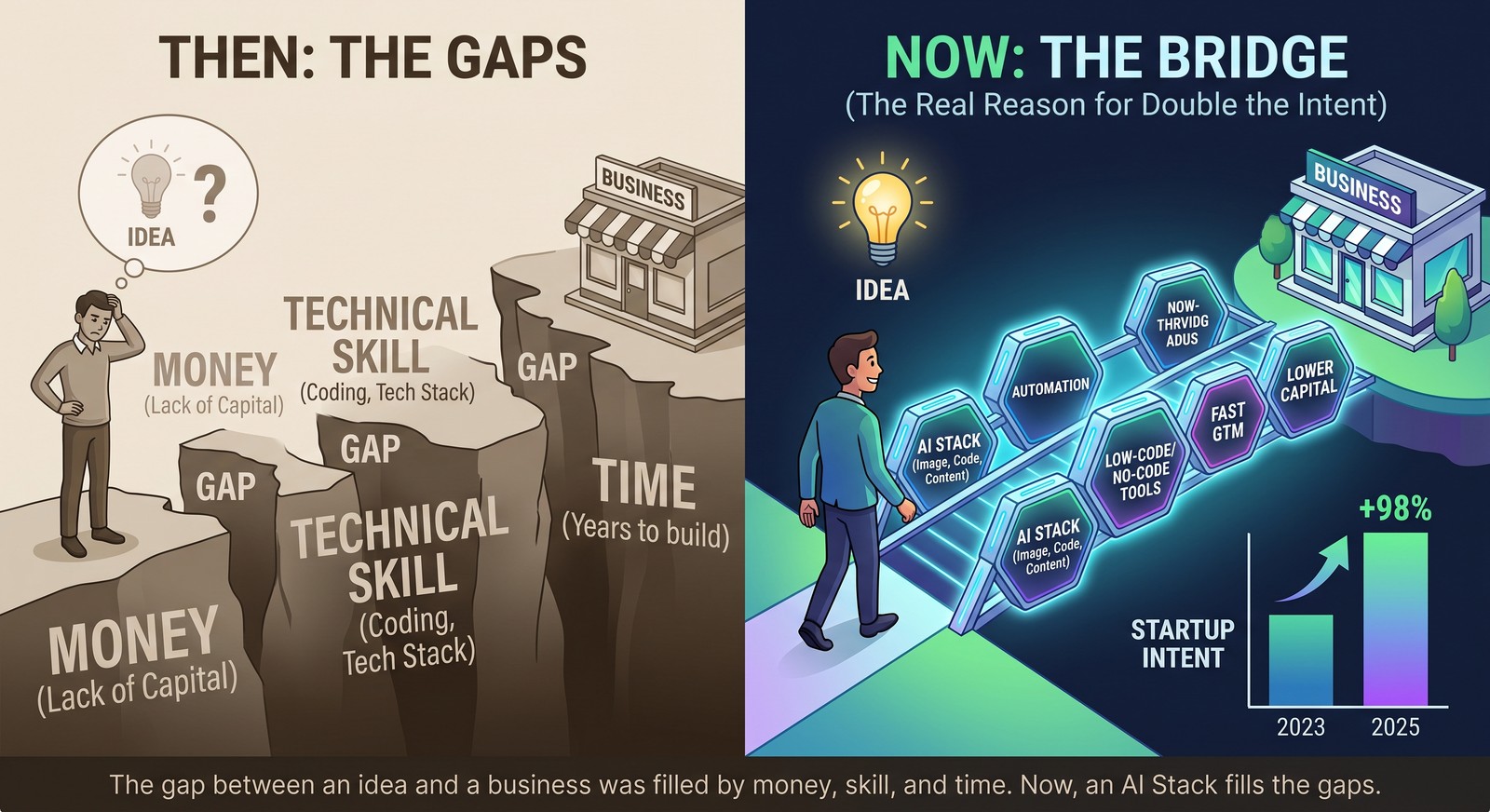
For decades, the gap between “I have an idea” and “I have a business” was filled by money, technical skill, and time. Most people didn’t have enough of any three.
AI compressed all three gaps simultaneously.
You no longer need to hire a copywriter to launch a landing page. You don’t need a developer to build an early prototype. You don’t need a virtual assistant to handle your inbox triage. One person with a decent AI stack can now do the work that used to require a small team.
The barriers didn’t disappear. They shrank to a size most people can climb over alone.
That’s why startup intent jumped. Not because the economy got worse. Because the cost of trying got low enough that “why not” became a reasonable answer.
What the Winning AI Stack Looks Like Right Now
Not all AI tools are created equal. The ones actually driving results in 2026 fall into a pretty clean set of jobs.
For writing and thinking: Claude wins long-form. Gemini wins if you’re deep in Google Workspace. Perplexity wins when you need something cited and researched fast. Use the right one for the right job. Don’t pick one and force it to do everything.
For automation: n8n is the tool serious solopreneurs keep reaching for. It’s not glamorous, but if you can describe a workflow, you can usually build it in n8n without writing a line of code. Connect your forms to your CRM. Auto-route your leads. Build a follow-up sequence that fires without you touching it.
For product prototypes: Lovable and Replit are doing something genuinely useful: turning descriptions into working software. Not perfect software. But working software you can put in front of a customer and get feedback on this week instead of next quarter.
For voice and audio: ElevenLabs has become the default for anyone building anything that talks. Podcast intros. Explainer videos. Customer onboarding narration. If it needs a voice and you don’t want to record one, ElevenLabs is where people are going.
The pattern across all of these: they’re narrow. They do one thing extremely well. The solopreneurs winning right now are combining four or five narrow tools, not betting everything on one platform that promises to do it all.
The Autonomy Trap (and Why Human Supervision Wins)

Here’s a mistake a lot of new AI-powered businesses make: they hand too much over.
Full automation sounds like the dream. Set it up, walk away, collect the results. In practice, it’s how you end up with customer emails that say something you’d never say, or social posts that go out with the wrong context, or lead-gen messages that torpedo your reputation.
The businesses building real traction in 2026 are running human-supervised AI, not fully autonomous pipelines.
AI drafts. AI sorts. AI summarizes. AI flags. Humans review, decide, and send.
This isn’t a limitation. It’s the model. The humans who are best at using AI right now aren’t the ones who’ve removed themselves from the process. They’re the ones who’ve gotten faster at the review step. They touch every important output, they just touch it for five seconds instead of fifty minutes.
If you’re building an AI-powered business, design for supervision, not elimination. You’ll catch more errors, build more trust with customers, and sleep better.
The Quiet Shift Nobody’s Talking About Enough
Underneath all of this, there’s a structural change happening to how people are building income.
The creator economy conversation used to be about going viral, landing brand deals, and scaling an audience. That conversation is aging out.
What’s replacing it: owned income streams. Recurring offers. Audiences you control, not platforms you rent.
The funding data backs this up. More than $1.39 billion moved into creator-focused companies in September 2026 alone, but it’s not going to influencer tools. It’s going to creator commerce, live selling, and AI-powered expert products.
The shift is from attention to ownership. You don’t just want followers. You want customers. You want a list. You want a product people pay for directly, without a platform taking its cut.
This is why the side hustle + AI tools combination is so powerful right now. AI lowers the cost of building owned products. A small email list plus a well-built digital product plus an AI-powered content engine is a real business in 2026, built by one person in their spare time.
The Window Is Open, But It Won’t Stay This Wide
Here’s the uncomfortable part.
Right now, the gap between what AI can do and what most people know it can do is massive. That gap is closing. As more people figure this out, the advantage goes to the ones who moved first and built real skills, real audiences, and real products.
A year from now, this moment will look obvious in hindsight. The same way early email marketing looks obvious now. The same way getting on YouTube in 2012 looks obvious now.
33% of American adults are sensing it. They don’t all know exactly what they’re going to build. But they’re picking up the same signal: the tools are here, the cost is low, and the risk of staying put is starting to outweigh the risk of moving.
The question isn’t whether to start. It’s whether you start while the window is still this wide.
If you found this useful, follow for more on building real businesses with AI tools, written for people who want to own their income, not just their workflow.
Chris Meredith writes about AI, technology, and what it actually means for real people. Follow along on Substack: monkeyattack.substack.com