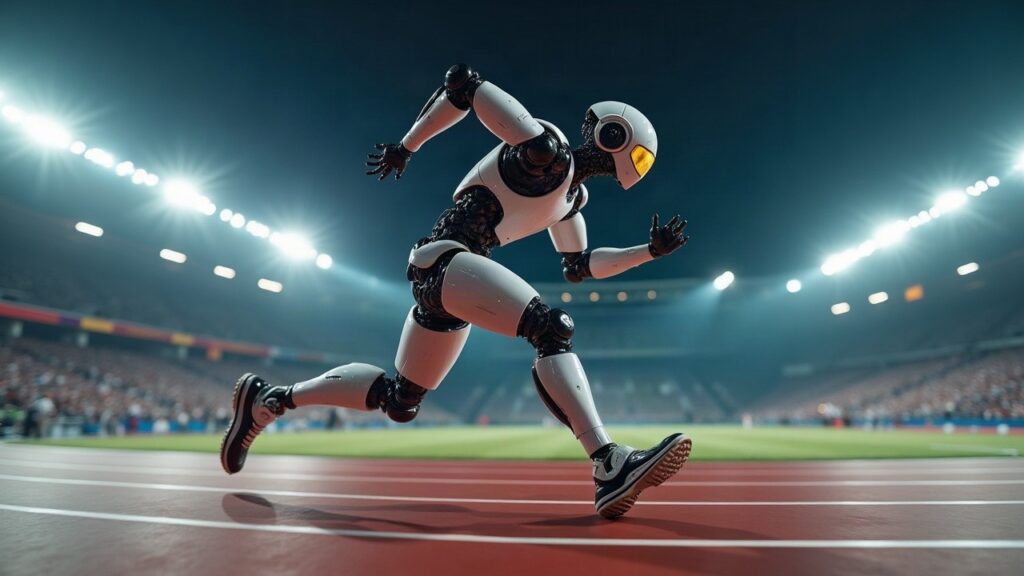
Last month, four world records in track and field were broken in Beijing. The 100 meters. The 400 meters. The 1,500 meters. And the high jump.
Not one of them will appear in the official record books.
The winners were robots, so the sport’s governing bodies have nowhere to put them.
At the World Humanoid Robot Games in late August, a bipedal machine called Tiangong Ultra ran the 100 meters in 8.64 seconds. Usain Bolt, the fastest human in recorded history, did it in 9.58 seconds in 2009. Bolt’s world record stood for seventeen years. Tiangong Ultra beat it by nearly a full second, then broke its own mark twice more in the same five-day event.
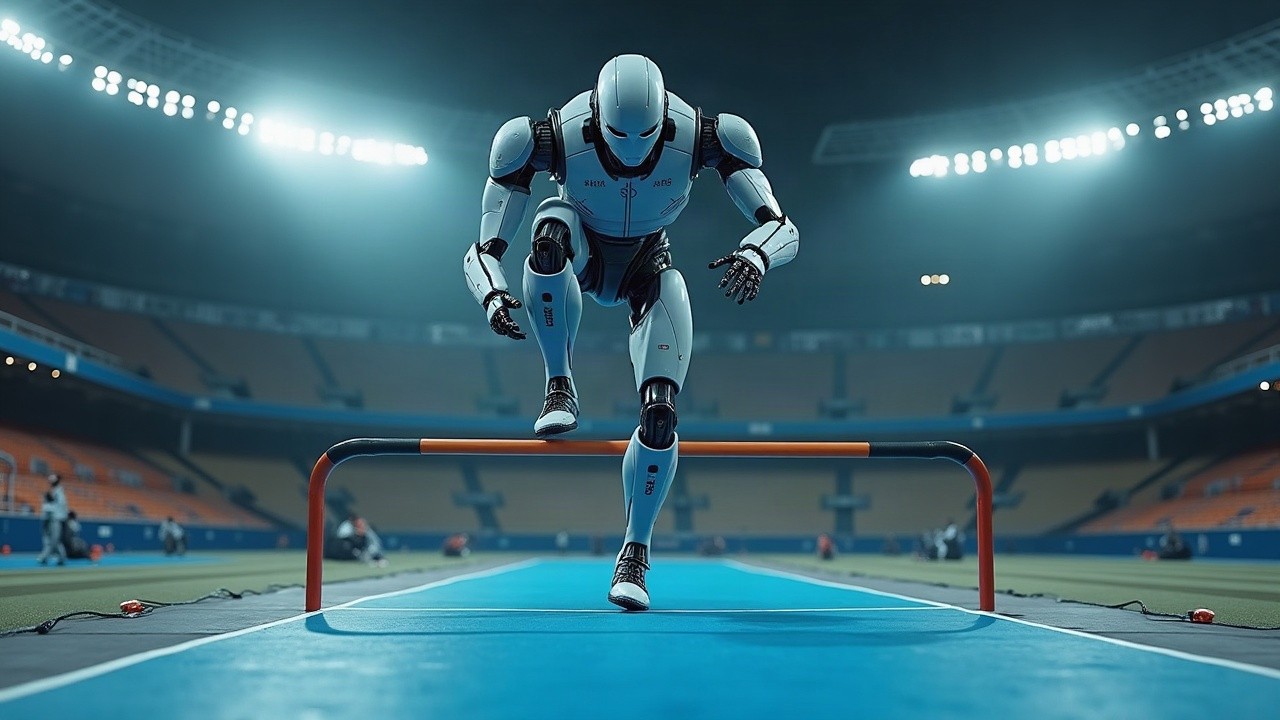
The 400 meters went in 38.15 seconds. The human world record is 43.03. The 1,500 meters went in 2:21.64. The human world record is 3:26.00, set by Hicham El Guerrouj in 1998. The high jump cleared 2.88 meters. The standing human record is 2.45 meters, set by Cuban athlete Javier Sotomayor in 1993. Unitree’s “Superman” robot posted a top speed of 12.66 meters per second, according to the company. Bolt’s recorded peak was 12.4.
The IOC, World Athletics, and every sports governing body on earth has said nothing publicly about what any of it means.
The breathless headline version of this is wrong, and it’s worth getting that out of the way.
These robots did not “beat” human athletes in any competitive sense. They ran in robot-specific categories on a controlled track, built for machines, against other machines. The conditions are not identical. The rules are not the same. World Athletics is not going to scrub Bolt’s name from the books.
The thing is, that distinction is getting smaller every year, and it matters less than people assume.
In 2024, people were still laughing at robot walking clips. The bipedal machines lurched. They stumbled on gentle inclines. You watched Boston Dynamics demos with a mix of amazement and comfort, because the robots looked impressive until they did not, and then they looked ridiculous.
By August 2026, one of them just ran the 100 meters faster than any human ever has.
That is not a small gap closing. That is a threshold being crossed.
The institutional blindspot here is what I keep thinking about.
I spent a few minutes looking for any official statement from World Athletics or the IOC about the robot games. Nothing I could find. Not a dismissal. Not a position paper. Not even a spokesperson saying “interesting, but not our jurisdiction.” Nothing from the bodies that exist specifically to define human athletic achievement.
That silence is the story.
Sports federations were not built for this. Their entire architecture, the records, the categories, the rankings, the qualifying standards, assumes the competitor is human. What happens when the fastest sprinter alive is not eligible to compete in any recognized event? You get a category error that nobody in power wants to address, because addressing it forces a conversation about what athletic achievement is actually for.
Is it for celebrating what humans can do? Then robot records are irrelevant and the games are a curiosity.
Is it for measuring the outer limits of bipedal locomotion? Then Tiangong Ultra is the current champion of that, and the records belong to it.
Most people have not thought about which answer they actually believe. The moment they do, things get complicated fast.
The Vision Times ran a headline I have not been able to stop thinking about: “Faster Than Usain Bolt, but Still Learning to Stop.”
That is not a metaphor. Deceleration is genuinely hard for humanoid robots. Tiangong Ultra can cover ground faster than any human but braking cleanly remains an engineering challenge. The machines that broke these records cannot yet play basketball, navigate a crowded sidewalk, or compete in an obstacle course the way a reasonably fit adult can.
This is the honest version of where we are. Not “robots are now superhuman.” Not “human athleticism is obsolete.” The real picture is weirder and more interesting: we have built machines that are superhuman in narrow, specific ways, while remaining substantially below human capability in almost everything else.
The 100 meters is simple. Go straight, as fast as possible, on a flat surface, for ten seconds. That is almost the perfect task for a machine to master first, because it eliminates variables. No reading of a defense. No unpredictable opponent. No changing terrain. No need to stop gracefully.
The fact that robots conquered this specific task first is not surprising if you think about it for thirty seconds. It is almost exactly what you would design for if you wanted to build a robot that looked impressive before it was actually useful.
None of which makes what happened in Beijing unimportant. I just think the important thing is different from what most coverage is focused on.
The sprint record is a marketing milestone. It tells you something about what Chinese robotics companies can build for a controlled showcase event. It does not tell you much about when robots will replace warehouse workers or home health aides or construction crews.
What it does tell you is this: the development curve has moved from the theoretical phase into the visible phase. You can now watch a video of a robot beating Usain Bolt’s world record. That makes it real in a way that lab demos and research papers do not.
I have watched a lot of technology transitions. The moment when a thing stops being a talking point and starts being something you can see with your own eyes is different. It changes how people think about timelines. It changes what seems plausible.
Five years ago, if you told someone that a bipedal robot would run the 100 meters faster than any human in history, you would have sounded like you were describing science fiction. Last month it happened in a stadium, on camera, multiple times, with journalists in attendance.
The audience’s mental model of what robots can do just shifted. Not because robots can suddenly do everything, but because the gap between “what we imagined robots would do” and “what robots are actually doing” just closed in one very specific, very photogenic way.
The Olympics question is not going to stay hypothetical much longer.
World Athletics will have to decide what it wants to be. Either it is the governing body for bipedal locomotion as a physical challenge, in which case robot competitors are relevant. Or it is the governing body for human athletic competition specifically, in which case it needs to say that clearly, and explain why.
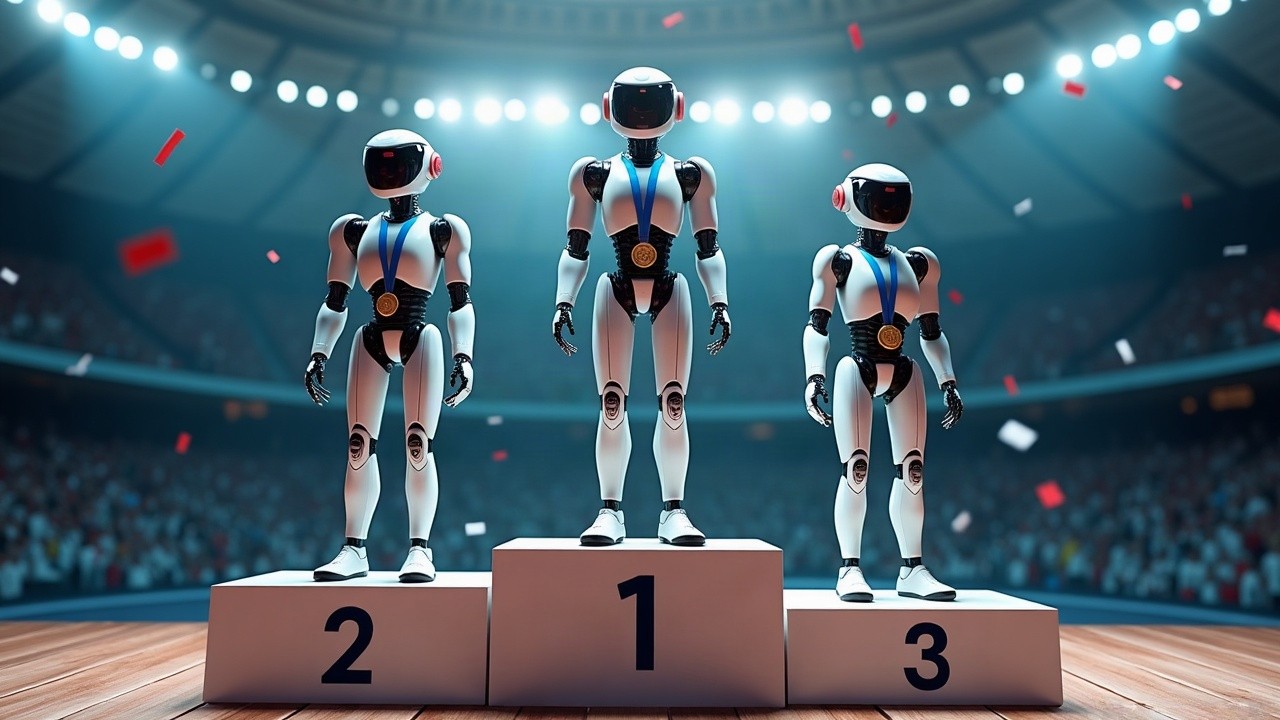
Neither answer is wrong. Both answers have consequences. The first turns athletics into a weird hybrid sport where the machine podium exists in parallel with the human podium. The second draws a bright line around human achievement that becomes philosophically harder to defend every time a robot breaks another record by a wider margin.
I would bet on the second answer winning for now, because institutions almost always choose the option that requires the least immediate change. But “for now” is doing a lot of work in that sentence.
At the current pace, there is no obvious floor to how fast these machines will get or how much more capable they will become. Today the robots are better at straight-line sprinting and worse at almost everything else. Give it five years.
I do not think the Olympics is the real story here. Sports records are a proxy for something bigger: we are in the early phase of machines becoming physically superhuman, in narrow ways, on a compressed timeline.
The sprint record is the easy-to-understand version of a harder question. When machines can do more than humans, physically, what do we value about human physical performance? When machines can think better than humans in certain domains, what do we value about human intelligence?
Those are not rhetorical questions. The answers are going to shape education, labor markets, culture, and policy for the next generation.
Tiangong Ultra just ran 8.64 seconds. Nobody put it in the record books. But everyone who saw it thought about what comes next.
That is the part that matters.
Chris Meredith writes about AI, technology, and what it actually means for real people. Follow along on Substack: monkeyattack.substack.com