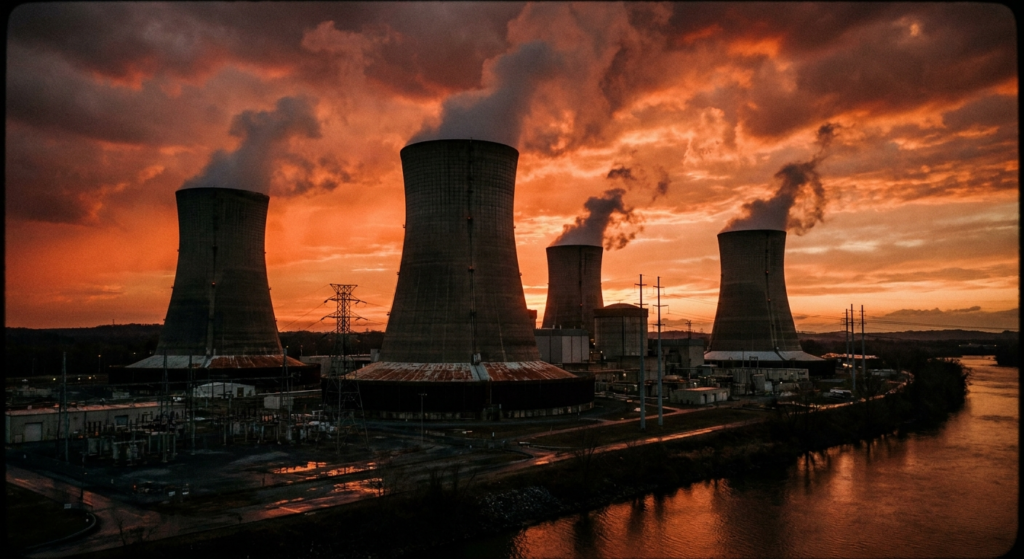
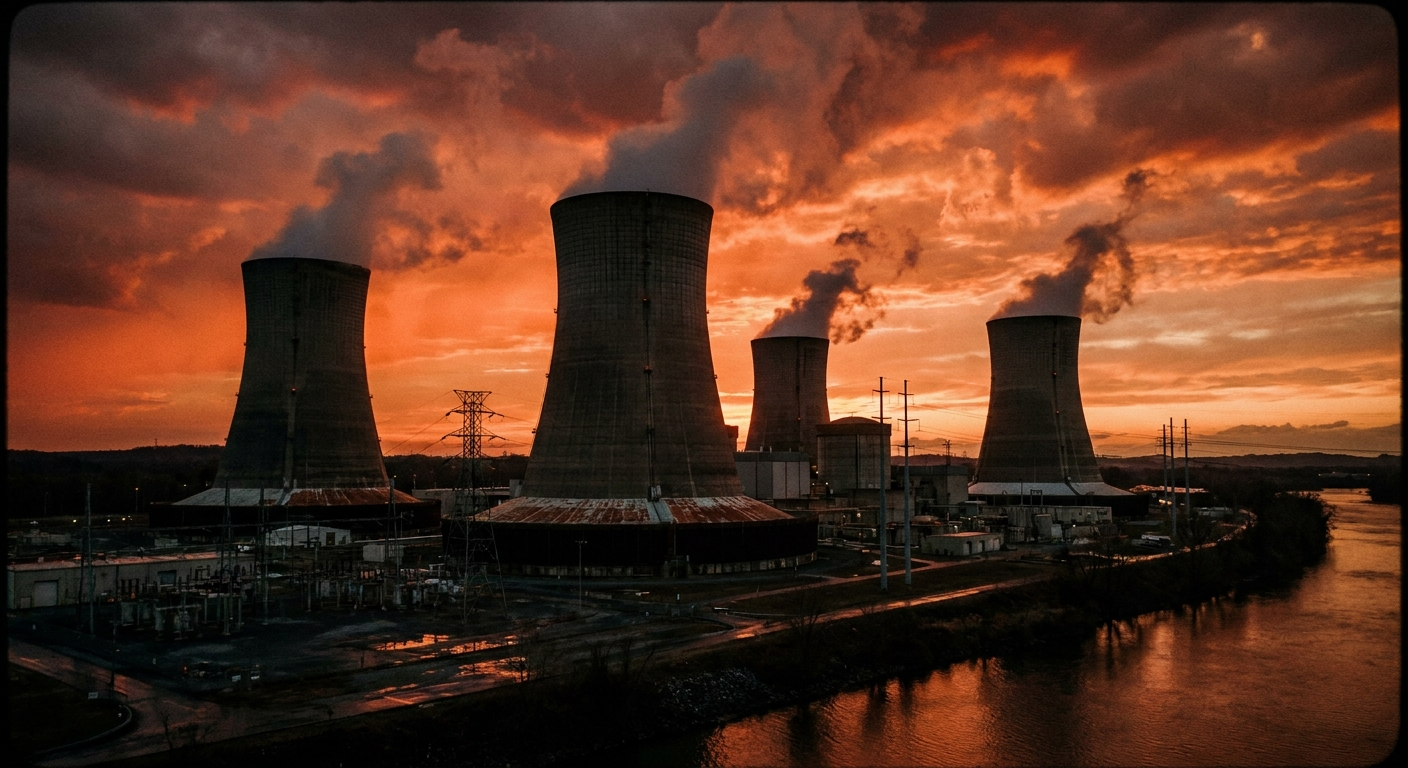
There are two reactors at Three Mile Island.
Unit 2 is the one you have heard of. It partially melted down in 1979 and has sat permanently shut ever since. It will never produce electricity again.
Unit 1 is different. It ran safely alongside Unit 2 for 45 years, was closed in 2019 for entirely economic reasons, and sat idle for five years while the site’s name kept doing the cultural work of the disaster that happened at the other end of the campus.
That reactor, the one that just needed a buyer, is the one Microsoft agreed to restart.
Not to power Philadelphia. Not to light up homes across the mid-Atlantic. To run AI.
The Crane Clean Energy Center, as the rebranded plant is now called, will send its first electrons to data centers by 2027 under a 20-year power purchase agreement. The financial terms of that contract were never publicly disclosed. What was disclosed is why it exists: Microsoft’s AI infrastructure has an appetite that the public grid cannot satisfy. So Microsoft went around the public grid entirely.
They are not alone.
The Grid Math Does Not Work
Here is the problem in plain numbers. US data centers consumed roughly 31 gigawatts of power in 2025. By 2027, that number is projected to reach 66 gigawatts. In two years, the industry’s power draw will more than double. AI-specific hardware already accounts for 31 percent of data center electricity consumption, and that share is climbing every quarter.
Goldman Sachs estimates that AI data center electricity demand will grow 165 percent by 2030. Power prices near hyperscale facilities have already surged 267 percent. The grid interconnection queue, the wait time to connect a new power source to the public electricity network, currently averages around five years in the US, and stretches to eight to ten years for projects that require major new transmission infrastructure.
Five to ten years. A company building AI infrastructure today cannot wait that long for power. The products they are racing to build will be obsolete. The competitors will have lapped them twice.
So the largest technology companies on earth made a decision: build a parallel power system.
The Private Nuclear Grid
Meta has committed to up to 6.6 gigawatts of nuclear capacity, spread across deals with TerraPower, Oklo, Vistra, and Constellation. To put that in context, 6.6 gigawatts is roughly the output of six large conventional nuclear plants. Meta, the company that makes Instagram and Facebook, is now one of the largest nuclear energy customers in the world.
Google signed agreements for 500 megawatts of power from Kairos Power’s next-generation reactors. Amazon anchored a multi-investor $700 million funding round in X-energy for a fleet of small modular reactors and has separately signed nuclear-linked power agreements for major AI campus development.
Across the hyperscalers, industry analysts estimate combined nuclear commitments approaching 10 gigawatts of capacity. Most of the individual contract terms are not publicly filed, which makes precise aggregation difficult. What the individual announcements confirm, taken together, is that the four major players, Microsoft, Google, Amazon, and Meta, are buying nuclear power at a scale the industry has not seen from the private sector in decades.
None of it flows through your utility. None of it is subject to your state’s public utilities commission. It exists in a parallel system, purpose-built for machines.
What “Small Modular Reactor” Actually Means
Most of these deals involve a technology category called small modular reactors, or SMRs. The pitch is straightforward: instead of one massive 1,000-megawatt reactor requiring a decade to build and $10 billion to finance, SMRs are factory-built units in the 50 to 300 megawatt range that can be shipped and assembled on-site in a fraction of the time.
The reality is more complicated. As of mid-2026, no SMR has achieved commercial operation anywhere in the Western world. China’s Linglong One is the furthest along globally, completing non-nuclear testing and working toward grid connection, but has not yet achieved criticality. In North America, the earliest projected commercial SMR, Ontario Power Generation’s BWRX-300, targets 2029. The US has yet to issue a construction license for any SMR design, though applications from GE Hitachi and X-energy are moving through the Nuclear Regulatory Commission.
The technology that Big Tech is betting on, at a scale of nearly 10 gigawatts and hundreds of billions of dollars in commitment, has never been commercially operated in North America.
That is not necessarily a reason to doubt it. Every technology has a first commercial deployment. But it is a reason to understand what the industry is actually doing here: betting at civilizational scale on a technology that has not yet proven itself in the markets they need it in.
The Part Nobody Is Saying Out Loud
I want to sit with something for a moment, because I think it gets glossed over in most coverage of this story.
The United States is watching its largest corporations quietly construct a private energy infrastructure, financed by AI profits and structured to bypass the public utility system that the rest of the country depends on. The grid that powers your home, your hospital, your school, was built over a century as shared public infrastructure. It is regulated, rate-controlled, and theoretically accountable to the people it serves.
The AI grid is none of those things.
This is not a conspiracy. It is the logical outcome of a calculation. Public grid interconnection takes years. The AI race waits for no one. Private nuclear contracts close in months. So the calculation made itself.
There is a version of this story where that is actually good news. The strongest counterargument goes like this: private capital is building nuclear capacity faster than any public process could, at no cost to taxpayers, using carbon-free fuel, in a country that desperately needs more baseload power. If AI companies had to wait for public grid expansion, they would run on natural gas instead. The private nuclear route is faster, cleaner, and self-financing. Public infrastructure benefits indirectly when AI companies stop competing with residential demand on the public grid. Maybe the question is not whether this is bad, but whether we can extend its logic to everyone.
It is a real argument. I hold it seriously. But it sidesteps the structural question, which is not about whether private nuclear is better than natural gas. It is about what happens to the shared system over time when its highest-value participants leave it.
But it raises questions that are not being asked loudly enough. What happens to the public grid when the largest electricity customers exit it? What happens to rate structures when corporate demand stops subsidizing residential pricing through shared infrastructure? What happens when the energy infrastructure that runs AI is as private, and as opaque, as AI itself?
The answer is already visible in Virginia. Dominion Energy grid zones in Northern Virginia now dedicate more than 28 percent of their electricity to data centers, with some regional estimates running higher. Data center demand has become the dominant variable in Virginia utility planning. Residents are watching their electricity bills rise as capacity costs get shared across a shrinking base of residential users, while the largest consumers lock themselves into private contracts that never touch the public bill.
The nuclear pivot accelerates that dynamic. It removes demand from the shared system, which sounds like relief but functions as abandonment.
The Speed of the Thing
What strikes me most about this story is not the scale. It is the speed.
Three years ago, the idea that Microsoft would restart a reactor at Three Mile Island would have read as satire. Two years ago, the idea that Meta would become one of the world’s largest nuclear energy customers would have required a caveat. Today it is a Tuesday press release.
The AI energy crisis arrived faster than energy infrastructure cycles can accommodate. Power plants are built on 20-year timelines. Grid interconnection moves on multi-year schedules. AI capabilities are compounding on 12-month cycles. The mismatch is structural, and the private nuclear grid is the industry’s answer to a structural problem.
It might even be the right answer, in the narrow technical sense that it works. Nuclear power is carbon-free, reliable, and dense. Restarting existing plants and building new modular ones alongside AI campuses could, in theory, produce a relatively clean power supply for a sector that would otherwise be running on natural gas peakers to keep up.
But “technically works” and “socially sound” are different questions. And the second question is not getting asked in proportion to the first.
What to Watch
If you want to track how this plays out, here are the signals that actually matter.
The first is whether TMI Unit 1 actually delivers power in 2027. That contract is the bellwether. If Microsoft’s Crane Clean Energy Center runs on time and on budget, it will validate the entire hyperscaler nuclear strategy and accelerate commitments across the industry. If it slips, the ripple effects hit billions in downstream planning.
The second is NRC progress on SMR licensing. The reactors Meta and Google are counting on for the 2030s need US regulatory approval that does not exist yet. Any significant delay resets the math on the entire SMR layer of these deals.
The third is state-level reaction. Utilities commissions are starting to notice that their largest commercial customers are building off-grid infrastructure. Some are beginning to ask whether that is permissible, and what the rate implications are for everyone left on the public system.
The fourth is the energy bill at your house. If you live in a data-center-dense region and your electricity costs have risen faster than inflation in the last two years, you are already inside this story. You just were not told it was about AI.
Unit 2 is still there, across the site from the reactor Microsoft is bringing back. It will never run again. Unit 1, the one that just needed a buyer, will be back online in 2027, processing requests for an AI model at a server farm somewhere, in the building shadow of the cooling tower that made nuclear power infamous in America.
The irony is real. So is the reactor.
Chris Meredith writes about technology, artificial intelligence, and the systems humans build that outlast their original intentions.
Chris Meredith writes about AI, technology, and what it actually means for real people. Follow along on Substack: monkeyattack.substack.com