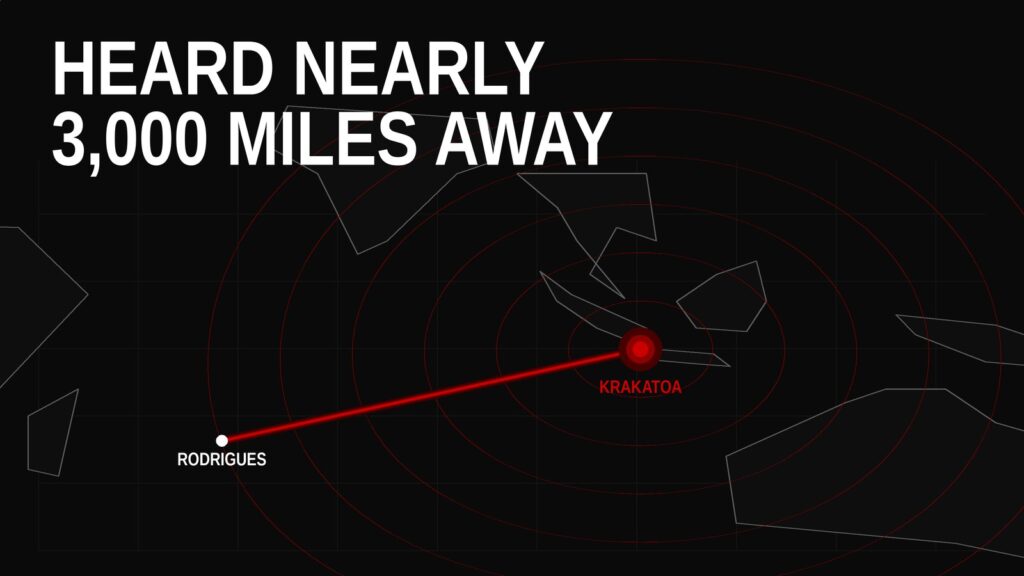
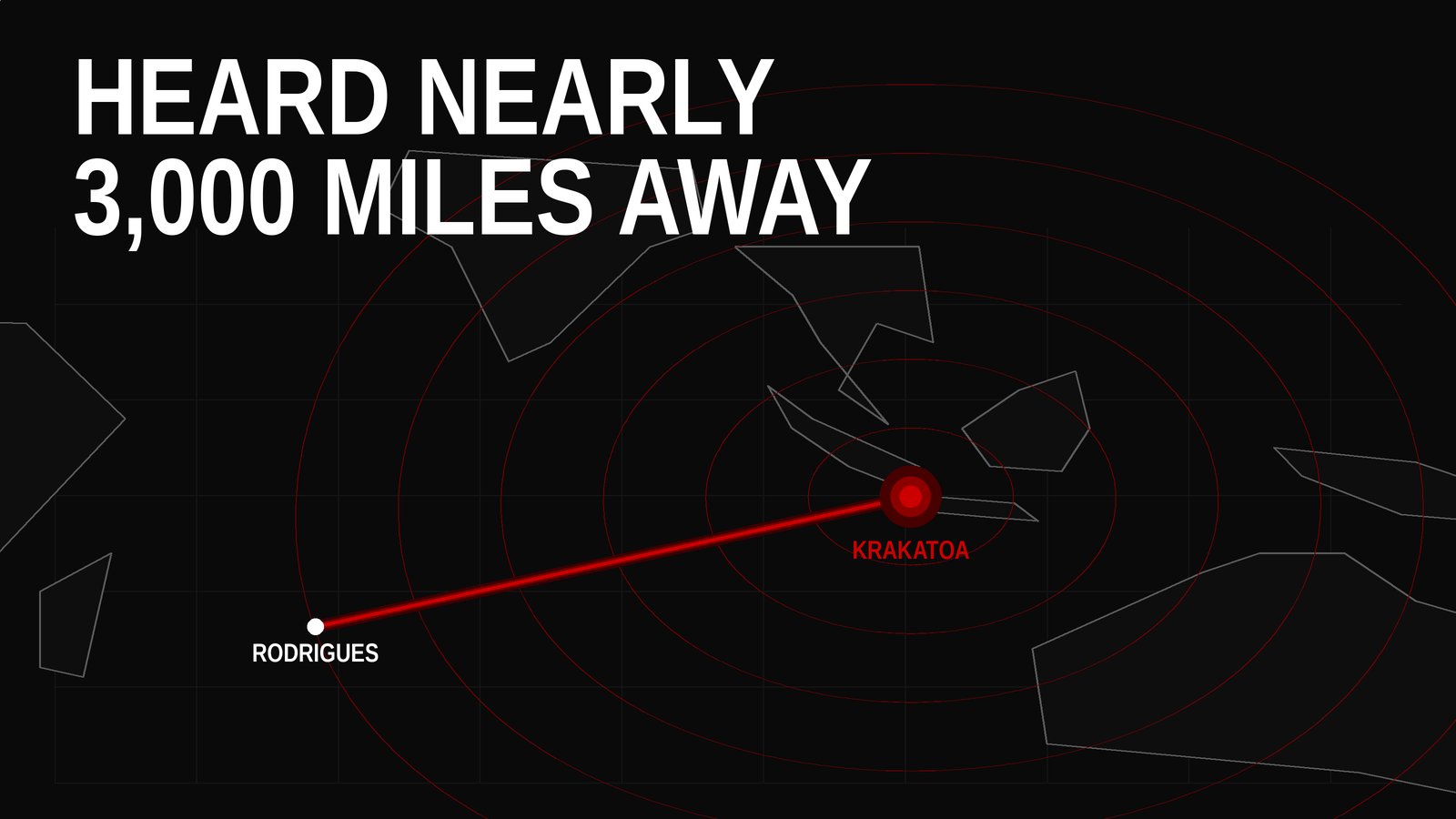
James Wallis was chief officer of police on Rodrigues, a small island near Mauritius. On the night of 26 August 1883 he wrote down noises coming from the east. The weather was stormy, with heavy rain and a south-east wind. His account, printed in the Royal Society’s report, says “reports were heard coming from the eastward, like the distant roars of heavy guns,” repeating “at intervals of between three and four hours” until three the next afternoon. [R1888] The Royal Society’s committee put the sounds down, very probably, to Krakatoa. That volcano was nearly three thousand miles to the east, across the Indian Ocean. [R1888]
Later writers have gone further. One of them calls the eruption possibly “the loudest noise the Earth has ever made.” [NAUT] Notice the “possibly.” The committee was just as careful.
The eruption
Krakatoa sits in the Sunda Strait between Java and Sumatra, in what was then the Dutch East Indies. [NAUT, WIKI] It gave warning first. On 20 May 1883, booming sounds like artillery were heard at Batavia and Buitenzorg, nearly a hundred miles away. Doors and windows rattled for many hours, and on a mail steamer passing through the strait, the compass needles were violently agitated. [R1888]
The main event came on the morning of 27 August. The report lists four great explosions, at 5:30, 6:44, 10:02 and 10:52. [R1888] The biggest came around ten o’clock, though the report’s own authors disagree on the minute: one section says 9:58 local time, another 10:02. [R1888]
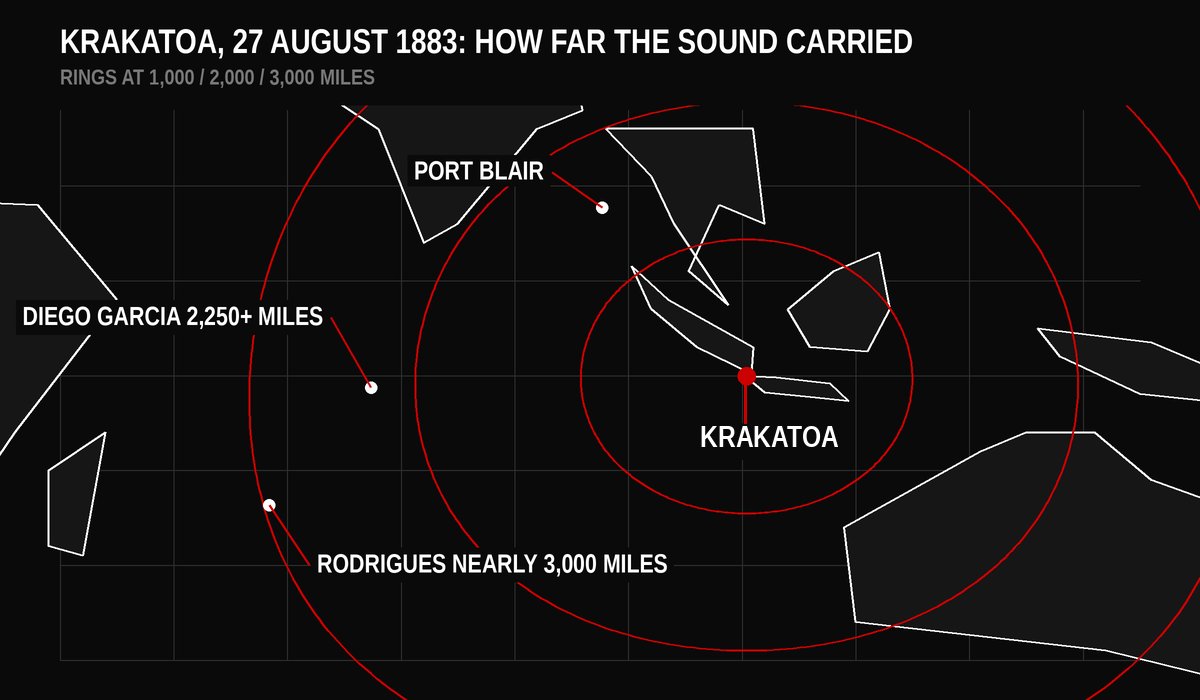
The committee also estimated how far the sound carried. The area where it was heard covered “rather less than one-thirteenth of the entire surface of the globe.” [R1888] Close to the volcano, though, the sound faded. At many nearby places it stopped being heard soon after ten in the morning, and the report’s “very probable” explanation is a screen of solid matter in the air, dense enough that the sound waves couldn’t get through. [R1888]
Farther out, people misread it. At Diego Garcia, more than 2,250 miles away, the sounds were taken for “guns fired by a vessel in distress,” and people at Port Blair in the Andaman Islands believed the same. At Dorey in New Guinea, the sounds were clearly heard and recorded at the time, long before anyone knew the cause. [R1888]
Rodrigues was the farthest of all. The report calls it “the only instance on record of sounds having been heard at anything like so great a distance from the place of their origin.” It also notes the sound carried much farther west of Krakatoa than east. [R1888]
How loud was it?
Not in decibels, at least not in 1888. The report records pressure changes on barometers and gauges. Later writers converted those readings. Aatish Bhatia, in a 2014 Nautilus article, arrives at over 172 decibels about a hundred miles away. The Royal Society’s own blog, in 2024, cites an estimated 180. [NAUT, RSBLOG] Both are estimates, and they disagree.
What the committee did record is physical. At Batavia, about a hundred miles off, “Lamps were thrown down, gas-jets extinguished, and a gasometer, under the influence of one of these great waves, leaped out of its well.” Windows burst and walls cracked, and all accounts, the report says, blamed the air itself, not an earthquake. [R1888]
The wave that went around
Past the range of human ears, something else was travelling: a pulse in the air pressure you couldn’t hear but could measure. Photographic barometer records from Bombay, Melbourne, Mauritius and the observatories of Britain all caught it. [R1888]
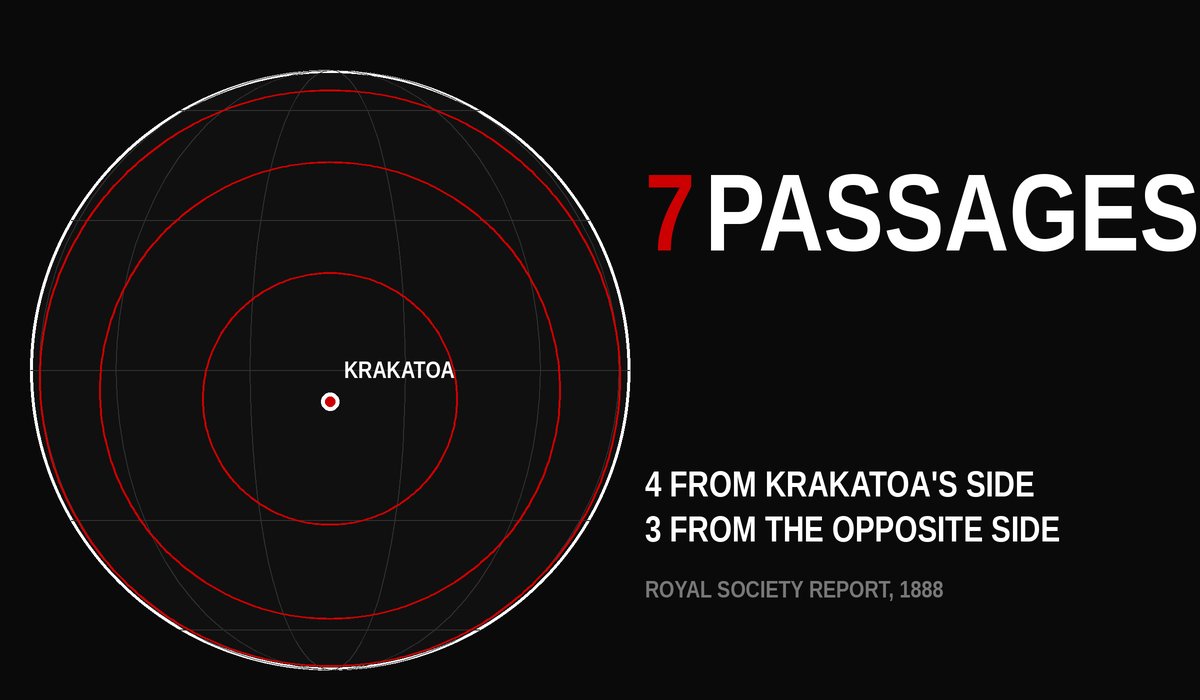
The committee concluded that there were seven passages of the wave, seen at many stations “not fewer than seven times.” Four came from Krakatoa’s side and three from the opposite side of the planet, and one trip around took about thirty-six hours. The report put the speed between 674 and 726 miles an hour. Sound in air at fifty degrees Fahrenheit travels at 757, and the report says the pulse had very nearly the velocity of sound. [R1888]
How many times did it go around? The counts vary. The report’s own tally is seven passages. Nautilus says the pressure waves circled the globe three to four times in each direction, and Wikipedia says three and a half. [R1888, NAUT, WIKI]
What the report actually says
Popular versions say the guns at Rodrigues were the big final explosion. The report is more careful. In its summary, it says there is no direct evidence that the great final explosion was heard at any considerable distance. It does say that the sounds of some of the explosions were heard at very great distances, and it puts Rodrigues at “probably.” [R1888]
Wallis’s reports ran from the night of the 26th until three in the afternoon on the 27th, a longer stretch than the four morning explosions. He gives intervals rather than clock times, so his account alone doesn’t say which explosions he heard. What the report supports is that some of them were probably heard almost three thousand miles away. [R1888]
The committee also threw one claim out. A communication to the French Academy of Sciences, published in March 1885, described sounds said to have been heard in the Cayman Islands on 26 August 1883 and blamed on Krakatoa. The report called that evidence “of so indefinite a nature” that it wasn’t put in the table. [R1888]
On why the sound travelled so much farther west, the committee’s most probable answer is that the lower air in the Trade Wind region was moving westward, and Rodrigues lies inside it. [R1888]
The committee
The early news from the strait was, in the report’s words, “quite misleading.” The shore towns had sat in darkness for many hours and were then overwhelmed by great sea waves, and the survivors weren’t in a position to make trustworthy observations. [R1888]
The cost in lives was far larger than any sound. The report counts 36,380 people lost to the waves that struck the strait’s coasts. The Dutch figure is 36,417, and some estimates run above 120,000. The true number is uncertain. [R1888, NAUT]
On 17 January 1884, the Royal Society’s Council resolved to set up a committee to “collect the various accounts of the volcanic eruption at Krakatoa, and attendant phenomena.” George Symons, a meteorologist, chaired it and put out a public appeal. Letters and postcards arrived from across the world, and some reports came from ships. [R1888, GAC]
People wrote about more than the sound. Vivid red and orange sunsets followed across the world, and the report includes six colour lithographs of sunsets sketched from the Chelsea Embankment. [GAC, RSBLOG]
The report came out in 1888, five years after the eruption, and its opening section calls the event “perhaps without a parallel in historic times.” [R1888, GAC] Even so, the committee that printed Wallis’s account would say only that the sound was probably heard at Rodrigues, which is a long way short of the famous version, and that version runs louder than the evidence does.
Read it yourself
The full 1888 report is free on the Internet Archive: archive.org/details/eruptionofkrakat00roya. Search “The Eruption of Krakatoa and Subsequent Phenomena,” open the section on the sounds, and read Wallis’s account in full.
Watch the video on Phantom Findings: Krakatoa 1883 on YouTube. Tell us in the comments which fact you want checked next.
Sources
Quotes and numbers here come from the Royal Society’s 1888 report on the eruption, edited by G. J. Symons [R1888]. Aatish Bhatia’s Nautilus article from 26 Sep 2014 [NAUT] and the Royal Society’s 2024 blog post “Crowdsourcing Krakatoa” [RSBLOG] supply the decibel estimates. A Google Arts & Culture page on the eruption [GAC] backs the committee’s origins and the sunset lithographs. Wikipedia [WIKI] was only used to cross-check.
Chris Meredith writes about AI, technology, and what it actually means for real people. Follow along on Substack: monkeyattack.substack.com