Most people type between 40 and 60 words per minute. Most people speak between 130 and 150. That 3x gap sat unexploited for the entire history of the personal computer, because dictation software used to be bad enough that fixing the errors cost more time than it saved.
That is no longer true. Leading speech models run under 7% word error rate in production, and languages that were badly served a few years ago have crossed 96% accuracy. The technology worked out. What did not is a less glamorous question almost nobody asks before installing a dictation app: when you talk to your computer, where does your voice actually go?
The naming mess, cleared up
Three product names get conflated constantly, and untangling them makes the rest of the landscape legible.
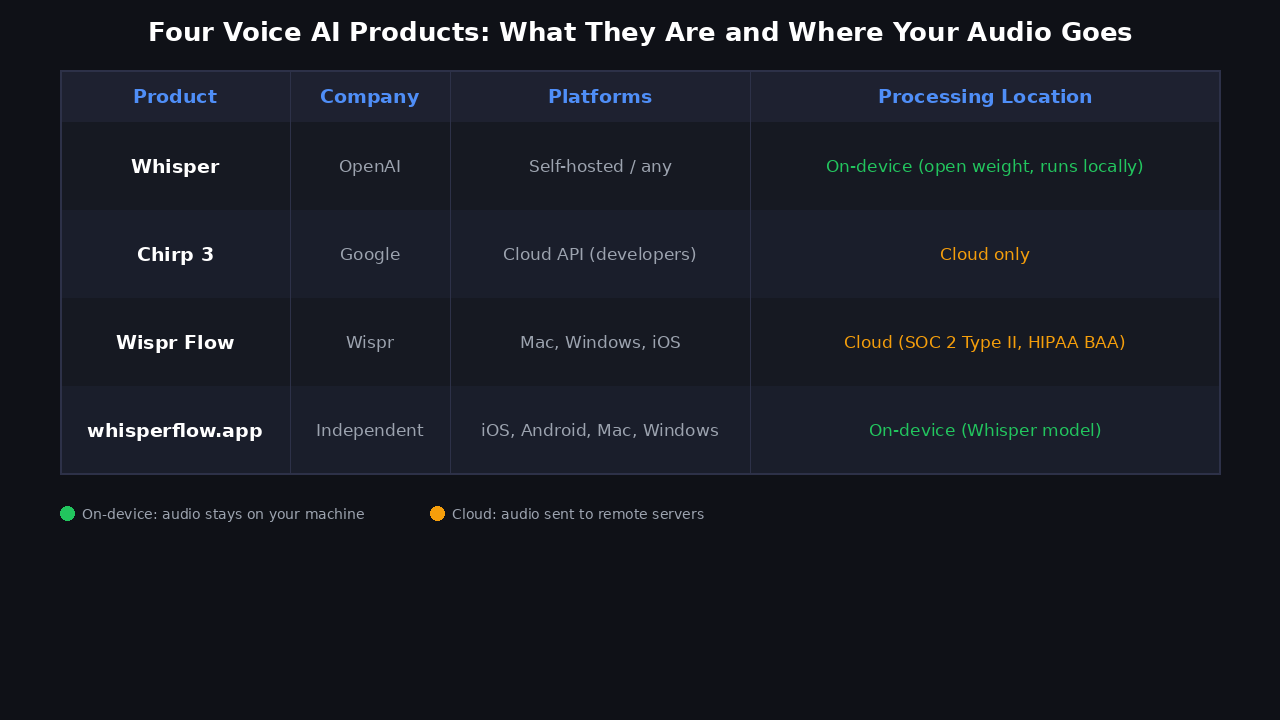
Whisper is OpenAI’s speech recognition model. It is open weight, so anyone can download it and run it on their own hardware without paying per minute. Whisper Large V3 and its faster sibling V3 Turbo power a large share of third party transcription apps.
Chirp 3 is Google’s speech API: 125 languages and change, speaker diarization, denoising, streaming, cloud only. Google does have consumer on-device features elsewhere in its lineup: Pixel Recorder transcribes locally on Pixel phones, and Gboard’s advanced voice typing keeps audio on-device on Pixel 9 and later. But Chirp 3, the product that competes with Whisper and other developer speech APIs, is cloud by design.
Wispr Flow is neither of those. It is an independent app from a company called Wispr, at wisprflow.ai, for Mac, Windows, and iOS. It is not a Google product and it does not use Chirp. Separately, whisperflow.app is a smaller app with a confusingly adjacent name, running the open weight Whisper model locally on iOS, Android, Mac, and Windows.
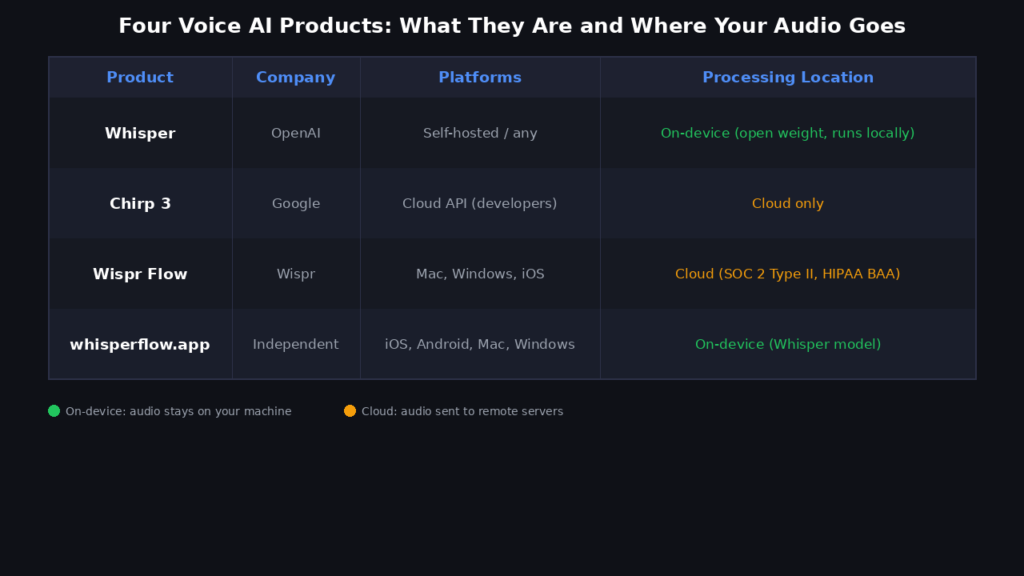
Four names, four companies, three architectures. Worth ten seconds before you hand any of them a microphone.
What “on-device” is supposed to mean
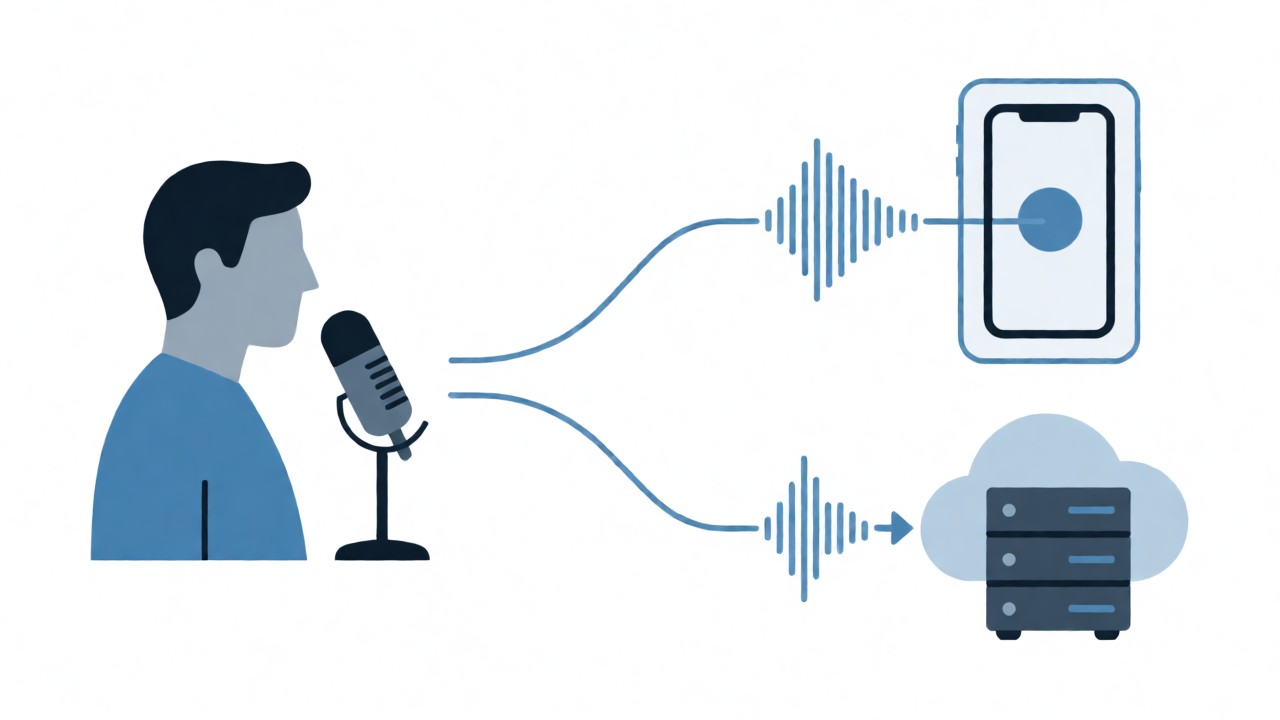
On-device processing means the audio never leaves the machine. The model runs on your own silicon, produces text locally, and no network request carries your voice anywhere.
Apple’s built-in dictation is the clearest large scale example. On Apple Silicon it runs through the Neural Engine locally for most languages, going to the cloud only for rarer ones. With iOS 26 and macOS Tahoe, Apple opened this to developers through the SpeechAnalyzer API, and Apple claims the new system is 55% faster than Whisper Large V3 Turbo. That figure comes from Apple’s own materials and has not been independently verified, so treat it as a vendor claim, not a benchmark.
Superwhisper is the stricter case: Mac only, fully on-device, explicitly no network transmission of audio. It costs $249.99 as a lifetime purchase, holds a 4.9 out of 5 on Product Hunt, and won a Privacy Award in Winter 2025. whisperflow.app makes the same local claim across more platforms, and anyone technical enough can self-host Whisper outright.
On the other side of the line, Wispr Flow routes audio through OpenAI plus a fine-tuned Llama model in the cloud. To its credit it carries SOC 2 Type II, ISO 27001, and will sign a HIPAA business associate agreement, real compliance work many competitors have skipped. Reception is split, 4.7 out of 5 on Product Hunt against 2.7 on Trustpilot. But it is a cloud service, and some of its positioning has left users with the opposite impression. Google Chirp, the OpenAI API tiers, and Amazon Transcribe are cloud by design and say so.
The narrow definition problem
In November 2025, someone reverse engineered a dictation app called Typeless and found its “on-device” marketing described where transcription *history* was stored. The audio itself was routed to AWS. Nothing in the marketing was technically a lie. The words just meant something much smaller than a reasonable person would assume.
“On-device” has no certification behind it and no agreed definition. It can describe the model, the storage, the cache, or the settings sync, and only one of those is the thing you care about. An app can say it truthfully while your voice travels to a data center on every keystroke you skip.
Accuracy stopped being the excuse
The old defense of cloud processing was straightforward: big models need big machines, and the accuracy gap justified the tradeoff. That defense has expired. Leading speech models now run under 7% word error rate in production, and self-hosted Whisper trades shots with cloud offerings for common languages and clean audio.
Cloud still wins in places. OpenAI’s GPT-4o-transcribe, released in March 2025, beats Whisper on several benchmarks, though it does worse on long-form financial content, and the GPT-Realtime-Whisper streaming API arrived on May 7, 2026, for latency sensitive work. Chirp 3’s language coverage is not something a local model matches. But for one person dictating notes or email in a common language, the quality argument for sending audio off the device is gone.
Who this actually matters for
For a lot of people, honestly, it does not. If you dictate grocery lists, cloud transcription is fine.
For others it is not a preference, it is a legal boundary. Healthcare, legal, and government work often cannot route audio containing protected information to external servers at all. That constituency was locked out of voice input entirely until local models got good enough. More than 20% of vendors now offer on-device processing because of data exposure concerns, and the on-premise speech market is growing 22.71% annually through 2031.
The money confirms the direction. AI speech-to-text was a $4.5 billion market in 2024, projected at $19.2 billion by 2034. Voice agent usage grew 9x in 2025, and 67% of the Fortune 500 run production voice AI. That is a lot of audio moving through a lot of infrastructure, and most of the people generating it have never checked which infrastructure.
How to check before you install
Does the vendor say the audio never leaves the device, or just that something does not? Look for an explicit statement about the audio stream, not about history, storage, or settings. Vague phrasing is usually deliberate.
Does it work with the network off? The test that cannot be spun. Turn off wifi, dictate a paragraph, see what happens. A local model does not care.
If it is cloud, does it carry real compliance? SOC 2 Type II, ISO 27001, a signed BAA if you handle health data. Cloud is not disqualifying. Cloud with no audited controls is.
Do you need what the cloud is better at? Rare languages, diarization, streaming at scale. If you do, pay the privacy cost knowingly. If not, you are paying it for nothing.
The speed advantage is real and it is large. Just know the route your voice takes to get there.
Chris Meredith writes about AI, technology, and what it actually means for real people. Follow along on Substack: monkeyattack.substack.com