And the White House thinks this is exactly what education needs.
In April 2025, President Trump signed Executive Order 14277: “Advancing Artificial Intelligence Education for American Youth.” The order created a White House Task Force on AI Education, directed the Department of Education to fund AI teacher training, and called for a Presidential AI Challenge for students. The message was clear: AI is coming to your kids’ school, and the federal government is going to make sure of it.
Fast forward to summer 2026. A rural school district on the Seneca Nation reservation in western New York decided to take that mandate seriously.
Meet Sally.
Who Is Sally?
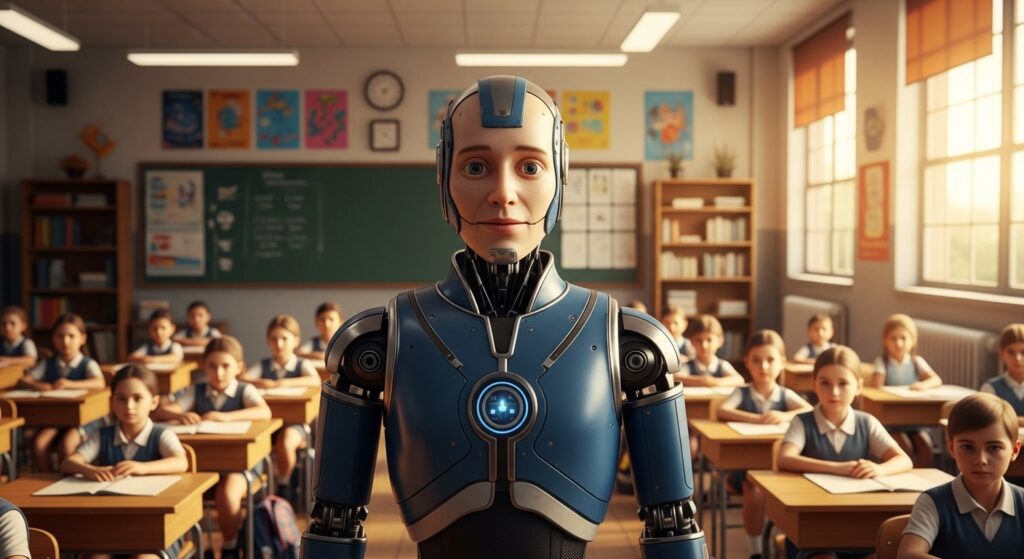
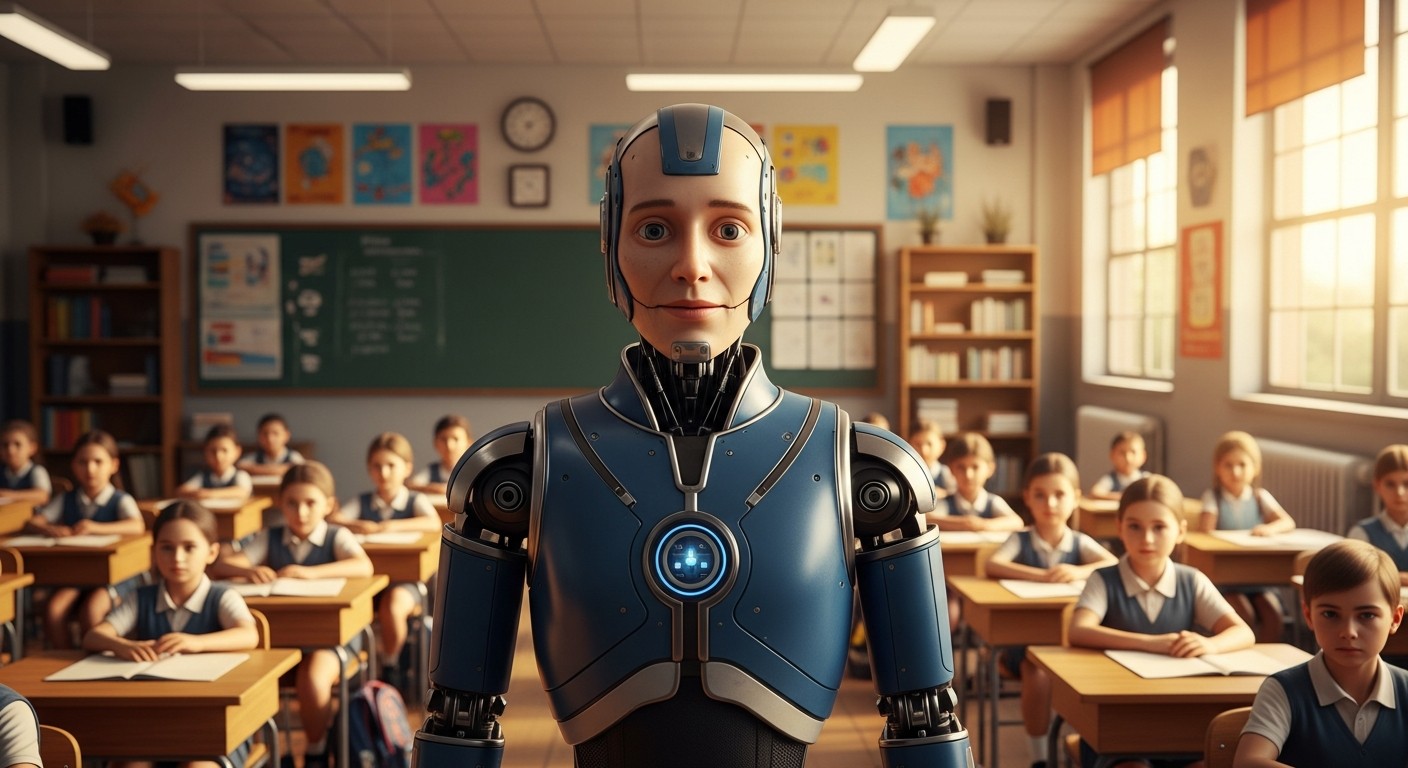
Sally is a hyperrealistic female humanoid robot, built by a company called Realbotix. She has silicone skin, long brown hair, and upper-body movement. She does not walk. She has no genitalia. She costs $57,590, which is the discounted price. The list price is $95,000.
The Salamanca City Central School District, which serves approximately 1,300 students (79% of whom are economically disadvantaged), purchased Sally to serve as a classroom teaching assistant. She is slated to deploy this fall in high school AI and robotics courses, with plans to expand if the experiment goes well.
So far, so weird.
But the company behind Sally is where things get genuinely strange.
The Company Behind the Robot
Realbotix Corp was not always Realbotix Corp. It used to be Tokens.com, a Toronto-based cryptocurrency company. You may remember Tokens.com from 2021, when they made headlines for purchasing virtual real estate in the metaverse for $2.4 million. That investment aged poorly.
In April 2024, pivoting hard, Tokens.com acquired a company called Simulacra Corporation for $16.7 million in stock. Simulacra owned Abyss Creations, the company that has been manufacturing RealDolls since 1997. RealDolls are realistic, anatomically complete sex dolls, and Abyss Creations has been the dominant player in that market for nearly three decades.
After the acquisition, Tokens.com renamed itself Realbotix Corp and announced a pivot into humanoid robotics. The company insists the robotics division is fully separated from the adult product line: different employees, different facilities, different technology. Sally, they say, is not a sex robot.
That may be true. But the parent company still owns Abyss Creations, which is still making RealDolls. A school district on a Native American reservation has sent $57,590 to a company that owns one of the world’s most recognizable sex doll brands, and that company also makes crypto plays on metaverse real estate.
Nobody apparently thought this was worth a second look before signing the check.

The Teachers Are Not Happy
While the White House task force was drafting AI curricula, New York’s teachers were drafting a resolution of their own.
In June 2026, the New York State United Teachers union passed a resolution calling for strict limits on both screen time and AI in classrooms. The specifics: no one-to-one device use for pre-K through 2nd grade students, full stop. A ban on non-educational AI at all grade levels. Any AI deployment in schools must be supervised and educator-led.
The resolution builds on New York’s existing bell-to-bell cellphone ban and reflects a position that has been gaining ground among educators: the technology rollout in schools has moved faster than the evidence that it works.
That concern is not unfounded.

What the Research Actually Says
Here is an uncomfortable fact about screens in schools: the data is not great.
A 2025 cohort study published in JAMA Network Open, tracking over 5,400 students in Ontario across 15 years, found that each additional hour of daily screen time was associated with 9 to 10 percent lower odds of achieving higher math and reading levels. Those are statistically significant findings, not noise.
The OECD’s PISA 2022 assessment, which covers 15-year-olds across more than 80 countries, found similar patterns: student-led device use during class was negatively associated with reading, math, and science performance. One of the world’s largest education studies, and the results point the same direction.
None of this means AI in schools is inherently harmful. The research mostly covers passive screen time and device use, not purpose-built AI tutoring tools. But it does complicate the narrative that more technology automatically means better outcomes. And it raises an obvious question: if we do not yet have solid evidence that iPads improved learning, what exactly is the theory of the case for a $57,000 humanoid robot?
There is actually a small body of research on social robots in education. A 2025 meta-analysis of 146 studies found that physical robots have a modest advantage over screen-based equivalents: d = 0.20, which is Cohen’s threshold for “small.” Engagement reliably goes up with robots. Test score gains are inconsistent and modest. And critically, every study in that literature uses clearly robotic platforms: cartoonish, obviously mechanical systems like NAO and Pepper, not hyperrealistic silicone-skinned humanoids. There is no published peer-reviewed research on hyperrealistic humanoid robots in education anywhere. The uncanny valley literature raises the possibility that realism may actively hurt acceptance rather than help it. A district paying $57,590 for a humanoid form factor is purchasing a hope, not a finding.
How We Got Here
To be fair to Salamanca, they are not rogue actors. They are responding to a federal policy environment that is aggressively pushing schools to adopt AI infrastructure now, theory to follow later.
Executive Order 14277 directs the government to build AI literacy programs, fund teacher training, create apprenticeship pipelines, and run a national student AI challenge. The underlying assumption is that AI fluency is a national competitiveness issue, and that getting students working with AI tools early is how the United States wins.
That logic is not crazy. AI literacy probably does matter for the workforce. But the execution gap between “AI literacy matters” and “let’s buy a robot from a company that also makes sex dolls” is large enough to fit several school buses.
The families of Salamanca did not get a vote. The 79% of students who qualify for free or reduced lunch did not get a vote. The teachers whose union is actively lobbying against exactly this kind of deployment did not get a vote. A school board approved a contract with a company whose headline product is anatomically realistic sex dolls, and that became federal AI education policy in action.
The Real Question
Nobody should be surprised that technology companies found a way to monetize an executive order about AI in schools. That is what technology companies do. And nobody should be surprised that a district serving low-income students on a reservation was an early adopter: those are often the schools that get targeted for experimental technology deployments, for complicated reasons involving funding incentives and administrative bandwidth.
The question worth asking is whether Sally teaches any actual AI or robotics concepts that a $5,000 laptop and a good curriculum could not. Whether the federal push into AI education is designed around student outcomes or around creating a market. And whether “we have a humanoid in the classroom” is the kind of headline that makes school boards look innovative and makes everyone else feel uneasy.
Sally is scheduled to show up at Salamanca City Central in the fall. The students will meet her. The research will follow, eventually.
In the meantime, the company that made her is also in the sex doll business, and the president signed an order saying this is what American education needs.
Make of that what you will.
Sources: Truthout, NYS Focus, Kotaku, JAMA Network Open (Li et al. 2025), PISA 2022 (OECD), EdSurge, Chalkbeat, White House EO 14277 fact sheet.
Chris Meredith writes about AI, technology, and what it actually means for real people. Follow along on Substack: monkeyattack.substack.com