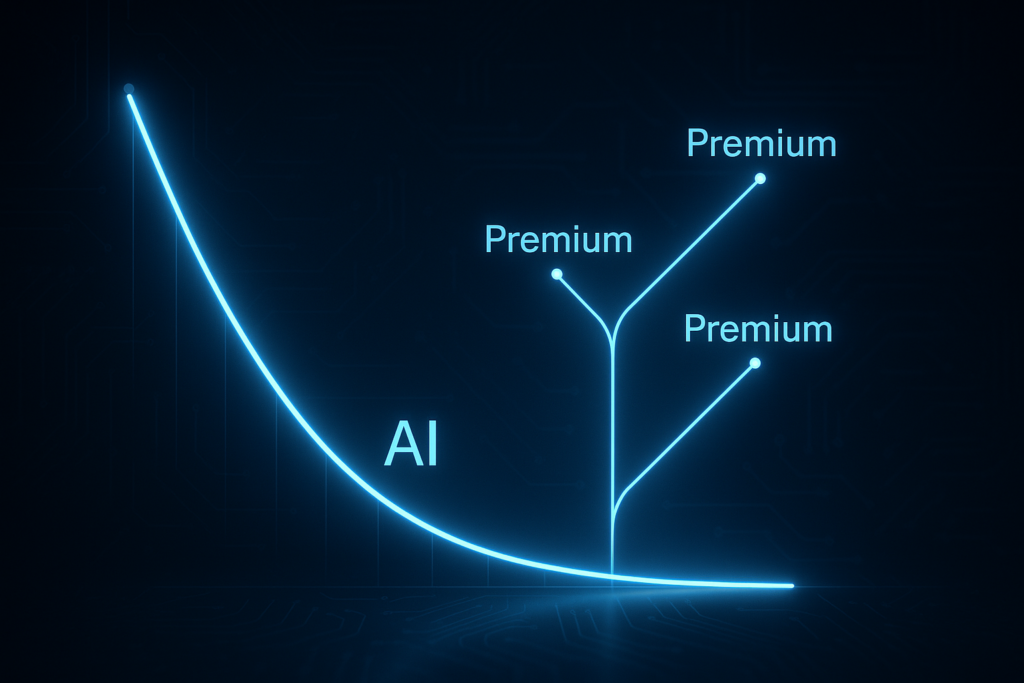
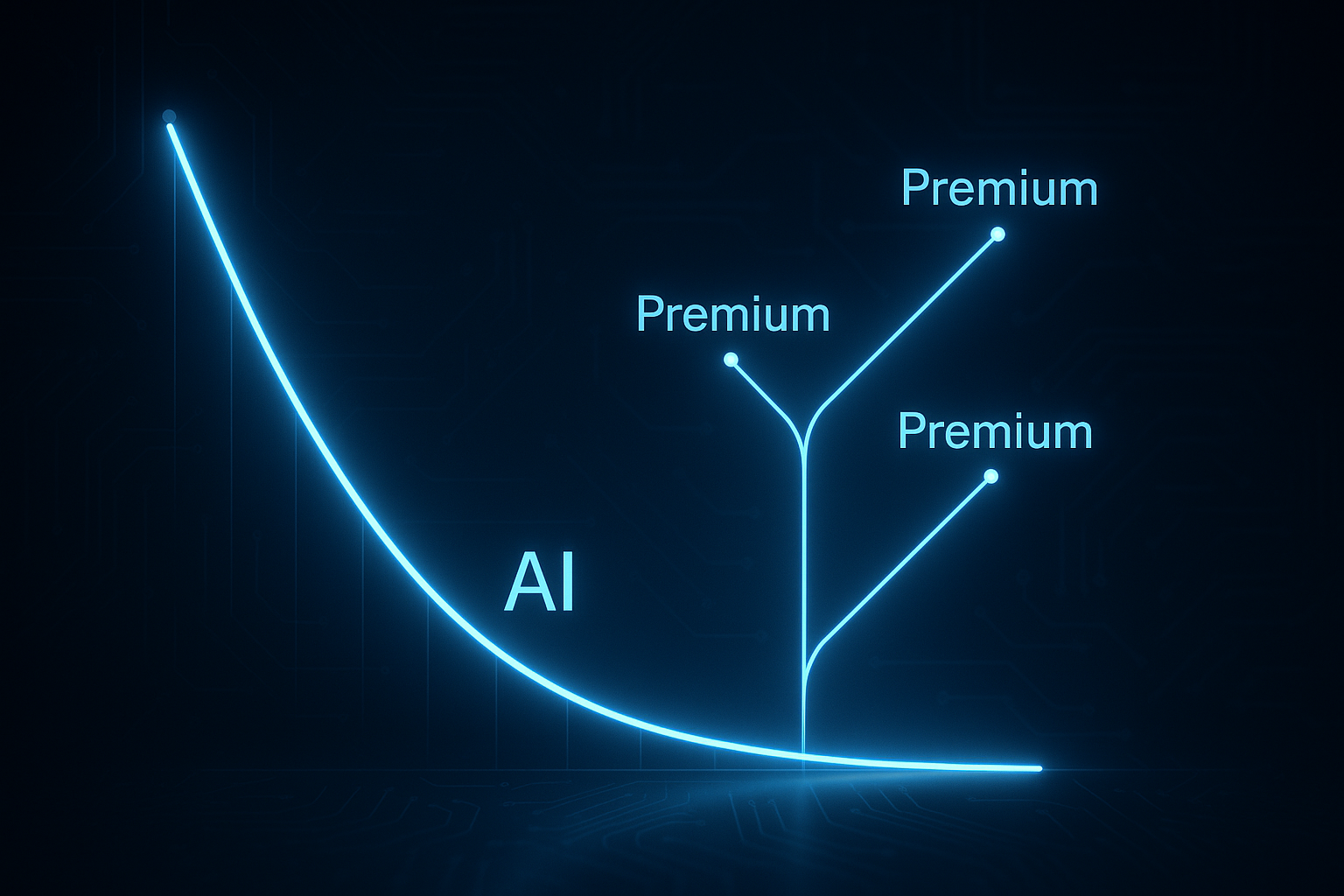
There’s a thing that happens in every maturing tech market. The base product gets cheap enough that the original price point becomes embarrassing. Cloud hosting did it. SaaS did it. Now AI is doing it, and Fable 5.1 is the clearest signal yet that we’re well into that phase.
When Dan Shipper, CEO of Every and one of the first outsiders to test the model, described his experience with Fable 5.1, he didn’t bury the lead: “Fable-level intelligence, Opus-level price, Sonnet-speed. In our tests it was about twice as fast as Opus 5 and used half as many tokens, so for anyone used to using Opus as their daily driver it’s an obvious upgrade.”
Read that again. Twice as fast. Half the tokens. The same capability tier. That’s a pricing signal, not a product announcement, and it rhymes with something the tech industry has seen before.
The Cloud Hosting Playbook
If you were building software in 2008 and needed a server, you bought one, racked it, and paid someone to keep the lights on. Amazon’s big move was putting compute in the cloud and then relentlessly making that compute cheaper. Year after year, AWS cut base instance prices. Azure and Google followed. The message from all three was the same: raw compute is becoming a commodity. Come for the cheap servers, stay for the services layered on top.
That’s the playbook. Drive the base cost toward zero to get mass adoption, then build a stack of premium capabilities around it that justify the relationship.
The bills that actually shock enterprise customers today are the data transfer fees, the managed database tiers, the support contracts, the enterprise agreements with pricing structures that require a dedicated person to decode. The EC2 instances are practically an afterthought. The base product is practically free. The bells and whistles are where the money lives.
AI is running the same play, just faster. A few years ago, accessing frontier-level intelligence cost serious money per token. Today, Fable 5.1 delivers Opus-grade performance at a price point that used to buy you Sonnet, and it’s twice as fast to boot. The base intelligence is commoditizing. The question is what replaces it as the value layer.
What Are AI’s Bells and Whistles Going to Be?
This is the part nobody has fully figured out yet, which is probably why providers are being careful about how aggressively they push pricing. The last thing they want is to recreate the cloud sticker-shock moment for AI, where a startup gets a bill that ends the company.
But the contours are starting to show. Here’s what to watch:
Memory and context. Most AI interactions today are stateless. The model doesn’t remember you. Long-term memory, persistent context across sessions, and the ability to maintain working knowledge of your specific situation, those are features that require infrastructure beyond the model itself. That’s a natural premium tier.
Agents and orchestration. Using an LLM to write a paragraph is cheap. Using it as the reasoning layer inside a system that takes actions, monitors outcomes, and loops until the job is done is a different product at a different price point. Agent orchestration infrastructure is already showing up as a distinct billing category.
Real-time and specialized data. A general-purpose model knows a lot. A model with live access to your industry’s data, your company’s internal knowledge, or a purpose-built expert corpus, that’s a premium product. Retrieval-augmented generation sounds technical but it’s really just a fancy way of saying “we connected the model to better information than it was trained on.”
Fine-tuning and customization. Training a model from scratch costs millions. Fine-tuning an existing frontier model on your specific domain or voice is orders of magnitude cheaper, but still a distinct paid tier. As base inference gets cheaper, fine-tuned models for specific workflows become the differentiation layer.
Priority compute. Anyone who’s hit a rate limit at 2am before a deadline understands this one. Guaranteed throughput, reserved capacity, and SLA-backed latency will be premium products because at scale, the difference between “available” and “guaranteed available” is the difference between a product that works and one that doesn’t.
The honest answer is that the AI providers don’t fully know yet what their bells and whistles are going to be. They’re watching which premium features enterprise customers actually pay for and which ones get purchased for show and never used. The pricing experiments are happening in real time.

Your Cost Model Is Already Wrong
If you’re building on AI today, Fable 5.1 type releases should change how you think about your cost model. The assumptions you baked in a year ago, about what frontier intelligence costs per token, are already wrong. They’ll be more wrong a year from now.
The practical implications:
If you’re building applications, this is straightforwardly good. Use cases that couldn’t survive the old inference costs are starting to make sense on paper again. The gap between “frontier intelligence” and “affordable” is closing fast enough to matter.
If you’re evaluating AI spend for a larger organization, the base model cost is increasingly a red herring. The real question is what’s in the stack around it: data pipelines, memory systems, orchestration, security, and compliance. That’s where the real costs will live, and that’s where the negotiations matter.
The broader implication is that cheap base inference is the precondition for AI becoming genuinely widespread, the same way cheap cloud compute was the precondition for SaaS becoming the default delivery model for software.
Fable 5.1 is a data point, not an endpoint. The trend is real and moving faster than the old pricing models expected.
The base intelligence is getting cheap. Figure out which bells and whistles you actually need, because that’s where the invoice is going to live.
Chris Meredith writes about AI, technology, and futures most people aren’t watching yet. He’s based in the US.
Chris Meredith writes about AI, technology, and what it actually means for real people. Follow along on Substack: monkeyattack.substack.com