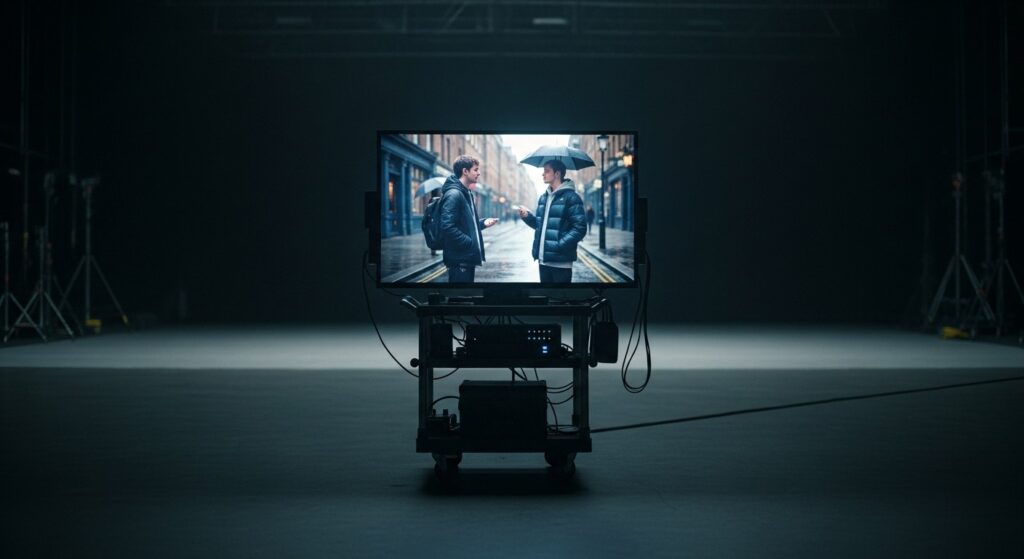
Israel Adesanya never stepped on a soundstage. Quinton “Rampage” Jackson didn’t show up to a costume fitting. N3on, the streamer, sat down for a two-minute voice recording and some photographs. That was the last the production team needed from him.
On August 5, 2026, Higgsfield AI premiered The Cully Hill Boys at The Glasshouse in New York City. One hundred and ten minutes. A full action-comedy feature. Licensed celebrity likenesses. Zero filming days.
Every frame was generated.
That’s not a marketing claim. That’s the production log. And once you understand what that workflow actually looks like, you start to see why this isn’t a novelty premiere. It’s the first clear signal that the production contract, not the shooting schedule, is now the load-bearing document in Hollywood.
The Stack
Here’s what built the film. Every shot, all video and all speech, was generated in Seedance. Faces and character sheets came from Soul Cinema. Edits, reverse angles, and point changes ran through Seedream and Nano Banana. Prompts were written in Claude, but in two separate chats: one for image prompts, one for video prompts.
That split isn’t incidental. The rules of one job actively poison the other. Image prompts need flat light and anti-CG wording. Video prompts need field of view in degrees and motivated light. Run them in the same chat and you get bleed that degrades both outputs. So they kept them separate.
That’s not a detail you get from a press release. It’s the kind of thing you learn by building at scale and getting it wrong first. And it signals something important: AI film production has its own craft layer, its own unwritten rules, and it punishes people who don’t respect the separation between still and motion.
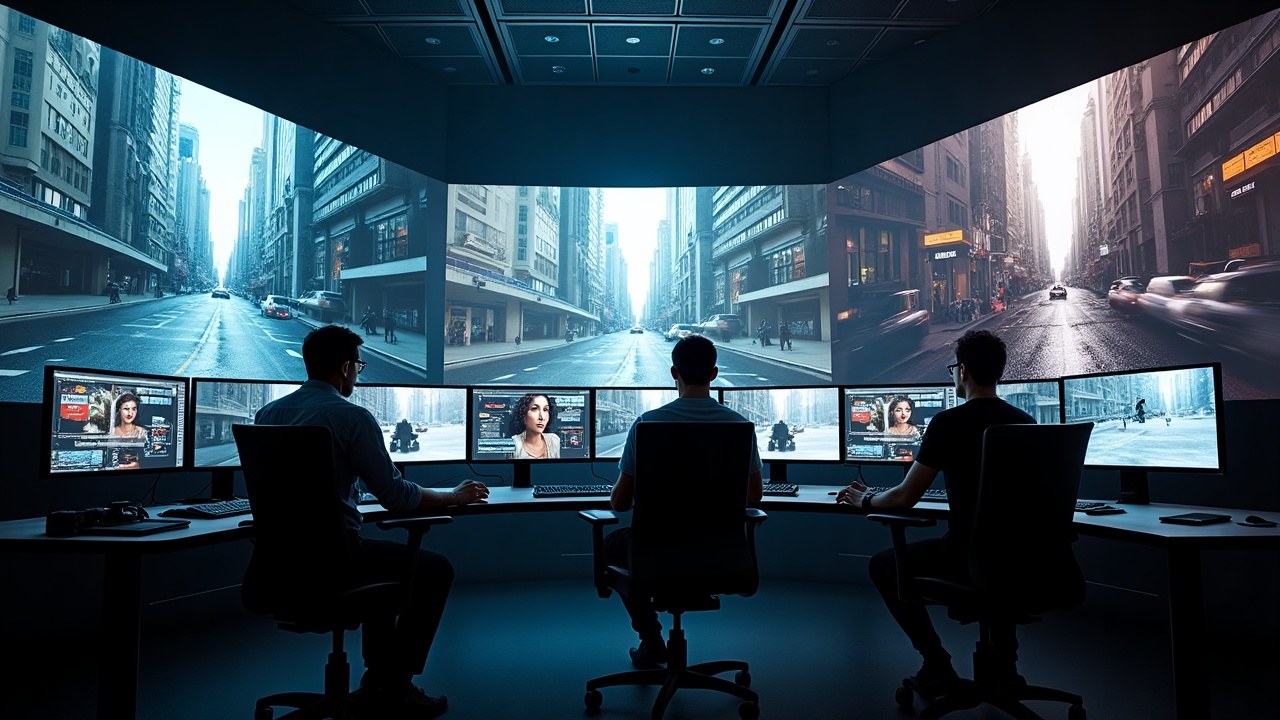
The team of 28 ran nine directors concurrently, produced more than 1,000 production-ready assets across 100-plus locations in 4K, and finished the film in four weeks. A comparable traditional production would take one to two years and cost north of $20 million. The Cully Hill Boys came in at around $2 million, roughly $1 million of which went to AI compute.
There’s one exception in the workflow, and it’s a telling one. A single fight sequence was choreographed by stunt performers and shot on a phone as a motion reference. That reference block then went back into the AI pipeline. The rest of the film needed no human-captured footage at all. But the physics of impact, the specific grammar of a fight, still needed a human anchor. That phone video is probably the clearest marker of where the boundary currently sits.
The Contract Is the New Shooting Day
What each performer provided was high-resolution photographs and voice recordings. What they received was compensation, script approval, and a clearly defined scope for how their likeness could be used. Source data was deleted within 30 days of production wrap. Contracts explicitly barred Higgsfield from retaining, training on, or licensing performer data to third parties.
N3on’s team has described what that commitment looked like in practice: a two-minute voice session, some photos, and that was the end of his involvement in production. He showed up to the premiere as an audience member and watched a version of himself in a 110-minute film.
The consent framework draws directly from AI provisions SAG-AFTRA won after its 118-day strike. Those provisions required advance notice and compensation before a performer’s digital replica could be used in any production. The Cully Hill Boys converts those labor-won protections into a working commercial model. The agencies representing some of the talent are already offering AI likeness licensing alongside sponsorships and endorsements, treating a client’s AI avatar as a managed line of business.
Congress isn’t far behind. The NO FAKES Act of 2026 would create a federal intellectual property right over every individual’s voice and visual likeness. That legislation, if it passes, gives these consent frameworks the force of law rather than just contract language.
The practical implication is significant. Actors, athletes, and creators no longer have to choose between availability and presence. If your schedule is full for the next two years, you can still be in a film. You negotiate the terms once, and from that point forward, only the asset goes into a shot.
The Script Came First
Before any of the AI production work started, the screenplay existed. Timothy W. Planagan spent approximately five years writing it. It made The Black List. It was a Feature Screenplay Finalist at the 2026 London Independent Screenplay and Film Awards. Higgsfield licensed the adaptation rights.
That matters because the reflex criticism of AI filmmaking is that it hollows out story in favor of spectacle. The Cully Hill Boys started with a five-year-developed script: three underachieving London rappers who accidentally get pulled into a drug war, a fast, funny, beat-driven crime movie about loyalty, friendship, and refusing to stay invisible. The story came before any of the technology choices.
What the AI tools did was make it financially possible to produce that script at a visual scale that would’ve been out of reach through traditional means: 100-plus distinct locations in 4K, for $2 million, in four weeks. The access question shifts completely.
Higgsfield’s previous feature, Hell Grind, ran 95 minutes and cost around $500,000 using roughly 100 assets. The Cully Hill Boys used more than 1,000 assets across a larger cast and a more complex story. The cost went up by a factor of four. The complexity went up by a factor of ten. The timeline stayed short.
Traditional studios don’t have a production model that scales that way. They have linear cost structures: more scenes means more shooting days, more shooting days means more crew hours, more crew hours means more money. AI production, at least at this stage, scales differently. The AI compute is the variable. The human team is smaller. The time compression is real.

What the Prompt Split Actually Tells You
I keep returning to that two-chat workflow. One chat for image prompts. One chat for video prompts. Different rules. Different vocabulary. Different outputs.
Most public discourse around AI video tools is still stuck on clip generation: type a sentence, get footage. What this team found is that serious production at feature length requires disciplined prompt hygiene. Image work needs to look real and grounded. Video work needs to move like a film, with attention to angle, light source, and field of view. Mixing the two instruction sets degrades both.
That’s a craft lesson. It’s also a signal that a new kind of film professional is emerging, someone who thinks in prompts the way a cinematographer thinks in lenses, who knows that “a wide shot” is not the same specification as a field of view in degrees.
The production also required 473,214 separate generations to complete the film. That number is significant not because it’s large, but because it shows what iteration looks like in this pipeline. There’s no single take. There’s no print that’s good enough. There are hundreds of thousands of attempts, sorted, refined, and assembled by a team that includes former costume designers, production designers, and newly titled generative artists. Human editorial judgment ran through all of it.
The YouTube Creator’s Turn
What’s happening with The Cully Hill Boys has a precedent, and it didn’t start in Hollywood.
The Backrooms started as a found-footage YouTube short from Kane Pixels, a teenager working with consumer VFX tools. It reached tens of millions of viewers without a studio, a distributor, or a theatrical release. The idea was original. The craft was disciplined. The audience showed up. A Blumhouse feature deal followed.
Obsession followed the same trajectory: a creator-built project that found a real audience before any major institution validated it. No green light required.
What both of those proved is something studios have been slow to internalize: the cultural gatekeeping was always more fragile than the financial gatekeeping. Once a creator could reach an audience, the only thing standing between a YouTube-native filmmaker and a feature film was the cost of production at scale.
That’s the wall AI is now lowering.
The Cully Hill Boys ran roughly $1 million in compute to produce 1,000-plus assets across 100-plus locations. That number will be lower for the next team, and lower again for the team after that. What the YouTube creator with an existing audience now has is a production ceiling that keeps falling toward them. The storytelling skills that built a channel, the instinct for pacing and retention and what keeps someone watching, those skills translate directly into the new pipeline.
What the studio system sold was access to the machine. Enough tokens, and you bring your own machine.
The Cully Hill Boys is the first proof that the machine is real and available. The next feature from a creator with a million subscribers and a solid script might not need a premiere in New York at all. It might just be a Tuesday upload.
Where This Lands
The Cully Hill Boys isn’t the last AI feature. It’s the proof of concept that makes every studio ask a question they’ve been avoiding: if a 28-person team can produce a 110-minute feature with licensed digital likenesses in four weeks for $2 million, what does a $100 million production budget actually buy?
It’s not buying the likenesses anymore. It’s not buying the locations. It’s buying a shooting schedule, a crew infrastructure, and a set of physical production habits that predate these tools.
None of this makes traditional filmmaking obsolete. Character-driven drama, physical performance at a specific real location, authenticity that depends on being present in a place, that category still has reasons to exist exactly as it does. But the argument that AI film is a YouTube demo trick doesn’t survive contact with a 110-minute feature that premiered in New York to press coverage in Variety and Forbes.
The contract is now the shooting day. The asset is now the actor. The prompt chat is now the production meeting.
That doesn’t mean the industry falls over. It means the question of when to use which model is genuinely open for the first time. And that’s the conversation Hollywood is walking into now, whether it’s ready for it or not.
Sources: Higgsfield AI project page | Forbes | Variety | Inc.
Chris Meredith writes about AI, technology, and what it actually means for real people. Follow along on Substack: monkeyattack.substack.com