
China shipped 97% of the world’s humanoid robots in the first half of 2026, roughly forty thousand units total. The production numbers are not in dispute. What’s murkier is whether those machines are actually doing useful work, and the data on deployment is a lot thinner than the production charts.
There’s a gap between shipping a robot and deploying one. China has gotten very good at the shipping part. The deployment part is proving messier than the production curves suggest.
The Numbers Are Hard to Ignore
China shipped over 40,000 humanoid robots in H1 2026, with full-year projections pushing past 100,000 units. A year ago the whole industry produced maybe 20,000. The robotics market hit $14.2 billion this year, up 47% from last year.
AgiBot holds roughly 44% of global market share with about 8,400 units shipped. Unitree is right behind them at around 5,900. A factory in Guangdong that opened in March runs at 10,000 units a year. UBTech wants 100,000 units off its lines before New Year’s.
China’s Ministry of Industry and Information Technology has set a target for real industrial deployments to be running by end of 2026. That’s the government’s stated deadline, and Chinese manufacturers have a decent track record of hitting government targets on hardware.

Where the Robots Are Actually Going
Through most of 2025, over 70% of Unitree’s humanoid robot revenue came from research and education customers. Industrial applications? Nine percent. You can ship a robot to a university lab and log it as a sale. That’s fine as a business, but it’s not the same as putting the thing to work on a factory floor.
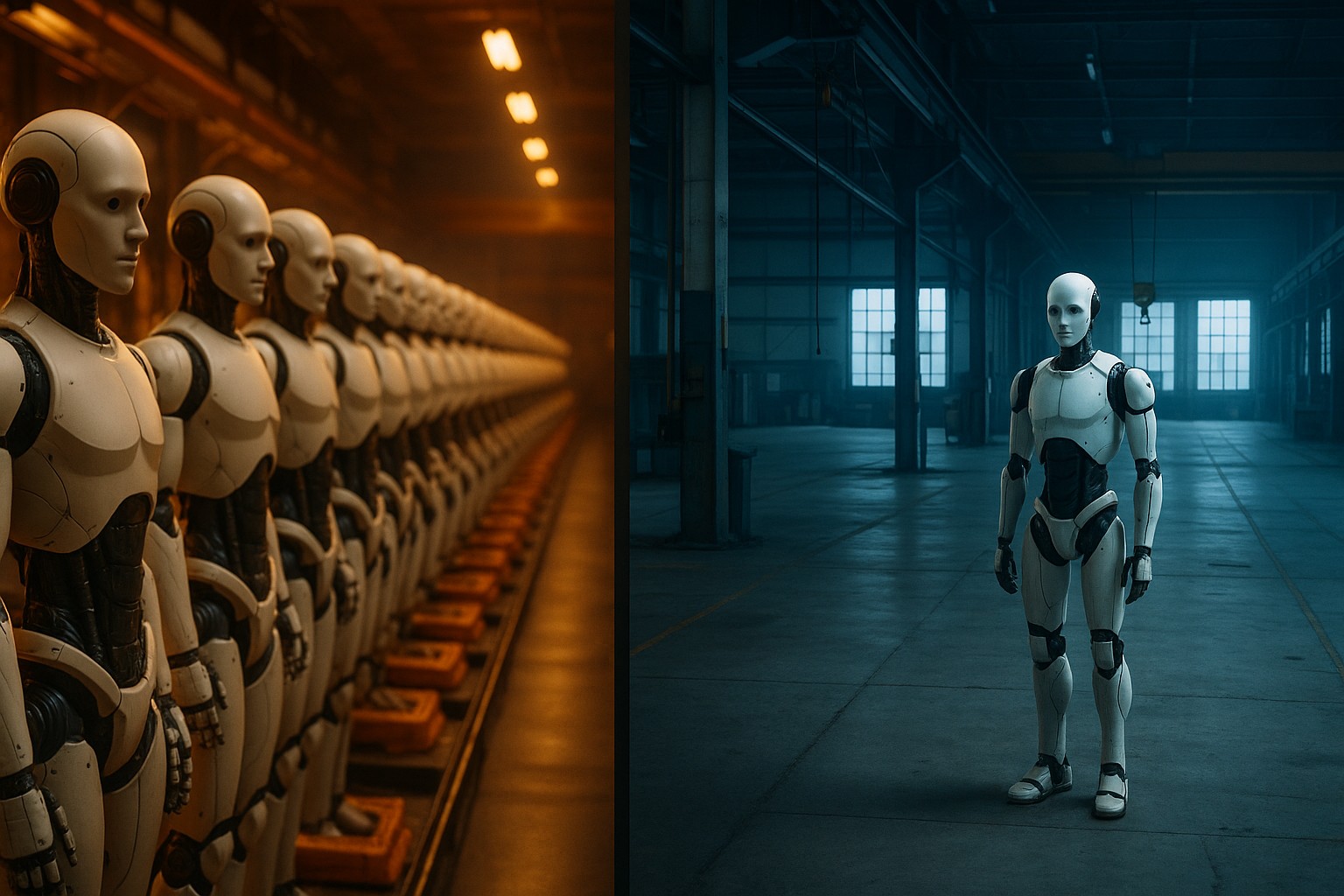
Industry estimates put actual working deployments at around 10% of total units produced. The rest are in labs, pilot programs, or sitting in a warehouse somewhere while the buyer figures out what to ask them to do.
New hardware goes through this. The question is always when the curve bends, and that depends almost entirely on whether the software can catch up.

The Generalization Problem
The hard part isn’t building the robot. It’s making the robot useful somewhere you didn’t design it for.
Factories are messy. Products change. Lighting varies. Parts show up at slightly different angles. A robot that can assemble one specific component in a controlled environment isn’t the same as a robot that can handle it when something’s a little off. That gap, between what the robot was trained on and what it runs into in practice, is what researchers call the generalization problem. It’s the deepest unsolved issue in the field.
China’s VLA (vision-language-action) model work is the most credible answer so far. Several manufacturers have started winning factory contracts specifically because their robots ship with VLA models that generalize better across tasks. Real progress. Still slower than the shipment numbers imply.
What’s Actually Working
The use cases that have moved past pilot stage share some obvious traits: structured environments, repetitive tasks, customers patient enough to work through the rough edges.
Automotive assembly, electronics manufacturing, and warehouse logistics are the closest thing the industry has to a proven playbook right now. China’s also deployed humanoid robots in public traffic management, which is genuinely useful work even if it sounds like a government press release. Some of the factory contracts being announced are real, not just for the cameras.
The rental market is worth paying attention to. A CNN piece from June tracked a growing business in renting humanoid robots for events and demonstrations. That’s a real revenue stream. It also means the companies haven’t cracked permanent industrial deployment yet. Renting a robot by the hour is roughly the consulting gig version of a robot business.
Where the Signal Actually Is
The production numbers prove China has figured out manufacturing at scale. That’s a real advantage. Hardware gets cheaper when you’re building it in volume, the supply chain deepens, and the iteration cycle speeds up. Getting there first matters.
The deployment numbers are a more honest read on where the industry actually stands. ROI is still elusive for most industrial applications. Setup costs are high. Task generalization isn’t reliable enough for environments that weren’t part of the training data.
Watch VLA model progress as the most telling indicator. After that, watch which factory contracts get renewed after the first year, not just which ones get announced. And the rental market, oddly, is worth tracking too: when the hourly rental business starts declining, it’ll mean companies are signing longer-term deployment deals instead. That’s the signal that something real has shifted.
Chris Meredith writes about AI, technology, and what it actually means for real people. Follow along on Substack: monkeyattack.substack.com