Ask five engineers which model backend to run their agent swarm on and you’ll get five different answers, each defended with a different benchmark. That’s not because the question is unanswerable. It’s because “which backend wins” isn’t one question. It’s at least three: which one is cheapest, which one is fastest to build with, and which one you can actually trust not to embarrass you in production. Those three answers rarely point at the same model.
Here’s what the numbers actually say, and where they stop telling the whole story.
The pricing table, with the caveats that matter
| Model | Input cost (per 1M tokens) | Output cost (per 1M tokens) | Cache hit rate | Best for |
|---|---|---|---|---|
| Claude Opus 5 | $5.00 | $25.00 | N/A (batch tier: 50% off) | Production, safety-critical work |
| Claude Sonnet 5 | $3.00 (intro $2.00 through Aug 31, 2026) | $15.00 (intro $10.00) | N/A | Balanced production |
| Claude Haiku 4.5 | $1.00 | $5.00 | N/A | Low-cost inference |
| Deepseek V4 Flash | $0.14 | $0.28 | $0.0028 | Agent swarms, highest cost-efficiency |
| Deepseek V4 Pro | $0.435 | $0.87 | $0.0036 | Reasoning plus cost balance |
| Kimi K3 | $3.00 | $15.00 | $0.30 | Long-horizon reasoning, 1M context |
| Kimi K2.7 Code | $0.95 | $4.00 | $0.19 | Specialized coding agents |
| MiniMax M2.7 | $0.0002 | $0.0002 | N/A | Ultra-low-cost, unverified at scale |
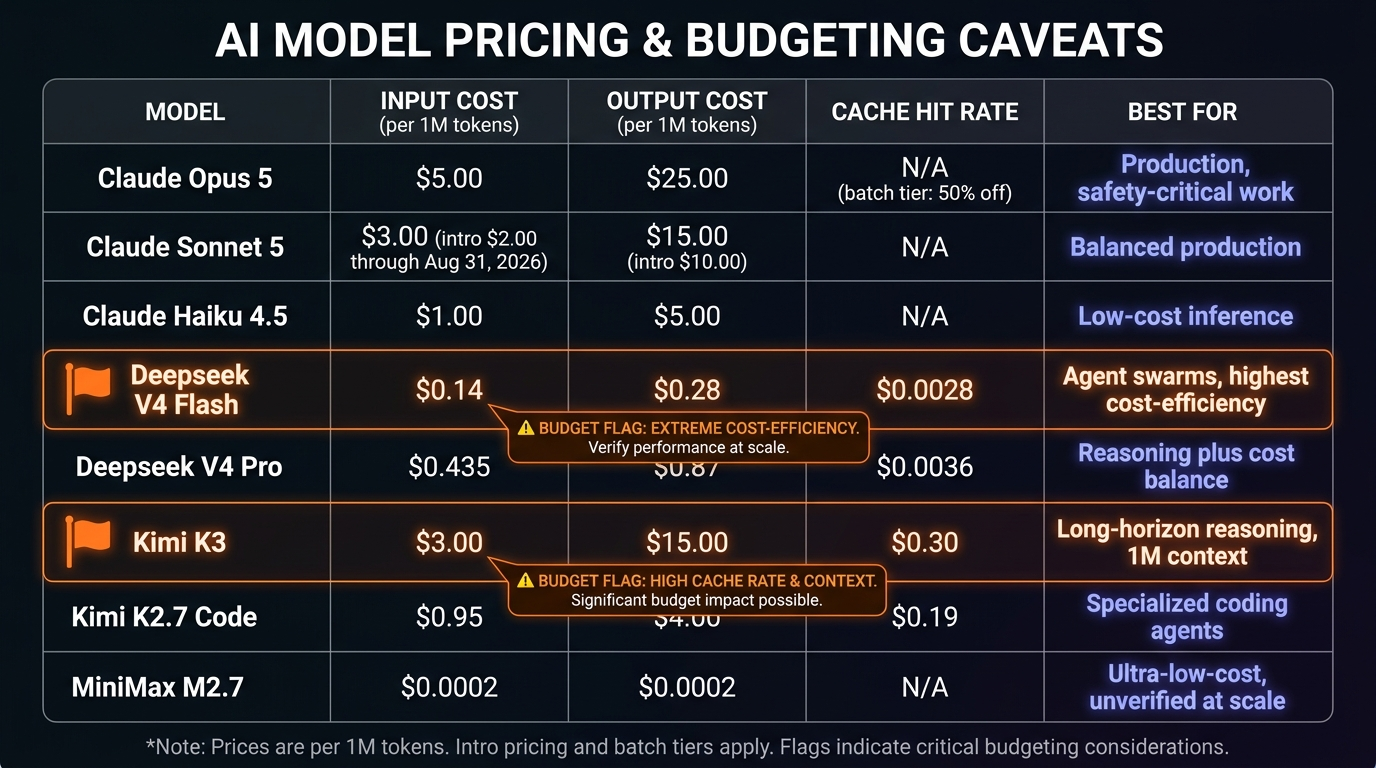
Two rows need a flag before anyone uses this table to budget a real system.
The Claude Sonnet 5 number carries an asterisk. The $2 input and $10 output figures are an introductory rate that expires August 31, 2026. Standard pricing is $3 and $15. If you’re modeling costs past that date, use the standard number, not the promotional one.
The MiniMax M2.7 row is the one to treat with real skepticism. A price of $0.0002 per million tokens for both input and output isn’t just cheap, it’s two orders of magnitude below every other model on this list, including Deepseek’s own aggressive pricing. That kind of gap usually means one of three things: the number is a rounding or decimal-placement error somewhere upstream, the pricing reflects a different billing model than the sticker suggests (a subscription tier being misreported as per-token, for instance), or it’s an early promotional rate that won’t hold. None of those possibilities make the model unusable. All of them make it a number to verify directly against MiniMax’s own current documentation before committing production spend to it, not one to take at face value from a pricing aggregator.
Coding benchmarks tell a different story than price alone
Price per token and quality per token are two separate axes, and conflating them is where a lot of backend decisions go wrong.
On coding benchmarks, MiniMax M2.7 scores in the 82nd percentile with a reported 59 percent on SWE-Bench Pro and 66 percent on Terminal-Bench, alongside a 74.2 percent result on the MCP Atlas agent benchmark. Those are strong numbers for any model, let alone one priced at a fraction of a cent. Deepseek V4 posts near-state-of-the-art results on the same class of coding and reasoning tasks, which is consistent with its design goal: a model explicitly tuned for agent swarm workloads, not a general chatbot with agent features bolted on.
Compare that to GPT-4 Turbo, which lands at 21.5 on the same coding scale, the 46th percentile, while running at 2 to 10 times the per-token cost of Claude models and roughly 5 times slower in output generation. The analysis behind that comparison is blunt about it: teams starting a new build in 2026 are better served by a current-generation model than by sticking with legacy GPT-4 Turbo out of habit.
Kimi K2.7 Code sits in the middle: purpose-built for coding agents, priced well below Claude’s tiers, with a cache-hit rate around $0.19 per million tokens that makes repeated-context workloads noticeably cheaper than running the same pattern on a model with no caching discount.
What the benchmarks don’t measure
None of the numbers above capture reliability under load, which is the thing that actually determines whether a production agent swarm survives contact with real users.
Claude’s pitch isn’t that it’s the cheapest or even the fastest. According to reporting by finout.io on Claude enterprise usage, multi-turn, agentic workloads reportedly account for more than half of enterprise API usage on the platform, which means the failure modes of long-running agent loops have been observed, reported on, and patched against at a scale most newer entrants haven’t had the traffic to match yet. That’s a genuinely different kind of evidence than a benchmark score, and it matters more for a production system than a half-point difference on a coding leaderboard.
Deepseek and Kimi are both younger platforms with smaller ecosystems. That’s not a knock on their technical quality, both post genuinely strong benchmark results, but it does mean less battle-tested tooling, fewer existing integrations, and a shorter track record if something goes wrong at 2 a.m. For a side project or an internal tool, that tradeoff is easy to accept in exchange for the cost savings. For a customer-facing system where downtime has a dollar cost attached, it’s a real risk to weigh, not a rounding error.
A framework, not a verdict
The honest answer to “which backend wins” depends on which of these three questions is actually driving the decision:
If the deciding factor is raw cost at scale, and the workload is well-scoped, repetitive, and can tolerate occasional imperfection, Deepseek V4 Flash’s caching economics make it hard to beat on price for agent swarms specifically, not for one-off queries.
If the deciding factor is coding capability per dollar, Kimi K2.7 Code and MiniMax M2.7 both post benchmark numbers that outperform legacy alternatives at a fraction of the cost, with the caveat that MiniMax’s pricing needs independent verification before you build a budget around it.
If the deciding factor is production reliability for something customers depend on, Claude’s combination of safety tooling, a proven agentic track record, and a batch pricing tier that cuts costs in half for workloads that can tolerate delay remains the more conservative and better-documented choice.
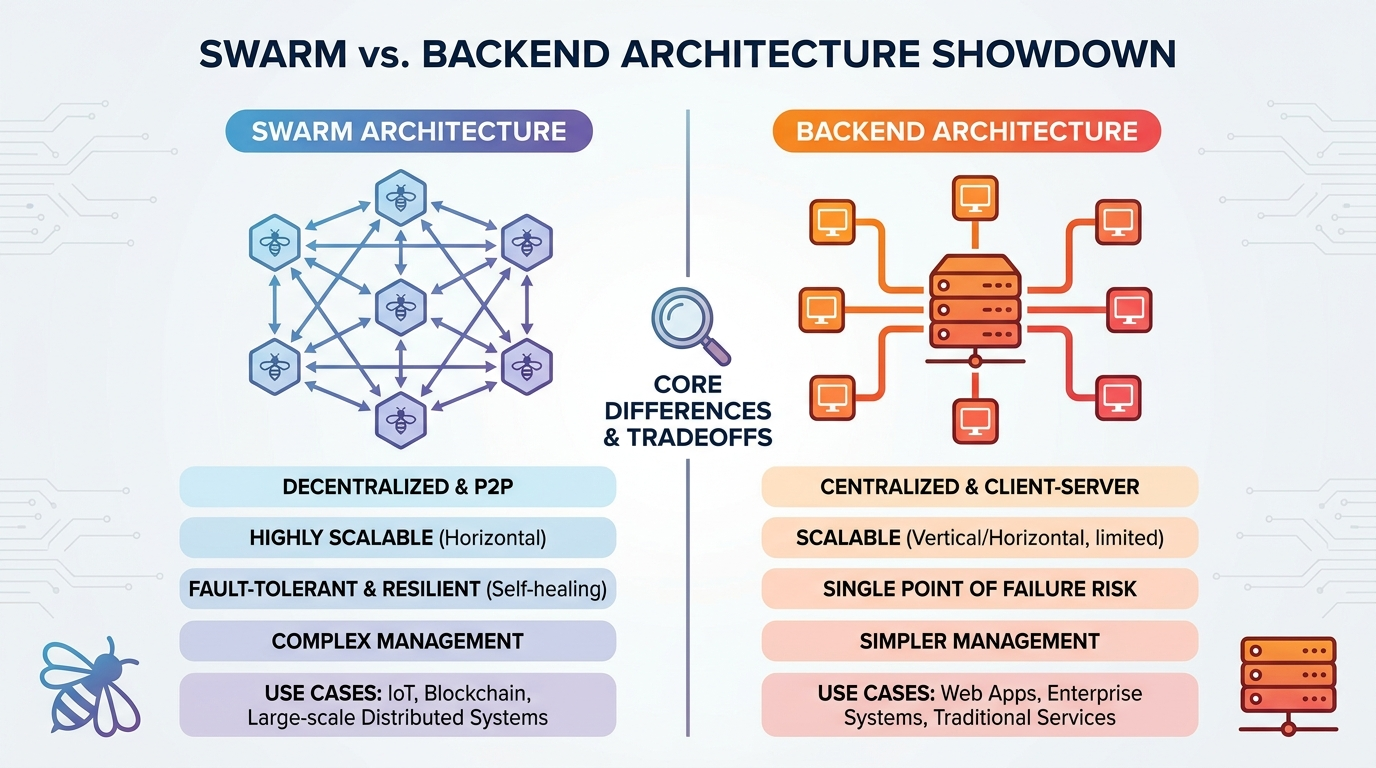
Most real systems end up mixing backends rather than picking one: a cheap, fast model for high-volume routine agent turns, and a more expensive, more reliable model reserved for the steps where a mistake actually costs something. The pricing table makes that split affordable. The benchmarks make it defensible. Neither one, on its own, tells you which model wins, because the question was never really about one model in the first place.
Sources: Anthropic Claude API pricing documentation; “Claude Code Pricing 2026” (finout.io) for the enterprise agentic-usage figure; Deepseek V4 API pricing (benchlm.ai) and “DeepSeek V4 Flash in AI Agent Price War” (techbooky.com); Kimi API pricing calculator (benchlm.ai) for K2.7 Code pricing; MiniMax M2.7 API pricing (pricepertoken.com) and MiniMax M3 benchmarks (minimax-ai.chat); GPT-4 Turbo performance analysis (artificialanalysis.ai) and “Best LLM for Coding Agents 2026” (evolink.ai). Pricing current as of August 2026; MiniMax M2.7 pricing unverified against primary documentation and should be confirmed before production budgeting. Claude Sonnet 5’s introductory rate expires August 31, 2026.
Chris Meredith writes about AI, technology, and what it actually means for real people. Follow along on Substack: monkeyattack.substack.com