
When Agility Robotics announced its $2.5 billion SPAC deal in late June 2026, the most striking thing about the announcement was not the valuation or the ticker. It was what the company explicitly refused to promise. This robot is not coming to your home. It is built for warehouses, distribution centers, and industrial facilities. In a category defined by inflated claims and science-fiction timelines, that kind of clarity is unusual enough to deserve close attention.
Once the SPAC transaction closes, the stock will trade under the ticker AGLT, and for the first time, retail investors will have a pure-play humanoid robot holding in their portfolio. The hype cycle has been building for years, driven by Tesla’s Optimus prototype and nine-figure funding rounds at stratospheric valuations. Agility is stepping into that moment and telling investors exactly what they are buying, and exactly what they are not. That is a rarer opening move than it sounds.
What Agility Actually Sells
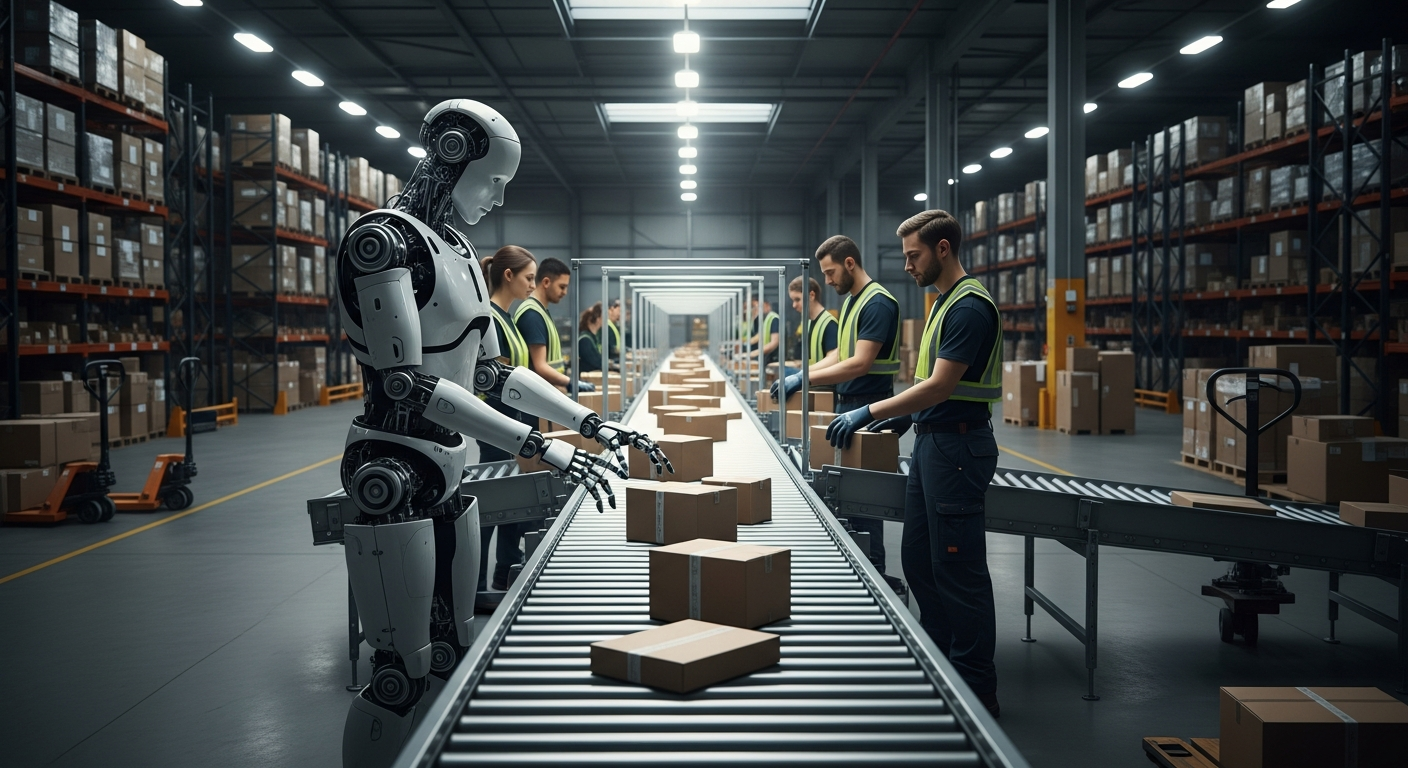
Digit is a bipedal robot designed for the specific physics of industrial work. It moves through facilities built for humans, climbs stairs, handles totes, and operates on the same floor plan as human workers without requiring retrofitted infrastructure. The pitch to a warehouse operator is straightforward: you already built your facility for a human-sized worker, and Digit fits that environment without you having to rebuild anything.
The $300 million backlog Agility has accumulated is the most concrete piece of evidence that this is not a concept company. Amazon is the most prominently cited deployment partner, and the relationship predates this IPO by years. By the time AGLT starts trading, Digit will have logged more than 65,000 hours of real-world operation. That number matters because it draws a hard line between Agility and the wave of humanoid robot startups that are still running prototype demos in controlled lab environments.
There is a meaningful difference between a robot that performs well in a choreographed demonstration and one that has accumulated tens of thousands of operating hours in actual logistics environments. Agility is on the right side of that line.
The Foxconn Signal
One detail in the deal structure deserves more attention than it has received: Foxconn is participating as a PIPE investor. PIPE stands for private investment in public equity, and in the context of a SPAC, PIPE investors are the institutions that commit capital specifically to backstop the transaction. They are not passive index funds buying on the open market. They are making a deliberate, informed bet on the company before it trades publicly.
Foxconn is not a passive observer to the robotics industry. The company assembles electronics at a scale that no other manufacturer on earth approaches, and it has been vocal about its interest in replacing repetitive manual labor with automated systems. When Foxconn takes a PIPE position in a humanoid robot company, it is not making a financial speculation. It is making a procurement signal. The implicit question the market should be asking is whether Foxconn’s investment in Agility is the precursor to a supply contract.
The strategic logic is tight enough that investors should not treat the Foxconn involvement as a footnote.
Where Agility Stands in the Competitive Landscape
The humanoid robot category is crowded with companies that are spending heavily and generating almost nothing in revenue. Tesla’s Optimus program has been developing in public view for years, and while Elon Musk has made ambitious production forecasts, the robot has not been deployed at commercial scale. Figure raised capital at a valuation in the billions and has posted impressive demo footage, but commercial deployments remain limited.
Agility’s competitive position rests on one thing that none of those competitors can claim in the same degree: it has paying customers, a growing backlog, and documented operational hours in real industrial settings. That does not mean Agility wins the long race. Tesla has manufacturing scale that no robotics startup can match, and if Optimus reaches volume production, it will reshape the competitive landscape. Figure and other well-capitalized entrants are developing platforms that may outperform Digit on specific dimensions.
What it does mean is that Agility is currently the only company in this category that has translated the humanoid robot premise into an actual revenue operation. For a SPAC deal at a $2.5 billion valuation, that distinction carries weight.
The Anti-Hype Advantage
Investors tend to undervalue honesty in a hyped category. The default mode for a company going public, especially in a space running at the temperature humanoid robotics has reached, is to say everything the market wants to hear. A company with a captive audience and a SPAC announcement could easily have told a story that included home use, elder care, and general-purpose domestic assistance. That story would have generated better headlines and possibly a higher opening day pop.
Agility did not tell that story. The company’s positioning has been consistent since its founding: Digit is an industrial robot, built for a specific environment, solving a specific problem. That focus is not a limitation dressed up as strategy. It is a deliberate choice reflected in how Agility has built its product, its backlog, and its commercial relationships. When a company going public in the middle of a hype cycle declines to exploit that hype, it is either a sign of unusual organizational discipline or a signal that the team believes the real story is strong enough to stand without embellishment.
The caveat that belongs here is that a $2.5 billion valuation against a $300 million backlog is still a significant premium to current fundamentals. This is a bet on scale, on the pace of adoption in industrial logistics, and on Agility’s ability to execute deployment and manufacturing as demand grows. The honest framing in the company’s public positioning does not change the math of what investors are paying for potential.
The Bigger Moment
Agility’s IPO lands at an unusual inflection point in the broader robotics industry. The technical barriers that prevented humanoid robots from operating reliably in unstructured environments have been falling steadily, and the combination of improvements in motor control, computer vision, and machine learning has accelerated what was previously a very slow capability curve. The question is no longer whether bipedal robots can perform useful industrial tasks. Agility has already answered that. The question is how fast deployment scales and what the unit economics look like as manufacturing volume increases.
The honest version of where the industry sits is this: humanoid robots are real and working in warehouses right now, but they are not yet cheap enough or reliable enough over long enough operational periods to be an obvious purchase for most industrial operators. Digit’s 65,000 hours of operation is impressive precisely because it is still a meaningful number rather than a trivially large one. The technology is past proof-of-concept and not yet at commodity.
AGLT gives retail investors their first chance to hold that inflection point directly. For investors who want humanoid robot exposure without waiting for Tesla to spin out Optimus or for Figure to eventually go public, Agility is the only game in town.

What to Watch After It Trades
The metrics that will matter once AGLT is trading are not the ones that dominate humanoid robot coverage. Demo footage, competition announcements, and keynote speculation will generate noise. The numbers worth tracking are backlog growth from the $300 million baseline, any expansion of the Amazon relationship or addition of new anchor customers, unit deployment pace relative to stated production capacity, and whether the Foxconn PIPE position develops into a commercial relationship.
If Agility can grow its backlog at a meaningful rate and demonstrate improving unit economics through production scale, the $2.5 billion entry valuation will look reasonable in retrospect. If deployment slows, if the Amazon relationship does not deepen, or if competitors accelerate their commercial timelines significantly, that same valuation will look like the market priced in too much optimism.
What Agility has going for it is exactly what its market positioning chose to emphasize rather than obscure: it is an industrial company with real customers, real operating hours, and a product designed to solve a specific and well-documented problem in logistics. That is a narrower story than the humanoid robot hype cycle tends to tell. It is also a more durable one.
The first humanoid robot stock is almost here. It is worth watching. Just do not expect it to show up at your front door.
Chris Meredith writes about AI, technology, and what it actually means for real people. Follow along on Substack: monkeyattack.substack.com